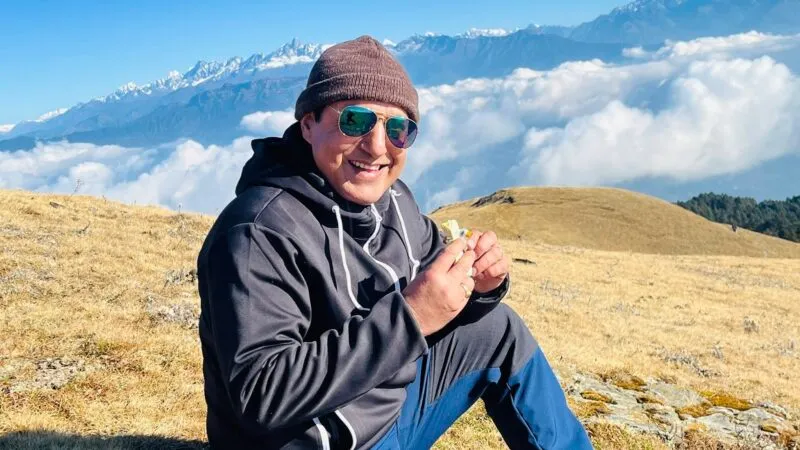
After thirty years of writing, Mani Lohani has learned that the hardest subjects make the best poems. The Nepali writer and television journalist, based in Nuwakot in central Nepal, has built a body of work around three things most people avoid: love, death, and what happens in between.
His poetry collection Malami Saajh and story collections Parast Prem and Nirbastra Man have circulated far enough to reach school curricula across Nepal and be translated into multiple languages. His book Mrityuko Aghiltir won a major national literary award. The accolades have followed—the Bhanumati Award, the Sarbottam Katha Award, others—but Lohani seems less interested in the honors than in what they represent: permission to keep asking difficult questions.
The weight of connection
When Lohani talks about why people struggle, he doesn't point to economics or politics. He points to relationships. "If people around the world are under stress, it is because of relationships," he says. Love energizes human life, but it doesn't reach everyone equally. This imbalance—the gap between what we need and what we receive—runs through much of his work.
We're a new kind of news feed.
Regular news is designed to drain you. We're a non-profit built to restore you. Every story we publish is scored for impact, progress, and hope.
Start Your News DetoxBut his real insight lives in how he frames death. Most writers treat it as tragedy or mystery to be solved. Lohani treats it as a fact of life, present from birth, and therefore something to befriend rather than fear. He's studied Eastern philosophy to understand this, and he's arrived at something almost radical in its simplicity: a person who accepts death naturally can remain joyful.
This isn't resignation. It's the opposite. If death is certain and unavoidable, then the question becomes: how do you live in the time you have? How do you be useful to others, love consciously, and feel proud of yourself? These are the questions Lohani's poems ask.
Poetry as compression, stories as mirrors
He distinguishes between his two forms. Poetry, for him, compresses deep experience into few words—it's the language of individual consciousness. Stories sprawl into society, reflecting how groups of people move and collide. But he's careful not to prescribe meaning. Readers bring their own understanding, their own pleasure. A poem about loss might land differently depending on who's reading it and when.
Lohani's work exists at an intersection: local enough to be rooted in Nepali culture, universal enough to translate. He's absorbed influences from contemporary world literature while keeping something distinctly Nepali in his voice—a specificity that paradoxically makes the work more resonant across borders. Loneliness and human connection aren't Nepali problems or global problems. They're just human problems.
At this point in his career, Lohani seems less concerned with being read than with being understood. He wants readers—whether in Kathmandu or elsewhere—to walk away from his work thinking differently about their own lives. Not happier necessarily, but more conscious. More loving. More aware that the time they have is the only time they'll get.