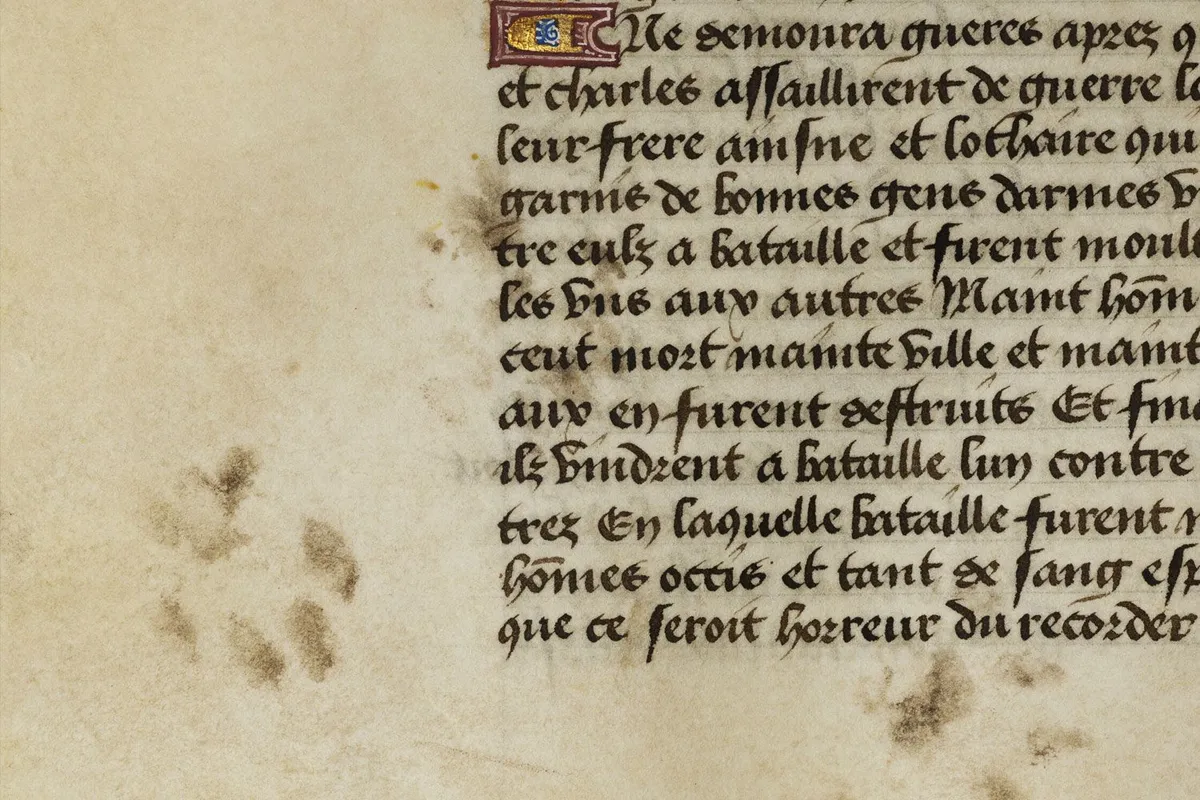
A Flemish scribe in the 15th century made a choice that would outlast five centuries: they left a manuscript out to dry. When they returned, a cat had walked across the wet ink, leaving behind a pattern of small paw prints that still sits in a museum today, unmistakably real in a way that most medieval art is not.
This accidental collaboration between human and animal is now the centerpiece of "Paws on Parchment," an exhibition at Baltimore's Walters Art Museum that opened this year. The show traces how cats moved through medieval life—not as the distant, revered creatures of later centuries, but as working animals, household companions, and subjects of art that reveal what people actually cared about.
A 15th-century prayer book featuring an illustrated grey cat The Walters Museum
What's striking is how universal the relationship was. In 13th-century Cairo, Sultan Al-Zahir Baybars founded a cat garden—essentially a shelter—to feed and house strays. The Prophet Muhammad, according to Islamic tradition, kept cats as companions. A Turkish cosmography from the same period, the Wonders of Creation, depicts a black cat sitting calmly among plants, rendered with the kind of observational detail that suggests genuine familiarity.
We're a new kind of news feed.
Regular news is designed to drain you. We're a non-profit built to restore you. Every story we publish is scored for impact, progress, and hope.
Start Your News DetoxBut cats in medieval manuscripts weren't always shown in moments of repose. They appeared in margins playing instruments or engaged in absurd scenarios—visual jokes that, according to curator Lynley Anne Herbert, "reinforce the importance of an orderly society by showing the chaos possible if the natural order of things got turned on its head." Cats were clever, unpredictable, and slightly unsettling to the medieval mind, which made them perfect for illustrating what happens when things go wrong.
"Paws on Parchment" is the first of three animal-themed exhibitions planned at the Walters Art Museum in Baltimore over the next two years.
Beyond the art, cats had a practical role that was genuinely critical. In a world without reliable food storage or pest control, mice and rats carried disease. Cats weren't luxuries—they were infrastructure. Their ability to hunt rodents was "critical to healthy living," Herbert notes, which meant keeping them fed and, by extension, cared for.
There's something quietly moving about how the exhibition itself has become part of the story. When the museum opened "Paws on Parchment," they partnered with the Baltimore Animal Rescue and Care Shelter to give a private tour to a litter of six-week-old foster kittens. Herbert, the curator, ended up adopting two of them. The paw prints of medieval cats, it turns out, have a way of leaving marks that reach forward as well as backward.
The exhibition runs through February 22, 2026, and is the first in a planned series of animal-themed shows at the Walters.