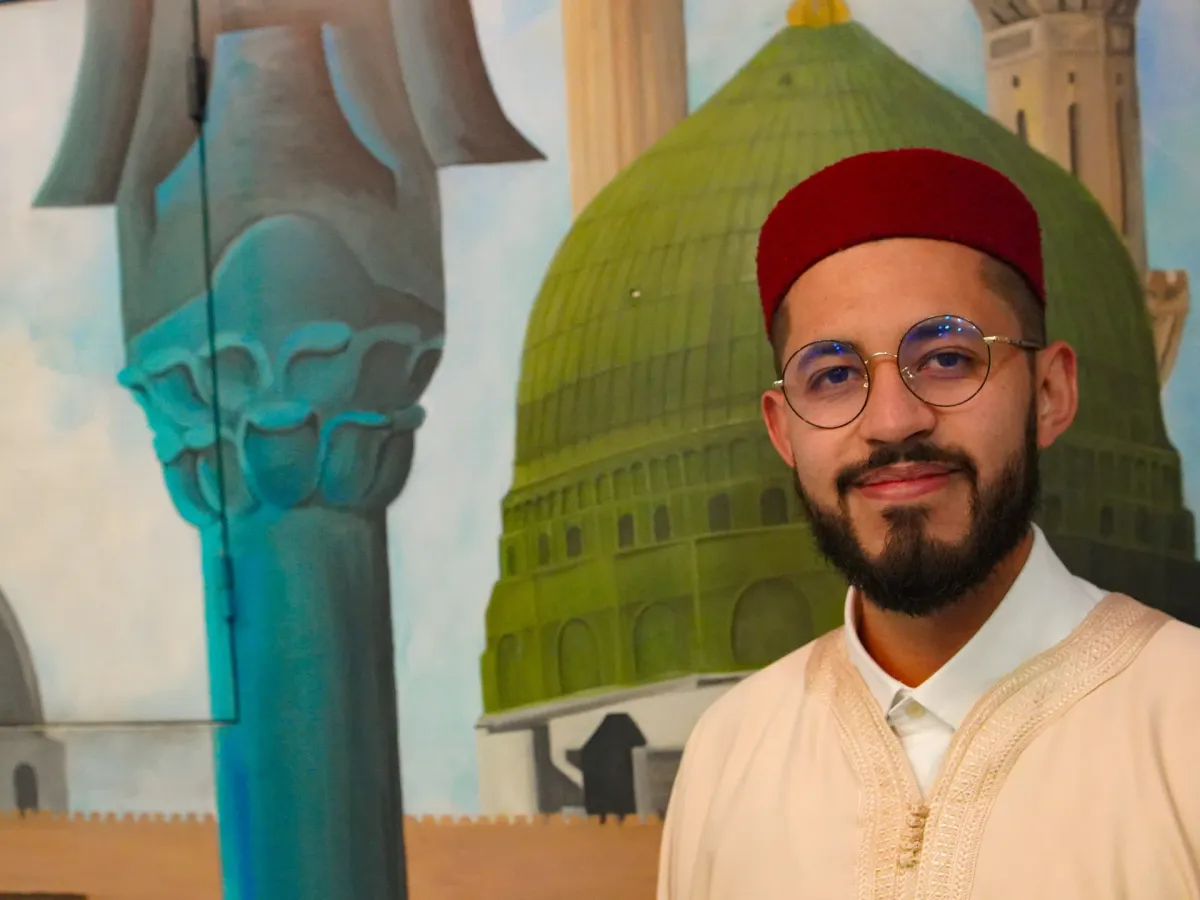
Ziauddin Yahya Iqbal Sandoval—Zia to his friends—is 14 years old, born and raised in Medellin, and he observes Ramadan with quiet conviction. He's one of an estimated 85,000 to 100,000 Muslims in Colombia, a number that sounds substantial until you realize it's less than 0.2 percent of the country's 50 million people. In a nation where nearly 63 percent identify as Catholic, being Muslim means belonging to something genuinely small.
But small doesn't mean isolated anymore. On the eve of Ramadan, golden letters spelling "Ramadan Karim"—a generous Ramadan—hung above a modest mosque in Belen, on Medellin's outskirts. Inside, about eight men of different ages and nationalities stood shoulder to shoulder in prayer. The diversity wasn't accidental. It was the story.
A Community Taking Root
Twenty-three years ago, Pakistani immigrant Rana Arif Mohammad arrived in Colombia with dreams of adventure through Latin America. What he found instead was isolation. "I met just four to five Muslims, a few from Lebanon and Turkey," he remembers. He settled in Medellin anyway, opened a restaurant serving Pakistani and Arabic food, and waited for the community to grow.
We're a new kind of news feed.
Regular news is designed to drain you. We're a non-profit built to restore you. Every story we publish is scored for impact, progress, and hope.
Start Your News DetoxIt has. Today, Medellin has five mosques. In 2020, Colombia elected its first Muslim mayor in the border city of Maicao. The shift didn't happen overnight—much of it traces back to Lebanon's civil war in the 1970s, which triggered an exodus of nearly one million Lebanese people, many of them Muslim. Some settled in cities like Maicao, where one of Latin America's largest mosques was built and completed in 1997. That wave of migration planted seeds that are still bearing fruit.
Mu'tasem Abdo, the imam at the Belen mosque who arrived from Egypt four years ago, notices the shift daily. "The majority who come are Colombians," he says, "but we see people from Trinidad and Tobago, Tunisia, Pakistan, and other Arab countries." For newcomers from Muslim-majority countries, celebrating Ramadan in Colombia can feel sparse compared to home. But for Colombian converts—and there are roughly 100 to 200 in Sheikh Ahmad Qurtubi's congregation in Bogota alone—it's something else entirely.

Diversity as Strength
At the Al-Qurtubi Islamic Centre in west Bogota, the congregation spans roughly 10 to 15 different nationalities. The challenge, Qurtubi admits, is real: "Maintaining a stable community that has an impact on society and a common identity" is harder when people come from different places and different paths to faith. Yet that's exactly what's happening. During Ramadan, a different family volunteers each night to cook Iftar—the meal that breaks the daily fast. The menu shifts with the cook. "One night you have Moroccan food, the next Pakistani, then Colombian," Qurtubi explains. "It depends on each person's culture and background."

Qia, serving tea in his uncle's restaurant in Medellin's upscale Poblado neighborhood, sees it clearly: "The Colombian Islamic community is small but enjoys more on account of its diversity." What started as a handful of isolated believers has become something with roots, infrastructure, and—most importantly—a reason to stay. "Knowledge is what allows a community to grow, to flourish, and to have the opportunity to prosper and put down roots here in Colombia," Qurtubi says. That's not just about faith. It's about belonging.