
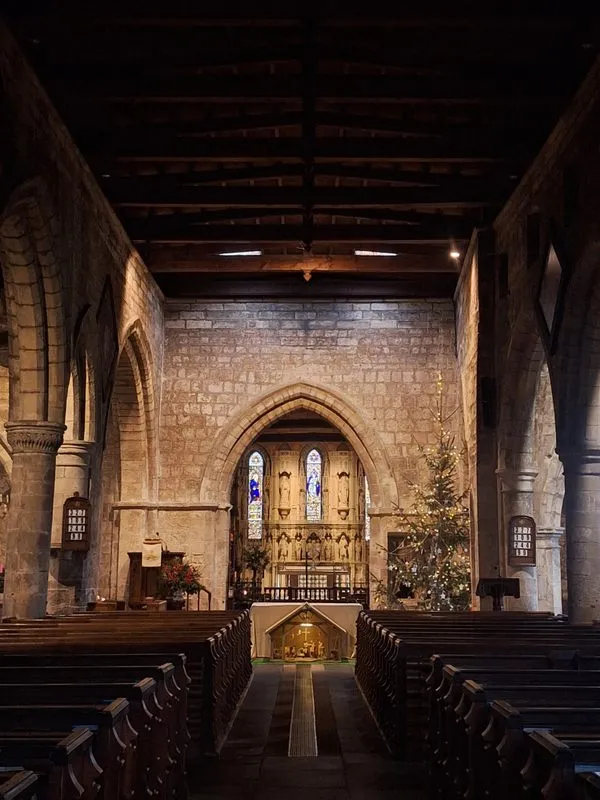
St Aiden arrived in Bamburgh in the seventh century with a mission: help a king spread Christianity across his realm. The Northumbrian ruler, King Oswold, had asked the monks of Iona to send someone. Aiden came, built a monastery on Lindisfarne, and established a church here. Legend says he was leaning against a wooden beam when he died—that same forked timber, blackened with age, still holds up the roof above the baptismal font.
But the real story of St Aiden involves an act of mercy that supposedly changed the course of history. One day, the king encountered people begging for alms. Instead of a coin, Oswold did something radical: he ordered his silver plate broken into pieces and distributed among them. Aiden watched this unfold and, moved by the king's generosity, grasped his hand and declared, "May this hand never perish."
Historian Bede recorded what happened next. Years later, in Oswold's final battle, his hand was severed from his body—but it didn't decay. The preserved hand became a sacred relic, kept in this church as proof that Aiden's blessing had come true. Today, an automaton near the back of the church dramatizes this moment, a mechanical reminder of a seventh-century act of compassion.
We're a new kind of news feed.
Regular news is designed to drain you. We're a non-profit built to restore you. Every story we publish is scored for impact, progress, and hope.
Start Your News DetoxA Building That Survived Everything
The stone church standing today dates to the twelfth century, though work to rebuild it in stone didn't start until a hundred years later. It's survived centuries of storms, wars, and the relentless North Sea. One architectural detail reveals how medieval worship actually worked: a small square window called a "squint" overlooks the chancel, the holiest part of the church. Ordinary people weren't allowed in there, so this window let them glimpse the altar and the priest during services without crossing into sacred space.
The church's walls tell stories of remarkable people. Dorothy Forster, memorialized in the chancel, executed one of Britain's most famous prison escapes—she dressed her imprisoned Jacobite husband as a maid and walked him out of Newgate unnoticed. The Sharpe family, who turned Bamburgh Castle into a charitable hub, are honored here too. Dr. Sharpe ran a shop where villagers could afford wax and corn, and opened schools for boys and girls that gave them real job prospects.
Grace Darling, the Victorian who rowed into the North Sea to rescue shipwrecked sailors, gets an exquisite stained glass window alongside Elizabeth Fry (prison reform pioneer) and Florence Nightingale. These weren't just local figures—they were women who chose danger and difficulty to help others.
What's Beneath
Steps outside lead down to the crypt, where a viewing platform reveals ossuaries—the final resting place for hundreds of Saxon Christians buried in a cemetery near the castle. A storm in 1817 disturbed those graves. For nearly 200 years, the remains waited. In 2016, they were finally laid to rest properly in the crypt below.
Walking through St Aiden's is walking through layers of history—from the timber that might have touched a saint, to the hand that supposedly never decayed, to the ordinary people who lived extraordinary lives in a small coastal town. The church isn't a museum. It's a monument to the idea that one act of kindness, one moment of bravery, can echo across centuries.