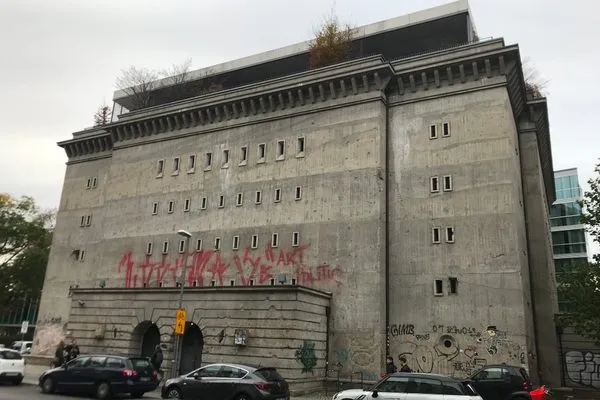
A gray concrete fortress sits oddly elegant on Reinhardtstrasse, surrounded by expensive restaurants and bookshops. Inside, it's a maze of bare concrete chambers where Nazi-era artifacts—scratched steel doors, faded directional arrows, old "No Smoking" signs—share space with works by Wolfgang Tillmans and Ai Weiwei.
The Reichsbahnbunker was built between 1942 and 1943 by forced laborers under Nazi orders. It was supposed to shelter up to 2,500 Reichsbahn passengers and was designed by Albert Speer as part of "World Capital Germania." That future never materialized. After the war, the bunker cycled through lives as a military prison, a clothing depot, a tropical fruit storage facility, and eventually a techno and fetish club until it closed in 1996.
By 2003, publisher and art collector Christian Boros saw something others didn't. He bought the abandoned structure and spent five years converting it into a private museum and his personal residence. The renovation was brutal—architects reportedly despaired while using diamond-tipped cutters to carve breakthroughs through the concrete. From 120 original shelter rooms, workers created 80 exhibition spaces across five floors, covering 3,000 square meters with ceiling heights that swing wildly between 2.2 meters and 13 meters.
We're a new kind of news feed.
Regular news is designed to drain you. We're a non-profit built to restore you. Every story we publish is scored for impact, progress, and hope.
Start Your News DetoxBoros made a deliberate choice to leave the interior raw. The bare concrete walls remain. Nazi-era relics stay visible. Black paint from its club days still marks some rooms. On the roof, he built a penthouse in the style of a Mies van der Rohe pavilion—complete with terrace, garden, and pool—that overlooks Berlin-Mitte.
The Visitor Experience
The space has become genuinely influential. The first exhibition (2008–2012) drew 120,000 visitors. The second (2012–2016) pulled in 200,000. Today's iteration, Boros #4, fills rooms with contemporary work that often breaks conventional boundaries. Sculptures pierce walls. Installations stretch across multiple chambers. Artists create pieces specifically for this location, merging their work with the bunker itself into what Germans call a Gesamtkunstwerk—a total work of art.
There's a catch: fire safety regulations limit tours to 12 people at a time, creating a waiting list that reflects just how much people want to experience this. The lack of natural light and labyrinthine layout create what feels like an artistic ghost train—disorienting, immersive, occasionally claustrophobic. Karen Boros, one of the owners, sometimes leads tours herself, treating visitors less like ticket-holders and more like guests in her home.
After two hours inside, most people emerge genuinely relieved to see sunlight and breathe open air. The bunker has transformed from a symbol of one of history's darkest periods into a space where contemporary art thrives in the most unexpected setting—a conversion that says something quietly powerful about what we choose to preserve and how we choose to use it.