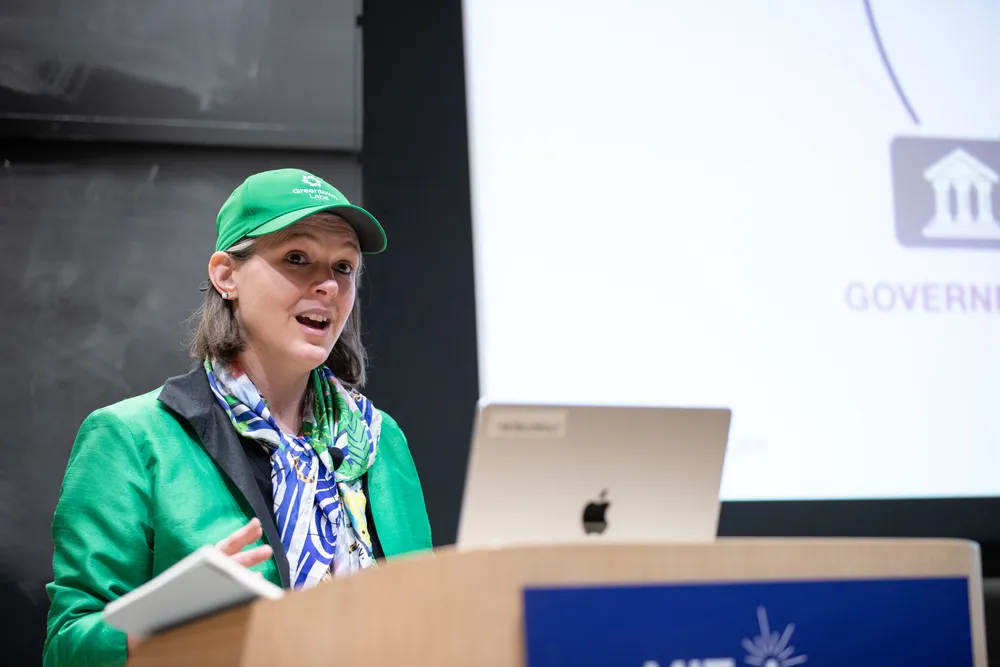
Georgina Campbell Flatter, the CEO of Greentown Labs, has a message for anyone trying to save the planet: stop going it alone. If we're going to scale up world-changing climate tech, she argues, we need a support system so robust it practically tucks you into bed at night.
Her mantra? "The power of 'and.'" It's not just a catchy phrase; it's a philosophy that says innovation isn't a solo sport. It's about getting everyone — people, companies, solutions — to play together in the same sandbox. Because, as she dryly notes, "No one can go alone." (Which, if you've ever tried to assemble IKEA furniture by yourself, you know is profoundly true.)
The Ecosystem Equation
Greentown Labs, for the uninitiated, is the world's largest energy and climate incubator. Their whole deal is building these collaborative "ecosystems." Campbell Flatter explains they use the "power of 'and'" to supercharge collaboration within their physical spaces and knit together different innovation hubs.
We're a new kind of news feed.
Regular news is designed to drain you. We're a non-profit built to restore you. Every story we publish is scored for impact, progress, and hope.
Start Your News DetoxThis "and" extends beyond just people. It's about embracing energy and climate, innovation and deployment, science and entrepreneurship, and even competition and collaboration. Because apparently, in our perpetually divided world, a little bit of togetherness goes a long way.
Greentown doesn't just gather smart people; they actively remove the bureaucratic barbed wire and financial quicksand that can bog down a startup. There's a whole science to this "innovation infrastructure," which mostly involves getting brilliant minds past what are known as the "valleys of death."
These valleys are where good ideas go to die. The first is the chasm between a raw idea and a working prototype. The second, even more treacherous, is the gap between a prototype and its first commercial test. Greentown? They specialize in dragging entrepreneurs across that second valley. Think of them as the sherpas of scale-up.
Entrepreneurs who can't afford their own fancy labs or are drowning in permit paperwork flock to Greentown. They find customers, funding, and the kind of infrastructure that turns a promising idea into something actually usable.
MIT's Mighty 'And'
Why focus on the second valley? Because MIT, as Campbell Flatter puts it, is "truly world class" at getting innovators over the first. Startups birthed from powerhouses like MIT and Harvard have a higher survival rate, thanks to this academic safety net of feedback, support, and mentorship. It's like having a cheat code for success.
MIT also acts as a magnet for talent. A full 30% of Greentown's entrepreneurs pack their bags and move to Massachusetts, drawn by the incubator itself, but also by MIT's brainpower, intellectual property, and sheer credibility. It's a symbiotic relationship that creates a formidable entrepreneurial ecosystem.
Campbell Flatter herself is a product of this ecosystem. After Oxford, she landed at MIT's Technology and Policy Program, where she learned firsthand just how brutal commercializing technology can be and how pivotal these ecosystems are. It also hammered home that energy and climate aren't just niche topics; they're the defining challenges of our century.
While at MIT, she ran the Clean Energy Prize, pushing to include traditional energy sectors alongside renewables. Because, as she realized, decarbonizing everything is the goal, not just swapping out one thing for another. That early lesson? "Embrace the power of 'and.'" Because when people stop working together, innovation doesn't just slow down; it grinds to a halt. And we simply don't have time for that.