

The technology sounds like science fiction: machines that suck moisture from the atmosphere and turn it into safe drinking water. But for three companies working across the US, Australia, and beyond, it's already happening at scale.
On a planet covered in water, the math is brutal. Only 2.5 percent of Earth's water is fresh enough to drink or grow food with. That sliver keeps shrinking as heat waves intensify droughts. Right now, 1.4 million deaths per year could be prevented with better access to clean water alone.
How atmospheric water generators work
Aquaria Technologies, founded by Brian Sheng, builds what amounts to a 21st-century vaporator — the fictional machines from Star Wars that desert dwellers used to survive. The real version works on the same principle: pull in air, cool it until moisture condenses into droplets, then purify it to drinking standards.
We're a new kind of news feed.
Regular news is designed to drain you. We're a non-profit built to restore you. Every story we publish is scored for impact, progress, and hope.
Start Your News DetoxAquaria's home units can produce up to 200 gallons daily (the EPA estimates Americans use about 82 gallons per person per day). The catch: their Hydropixel model, which makes 10 gallons daily, costs around $3,800. To lower the barrier, the company offers payment plans and can integrate the units with existing home solar systems.
In Australia, Aqua Ubique took a different approach. Co-founder Shannon Lemanski served with the Australian army in Papua New Guinea and watched families collect rainwater in single-use plastic bottles rather than drink from contaminated creeks. He returned home to discover over two million Australians lack access to safe drinking water.
Aqua Ubique structured itself as a social enterprise. For every five water cooler units leased to offices, one gets installed free in communities without clean water access. In May 2025, they placed two units in Cherbourg, Queensland — a town that endured a nine-month boil water alert in 2024 due to E. coli contamination. Dozens of children at a local daycare and seniors at an elders village now have access to safe water they didn't have before.
Scaling up for disaster response
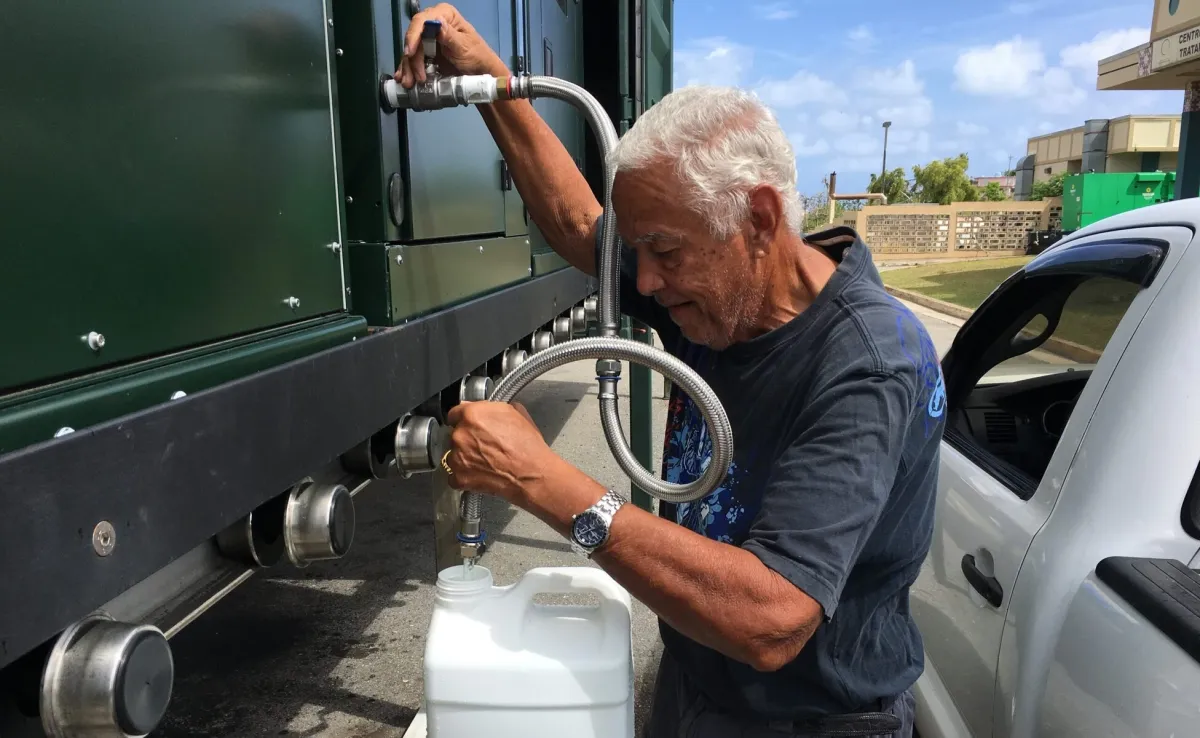
The Moses West Foundation, based in Illinois, deploys larger units for immediate crises. When Hurricane Maria devastated Puerto Rico in 2017 with 170 mph winds, founder Moses West — a former US Army ranger captain with an engineering background — brought an AWG 5000 unit that provided 15,000 families with unlimited free drinking water for six months. The island saved roughly $300 million in shipping costs for plastic water bottles.
The foundation's AWG800 system produces over 200 gallons daily and can run entirely on solar power, making it deployable in areas without grid electricity. It's roughly the size of a small car.
The reality check
Lemanski is clear about the limits. AWGs perform best in warm, humid climates and produce less in dry, cold environments. He sees them not as a standalone solution but as part of a hybrid system — paired with rainwater tanks, greywater recycling, and desalination plants. "When used together, AWGs can become part of a complete off-grid water system," he says.
The bigger problem, both Lemanski and Colin Hultz (chief business officer at Moses West) agree, is that almost nobody knows these machines exist. In Texas, some areas are in stage four drought conditions and running out of groundwater. The technology to address water scarcity is here. The awareness isn't.



