

Laine Dubin didn't set out to challenge an entire sport. She just wanted to document her progress and free up phone storage.
That was in 2018, when she started posting videos of her figure skating routines online. Within weeks, something shifted. People who'd never seen themselves represented in competitive skating began finding her videos. Then they found them again. One clip crossed 30 million views.
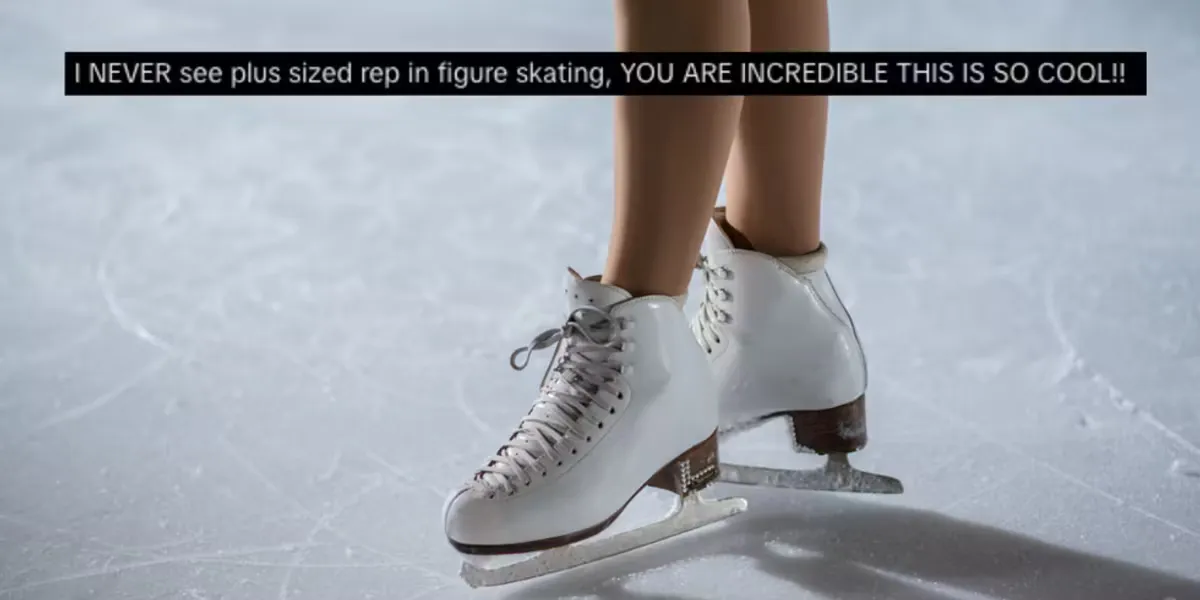
The response was immediate and raw. "As a bigger Asian girl who has always dreamed of ice skating this made me tear up," one commenter wrote. "Someone with my body type figure skating. Like a GODDESS." Another: "As a plus sized girl who had the idea of figure skating shot down, thank you for making the lil girl in me happy."
We're a new kind of news feed.
Regular news is designed to drain you. We're a non-profit built to restore you. Every story we publish is scored for impact, progress, and hope.
Start Your News DetoxDubin, who skated for Quinnipiac University and continues competing, had stumbled into something the sport desperately needed: proof that there's no single body type required to execute a triple axel with power and grace.
The weight of expectation
Figure skating has a body problem. Female skaters at the elite level are almost universally petite and slight—not by accident, but by design. The sport's uniform (tiny dresses that expose every contour) and its physics (less body mass theoretically helps with jumps) have created an unspoken rule about what female skaters should look like. The consequences have been brutal.
Tessa Virtue, a five-time Olympic medalist, has spent her career fending off comments about her body being either too muscular or too heavy. Gracie Gold, a two-time US National Champion, took time away from skating to recover from an eating disorder. Yulia Lipnitskaya, one of the sport's most promising young talents, retired at 19 due to anorexia.
These aren't isolated incidents. They're symptoms of a culture where female athletes are routinely mocked, fat-shamed, and dissected by viewers, coaches, and judges alike.
Dubin's visibility matters precisely because it interrupts this narrative. She's not arguing that plus-size skaters should be accommodated or included as a feel-good gesture. She's demonstrating, in real time across millions of views, that they're already here and they're already excellent.
"It's just people seeing representation in the media of themselves being represented first," Dubin told US Figure Skating in 2023. "That's what will make people feel validated and that's what will lead to change with body inclusivity in the skating space."
With each video, another generation of kids who thought they didn't belong finds evidence that they might. That's not inspiration in the abstract sense. That's a shift in what's possible.



