
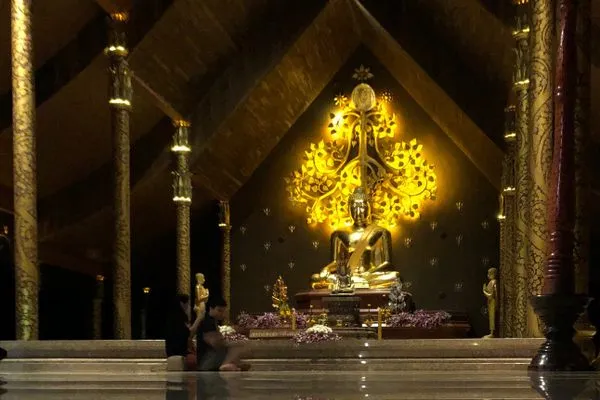
Wat Sirindhorn Wararam Phu Phrao sits on a hilltop in Ubon Ratchathani province, near Thailand's border with Laos. Most days it looks like any other Buddhist temple — golden spires catching the afternoon sun, the usual rhythm of prayer and pilgrimage. But when darkness falls, something shifts.
The temple's walls and pathways are painted with phosphorescent designs that charge in daylight and release their glow once the sun drops below the horizon. Bodhi trees swirl across surfaces in luminescent lines. Buddha figures line the outer walls, their forms outlined in soft, steady light. Inside the main prayer hall, a gilded Buddha statue sits backlit by an illuminated tree design, its reflection doubling across polished tile floors. The effect is deliberate and quietly profound — the temple seems to emit light from within.

The temple was named after Princess Sirindhorn, a member of Thailand's royal family, and the design reflects both Buddhist tradition and a modern approach to sacred space. Rather than competing with daylight, the architects embraced darkness as part of the spiritual experience. The glow-in-the-dark elements transform the temple into something that belongs to evening visitors — those who might otherwise miss the site entirely.
We're a new kind of news feed.
Regular news is designed to drain you. We're a non-profit built to restore you. Every story we publish is scored for impact, progress, and hope.
Start Your News DetoxThe location itself adds to the draw. Lake Sirindhorn borders one side of the hilltop; the Laotian border sits half a mile away on the other. Sunset here is dramatic — the lake catches the last light, the sky shifts through orange and pink, and then the temple begins its nightly emergence. For visitors with their own transport, parking is straightforward. For those without, tuk-tuk drivers typically wait near the temple to shuttle people back to town.
It's a small but meaningful innovation in how sacred spaces can invite contemplation. The temple doesn't need gimmicks to draw people — Buddhism does that on its own. But by making the space accessible after dark, Wat Sirindhorn extends an invitation that most temples don't: come see what we look like when the world quiets down.