

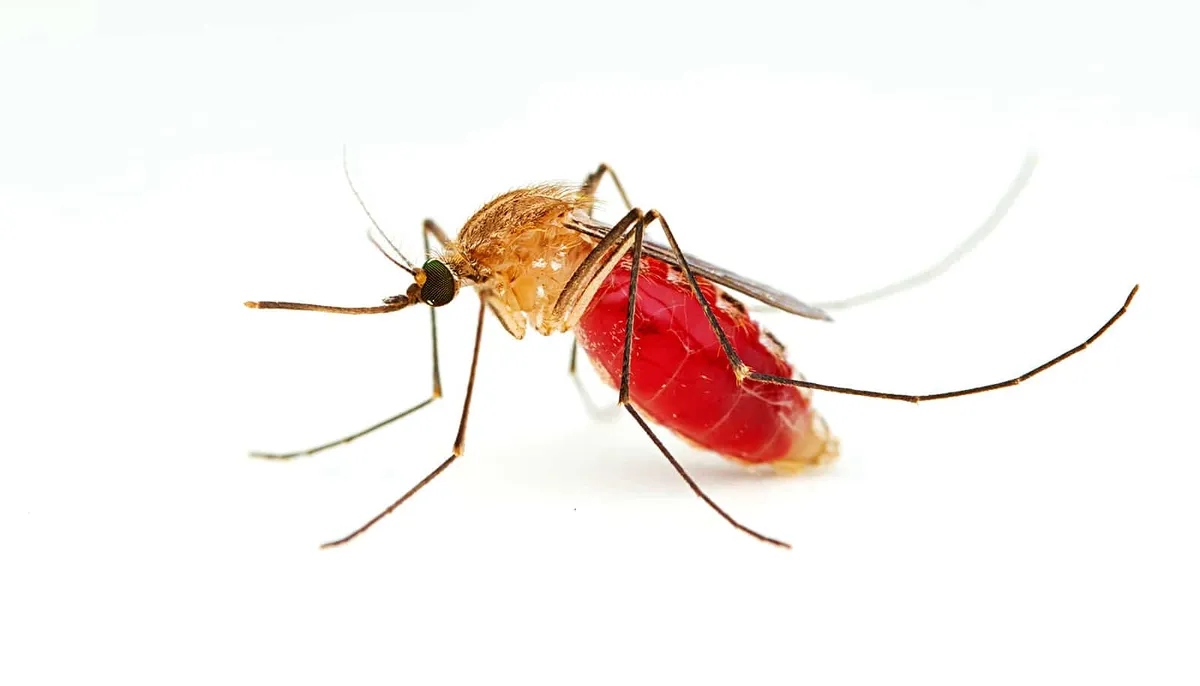
For decades, scientists assumed male mosquitoes were in charge of reproduction. Turns out they had it backwards.
Female mosquitoes mate exactly once in their lifetime. That single decision carries enormous weight — she'll store that male's sperm for months, using it to fertilize batches of eggs every few days. Given what's at stake, you'd expect her to be selective. Yet the prevailing assumption was that she had no real choice at all, that males simply took what they wanted.
Leslie Vosshall's team at Rockefeller University decided to actually look at what happens during mosquito mating, moment by moment. Using high-speed cameras, deep learning algorithms, and mosquitoes engineered to produce fluorescent sperm, they watched the process unfold in two of the world's most invasive species: the yellow fever mosquito and the Asian tiger mosquito. What they found, published in Current Biology, overturned a century of assumptions.
We're a new kind of news feed.
Regular news is designed to drain you. We're a non-profit built to restore you. Every story we publish is scored for impact, progress, and hope.
Start Your News DetoxThe Mechanism
The mating process follows a three-step sequence. A male makes contact with the female's genitalia. She then faces a choice: elongate her genital tip to roughly twice its resting length, or keep it retracted. If she elongates, the male's internal structures interlock with hers and sperm transfers. If she doesn't, nothing happens. No mating occurs.
Once she's mated successfully, her body locks down. She will never elongate that tip again, no matter how many other males attempt to mate with her. One shot. One decision. One consequence that plays out across her entire reproductive life.
This control mechanism appeared in both mosquito species the researchers studied, even though these insects diverged evolutionarily around 35 million years ago. The consistency suggests this isn't a quirk of one species — it's a fundamental feature of how these mosquitoes reproduce.
But here's where it gets interesting: the researchers discovered that each species has its own specific "lock and key." Asian tiger mosquito males are larger and have more robust genital structures. In laboratory conditions, they can override the mating control of yellow fever females — essentially picking the lock of a different species. Yet they can never override the mating control of their own females. A female mosquito's choice is absolute within her own kind.
This might explain something researchers have observed in the field: when Asian tiger mosquitoes invade an area, yellow fever mosquito populations often collapse or disappear entirely. It's not just competition. It's reproductive interference at a biological level.
The implications extend beyond pure biology. Understanding exactly how female mosquitoes make this decision — what neural signals they process, how they sense and respond to male stimulation — could inform new approaches to mosquito population control. Sterilized male release programs, which already exist in some regions, depend on males being able to mate with wild females. Knowing the mechanism gives researchers another angle to work with.
Vosshall's team is now mapping the neuronal code underlying the female's choice — trying to understand, at the level of individual neurons, how she senses the male and decides whether to proceed. It's painstaking work, but it's the kind of fundamental understanding that eventually opens doors to practical solutions.



