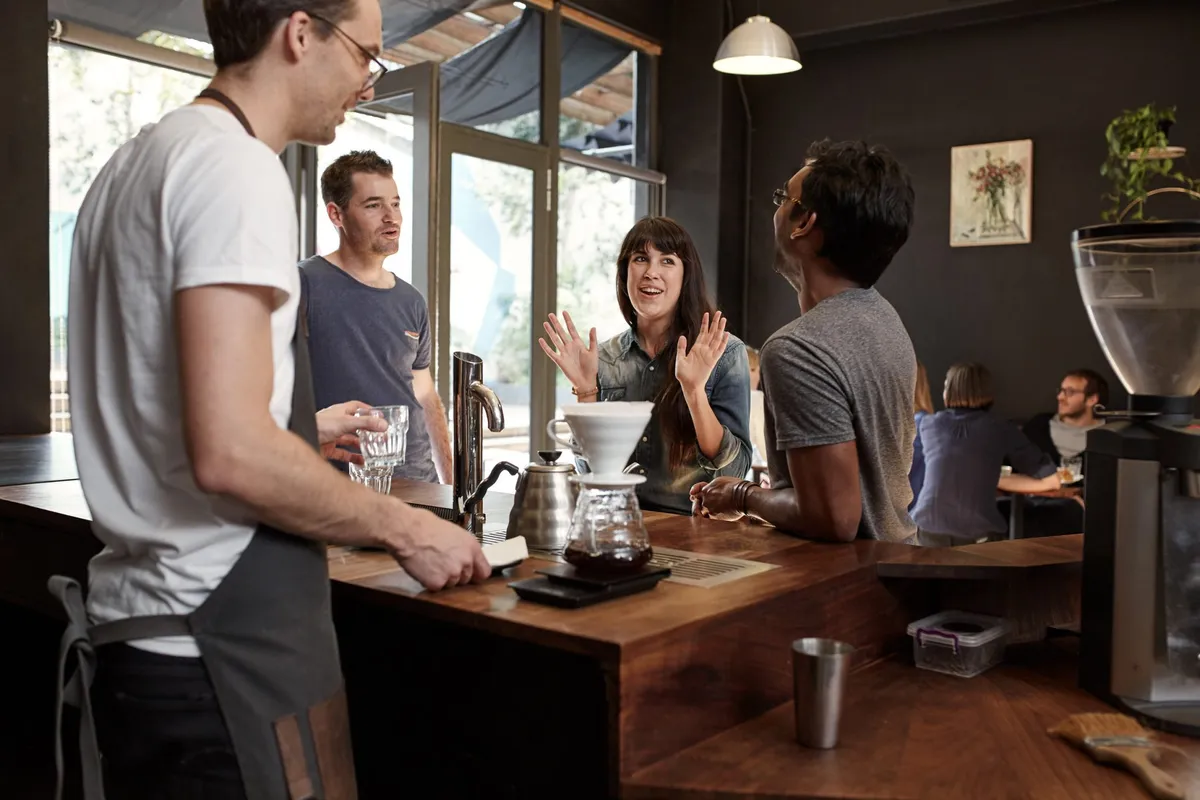
There's something countercultural about ordering the same coffee at the same café every Tuesday. About sitting in the same corner booth. About nodding at the same faces behind the counter week after week.
It feels predictable, maybe even boring. But the science says otherwise. Becoming a regular somewhere isn't just comforting—it's a genuine shift in how connected you feel to your community and yourself.
The Quiet Power of Weak Ties
Most of us focus on our close relationships. Family. Best friends. The people we text at midnight. But in 1973, Stanford sociologist Mark Granovetter noticed something else: the casual acquaintances matter just as much.
We're a new kind of news feed.
Regular news is designed to drain you. We're a non-profit built to restore you. Every story we publish is scored for impact, progress, and hope.
Start Your News DetoxThese are the weak ties. The barista who learns your order. The gym receptionist who remembers your name. The bartender who asks how your week went. The interactions are brief. The conversations are often about nothing—weather, a neighborhood pothole, the light this morning. Yet they add up in ways that matter.
A study from Oxford University found that people who were regulars at a local spot were more socially engaged, more content, and more likely to trust others in their community than those who weren't. Kasley Killam, a Harvard-trained social scientist, explains it this way: "These small interactions actually boost our mood and contribute to our social health by making us feel more connected, by allowing for regular, consistent interaction, and even by presenting us with the opportunity to potentially make friends."
A 2022 study in PNAS reinforced this. People who interacted with a mix of close friends and casual contacts in a single day reported greater happiness than those whose interactions stayed narrow. This matters now more than ever. An AARP survey found that more than one-third of American adults report feeling lonely.
The Isolation Loop
Loneliness has a feedback loop. You feel isolated, so you stay home. Staying home deepens the isolation. Maya Borgueta, a licensed clinical psychologist, says the antidote doesn't require reinventing your social life. "Going and sitting in a coffee shop and making that your safe place and your social connection for the day and knowing who the barista is and having a quick conversation with them can be really helpful," she explains. It doesn't demand a dinner party or joining a club. It demands consistency.
In 2014, Gillian Sandstrom at the University of Sussex tracked daily interactions across six days. Participants clicked a counter for close relationships and another for everyone else. At day's end, researchers measured happiness and belonging.
The pattern was clear. People who had more interactions with weak ties were happier. They were happier on days when they spoke to more casual acquaintances than usual. These microinteractions—they seem small, but they consistently predicted greater contentment.
Anchors Still Exist
There's nostalgia for "third spaces"—places that aren't home or work where people gather. Some say they've vanished. Killam disagrees. "These spots are still there; we just need to use them," she says. "If we show up to our local establishments and are regulars, that's a way for us to revitalize our communities and help ourselves, but also the other people we come into contact with."
A neighborhood café. A pizza place. A bookstore. A park bench. Any of these can become anchors. Returning again and again isn't a failure of curiosity. It's an investment in recognition, in familiarity, in the very real pleasure of being known. In a world that constantly pushes reinvention, there's something nourishing about walking into a room where someone says, "The usual?"
The next time you think about trying somewhere new, consider this: the place you already know might be exactly where you need to be.