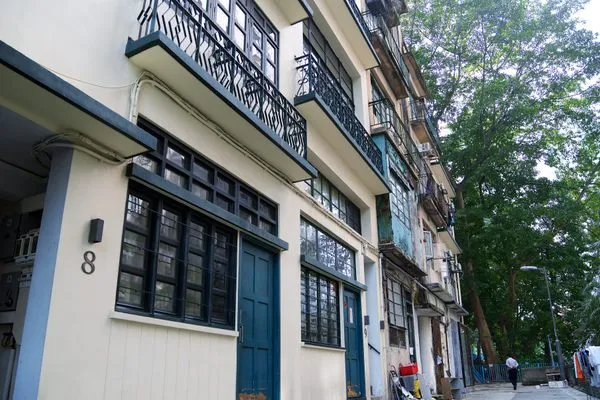
Wedged between the glass towers of Mid-Levels, Wing Lee Street feels like it shouldn't exist. Eleven Chinese tenement buildings—known as tong laus—line a narrow, car-free terrace, their weathered facades a sharp contrast to the modern skyline pressing in from all sides. For most of Hong Kong, this kind of place has already vanished.
These buildings are survivors. They were destroyed during World War II and rebuilt in the early 1950s, then spent decades as a working hub. At their peak, eleven different letterpress printing shops occupied the ground floors—a whole ecosystem of small trades that kept the street alive. The last print shop closed in 2012, and by then, Wing Lee Street had already been marked for demolition. The land was too valuable. The buildings too old.
Then something unexpected happened. A local filmmaker named Alex Law chose Wing Lee Street as the setting for his film Echoes of the Rainbow, a story about a working-class family navigating Hong Kong in the 1960s. The tong laus provided exactly what he needed: an authentic backdrop to a disappearing world. When the film premiered at the Berlin International Film Festival in 2010, it won the Crystal Bear award for best feature film in its category.
We're a new kind of news feed.
Regular news is designed to drain you. We're a non-profit built to restore you. Every story we publish is scored for impact, progress, and hope.
Start Your News DetoxA reprieve from the screen
The film's success sparked something in the public imagination. Suddenly, Wing Lee Street mattered—not as real estate, but as memory. Local opposition to the demolition grew loud enough that the government reversed course. Instead of tearing it down, they committed to restoration.
The work is finished now. The exteriors have been carefully restored, their surfaces cleaner and more polished than they were in decades. Some might argue they look almost too neat, too modern for their actual age. But step onto the street itself—narrow, quiet, free of cars—and the feeling shifts. There's a particular kind of stillness here, a sense of time moving differently. It's the kind of place that's becoming harder to find in Hong Kong, where the pressure to develop and redevelop is relentless.
What makes Wing Lee Street's survival unusual isn't just that it was saved, but how it was saved. Not through heritage designation or preservation law, but through a story. A film that reminded people why these buildings mattered—not as obstacles to progress, but as anchors to a version of the city that shaped who people were. The tong laus still stand. The street is still there. And for now, in a city constantly reinventing itself, that's enough.