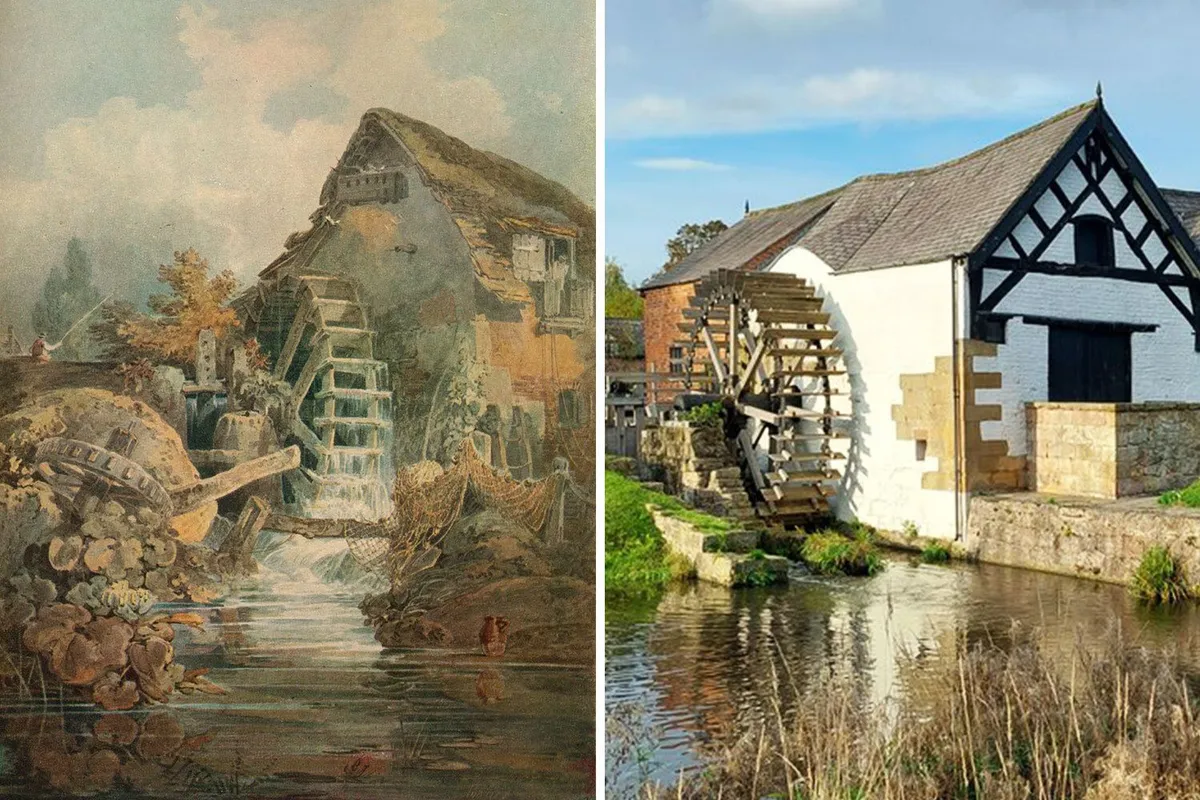
Rossett Mill has been standing on the banks of the River Alyn in Wales since 1588. In 1795, a young J.M.W. Turner, barely 20 and sketching his way across the British countryside, stopped to paint it. Now, after centuries of grinding grain and surviving near-demolition, the mill is on the market for £1.5 million.
The building Turner captured—he called it Marford Mill in his watercolor—is a working undershot mill, meaning water flowing beneath its large wheel powered the machinery. It's the kind of structure that appealed to Turner's eye: picturesque, functional, rooted in the landscape. He wasn't alone in finding it compelling. The mill was expanded twice after its construction, in 1661 and again in the 1820s, suggesting it remained central to the local economy for generations.
What's remarkable is that it almost didn't survive to see the 21st century. By the 1970s, Rossett Mill had deteriorated so badly that demolition seemed inevitable. Michael Kilgannon stepped in, bought the property, and began restoration work—a labor that ultimately cost him the house when he fell behind on mortgage payments. In 2010, Brendan and Celia Wilson found the mill in a newspaper advertisement and purchased it for £660,000. They invested another £250,000 converting it into a four-bedroom home, adding modern conveniences like central heating while keeping the historic structure intact.
We're a new kind of news feed.
Regular news is designed to drain you. We're a non-profit built to restore you. Every story we publish is scored for impact, progress, and hope.
Start Your News DetoxThe property spans 9.5 acres and overlooks the river that once powered its machinery. The Wilsons have maintained the mill in working condition, preserving not just a building but a functioning piece of industrial heritage. As Matt Royle, senior valuer at the estate agents listing the property, notes, it's a place where "history, land and lifestyle all come together."
Turner's eye for these structures proved durable. During his 1790s countryside tour, he also painted Winchester City Mill in England. Decades later, when the mill's assistant manager discovered the painting in Tate Britain's digital archives, officials ordered a print to hang inside—a small acknowledgment that Turner had seen something worth preserving, even if he couldn't have known how close the mill would come to vanishing.
For someone willing to steward a centuries-old property, Rossett Mill represents something increasingly rare: a working mill with documented artistic significance and a landscape to match.