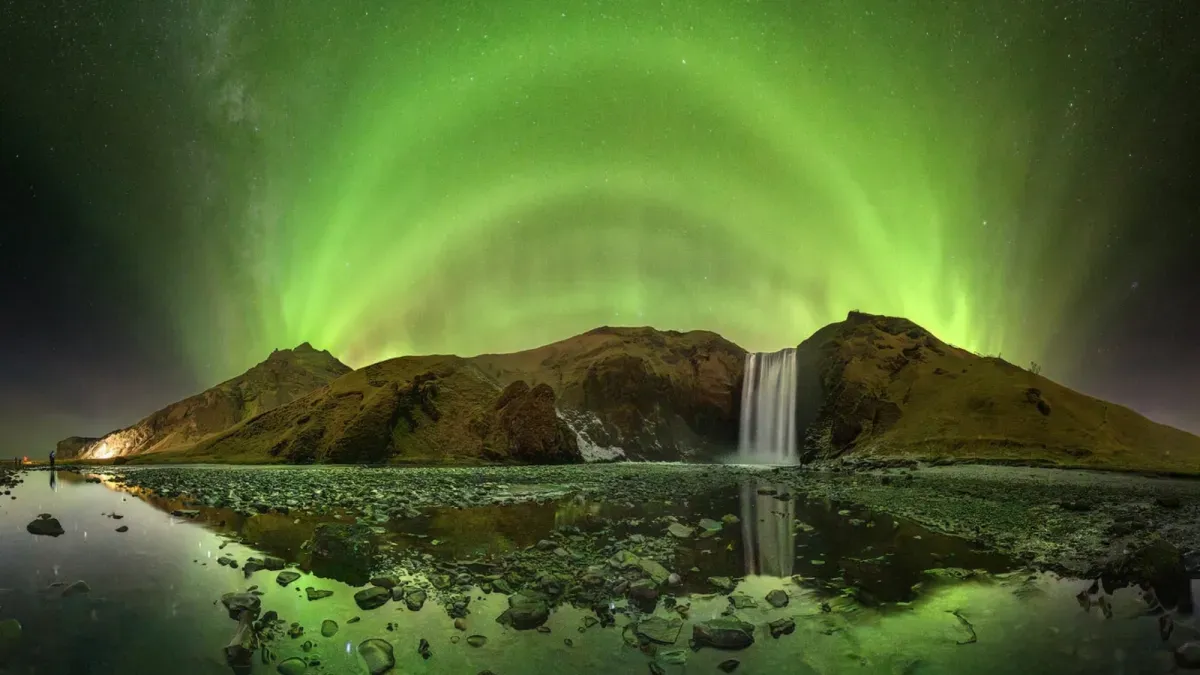
The aurora borealis is one of those things you have to see in person to fully understand. A photograph can hint at it—the ribbons of light, the color shifts across the dark sky—but it can't quite convey the feeling of standing beneath it. For photographers, though, the challenge is different: how do you translate that moment into a frame.
In 2025, they got their chance. The current solar cycle peaked this year, bringing some of the most intense geomagnetic activity in recent memory. The eighth Northern Lights Photographer of the Year competition gathered 25 extraordinary images from across the globe, and twelve of them tell the story of what happens when preparation meets an unpredictable sky.
The Patience Game
Many of these shots didn't happen by accident. Tori Harp spent eight months monitoring a moulin—an ice cave—in New Zealand's Aoraki/Mount Cook National Park before she set up her shot. She imagined a friend abseiling into the cave opening with the Southern Lights behind them. One night in 2025, it all aligned: the aurora australis lit up in pink tones that contrasted perfectly with the icy blues of the glacier.
We're a new kind of news feed.
Regular news is designed to drain you. We're a non-profit built to restore you. Every story we publish is scored for impact, progress, and hope.
Start Your News DetoxNikki Born's dream shot came after years of planning. She wanted to photograph Riisitunturi National Park's famous frozen trees beneath the Northern Lights. In March 2025, thick clouds blocked the sky all week. On the final night, after hours of waiting in the cold, she and her team gave up and started hiking back. Then the clouds broke. "The moment we reached the top, the sky burst into vivid shades of green," she wrote.
These aren't lucky shots. They're the result of understanding forecasts, knowing the landscape, and being willing to fail repeatedly until the conditions align.
When Science Meets Magic
Andres Papp captured a strong aurora storm rolling across a rocky beach, but the real work came in the composition. He used a 365 nanometer UV light torch to illuminate minerals in the rocks, creating a surreal glow that connected the foreground to the dancing sky above. The challenge wasn't just waiting for the aurora—it was balancing a five-second exposure to keep the aurora structure sharp while managing the artificial light so it didn't overwhelm the natural phenomenon.
Petr Horálek's October night in Sweden offered something rare: he captured both the aurora borealis and Comet Lemmon (discovered just nine months earlier) in a single frame. The comet was bright enough to see with the naked eye, and it appeared to dance alongside the aurora.
Sadeq Hayati took a different approach entirely. His image of Iceland's Arctic Henge was shot on a Samsung mobile phone in pro mode with an eight-second exposure. The photo captures red and green light filling the sky above the triangular stone gateway—proof that you don't need specialized equipment to catch these moments, just the right conditions and the presence of mind to look up.
The Deeper Connection
Daniel Mickleson's image from New Zealand's North Island carries another layer. The aurora lit the sky in pink and green above the Three Sisters rock formations and Taranaki Maunga mountain. In Te ao Māori (the Māori worldview), these aren't just landscapes—they're ancestral presences, guardians of the land. Mickleson captured that convergence: earth, sky, and ancestry in a single fleeting moment.
Jesús Garrido drove to a small bay on Lake Torneträsk in Swedish Lapland on October 1st, sensing it would be a good night. The lake was still liquid, still able to mirror the sky. As the Northern Lights began to move, then dance, red tones rose on the southern horizon while the water reflected everything happening above.
These twelve images represent something beyond technical skill or good timing. They're evidence of what happens when people commit to being present for rare natural events—when they do the research, accept the cold, plan for months, and then stay ready for the moment the sky decides to perform.
Geomagnetic activity is expected to remain strong through the rest of the solar cycle, which means the aurora season isn't over yet.