


A young male gorilla mid-pirouette in Rwanda's Virunga Mountains has beaten out more than 10,000 other entries to win the Nikon Comedy Wildlife Awards. Photographer Mark Meth-Cohn captured the moment during four days trekking through the misty mountains, watching a family group called the Amahoro family forage and play in a forest clearing. "One young male was especially keen to show off his acrobatic flair: pirouetting, tumbling, and high kicking," Meth-Cohn recalls. "Watching his performance was pure joy."
The competition, now in its record-breaking year with submissions from 109 countries, celebrates the moments when wildlife does what it does best: being completely, unintentionally ridiculous. A 10-year-old photographer captured two frogs in what looks unmistakably like a baptism scene. A young chimpanzee got caught mid-nose-pick. A bear cub grinned directly at the camera like it had done this a hundred times before (it probably had).

There's something quietly revolutionary about this competition. Wildlife photography often aims for the majestic—the perfect golden-hour lion, the eagle in flight, the untouched wilderness. The Comedy Wildlife Awards instead honor the unglamorous, unguarded moments when animals reveal themselves as fundamentally like us: clumsy, playful, confused, stubborn. A puffin at Bempton Cliffs in Yorkshire stands bewildered with grass blowing across its eyes, clearly wondering which direction its nest actually is. A red-throated loon approaches the water with its landing gear down, wobbly and unlikely to stick the landing. A fox kit nips at a photographer's shoe at dawn, curious about this strange human who keeps showing up.
We're a new kind of news feed.
Regular news is designed to drain you. We're a non-profit built to restore you. Every story we publish is scored for impact, progress, and hope.
Start Your News Detox
The young photographer who captured the baptism scene—now 13—started getting interested in photography just three years ago. "It's great to be considered alongside so many amazing entries," they wrote. "As a young photographer, it is affirming and inspiring to continue shooting." That's what these images do. They make wildlife feel accessible, funny, worth paying attention to. They suggest that you don't need a decade of experience or perfect conditions to capture something that matters.
Many of these photos required exactly the opposite of perfect conditions. A photographer lay on the cold edge of a pond under a camouflage net for the red-throated loon shot, enduring an early spring snowfall and nearly giving up before the moment arrived. A young wildlife photographer spent months following fox cubs across a nature reserve, learning their social behavior by simply being present and patient. The bluestriped fangblenny photo came from 10 meters underwater in the Philippines, with two flash guns carefully positioned to catch a fish's cheeky expression.
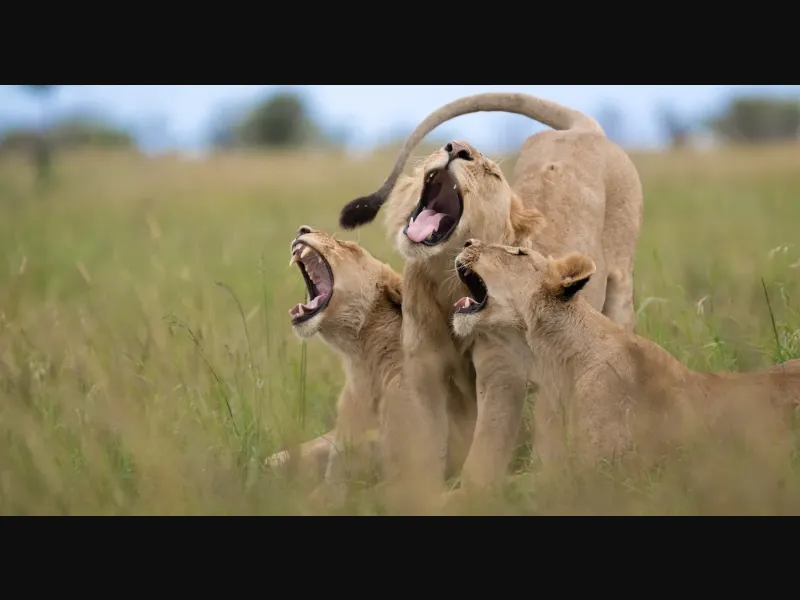
What emerges across these winning images is a portrait of wildlife as it actually exists: messy, social, full of personality. Lions in Tanzania's Serengeti during the dry season aren't noble or distant—they're exhausted mothers being pestered by hungry cubs who won't stop nipping and yelping for attention. A crowned sifaka in Madagascar locks eyes with a photographer with what looks like genuine curiosity. A blenny pops its head out of a coral hole with what can only be described as a smile.
If you're drawn to these images, you can vote in the People's Choice category until March 1, 2026. But the real takeaway doesn't require a vote. These photos suggest that if you pay enough attention—if you lie in the wet grass long enough, or spend enough mornings in a nature reserve, or dive deep enough underwater—you'll find that the animal kingdom is far funnier, far more relatable, and far more worth protecting than any majestic shot could ever convey.





