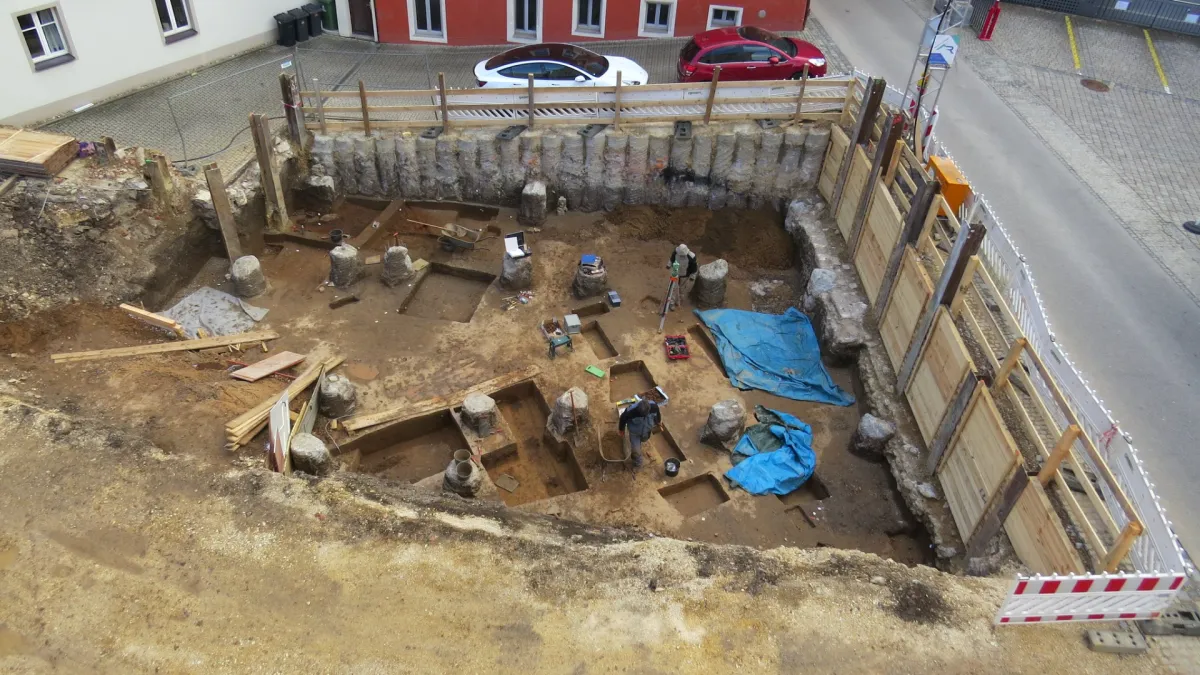
A routine dig before residential construction in Regensburg's old town became something else entirely when archaeologists hit wood-stained soil and the remnants of a 2,000-year-old sanctuary. The temple, dedicated to Mithras—the mysterious god worshipped by Roman legionaries—is the first of its kind ever found in Regensburg's historic center, and the oldest of nine Mithras shrines discovered across Bavaria.
The ArchëoTeam excavation, meant as standard preventative archaeology, revealed artifacts that pinned the sanctuary to between 80–171 AD, when a Roman cohort fort and Danube settlement occupied the area. The temple itself was built of wood, long since rotted away, but what remained told a clear story: an altar stone, votive metal sheets, a sacred cupboard (aedicula), coins, and fragments of ceramic vessels decorated with snakes. Incense burners and handled jugs suggested this wasn't just a place of prayer—it was where rituals happened, where people gathered.
Mithras worship was never mainstream in the way Jupiter or Mars were. The cult appealed particularly to soldiers and merchants, spreading quietly through the Roman Empire in underground chambers and modest sanctuaries. Finding physical evidence of these practices is rare. Each artifact—a bent metal sheet left as an offering, a coin placed at the altar—speaks to individual acts of devotion by people whose names we'll never know.
We're a new kind of news feed.
Regular news is designed to drain you. We're a non-profit built to restore you. Every story we publish is scored for impact, progress, and hope.
Start Your News DetoxWhat This Changes
This discovery matters because Regensburg's Roman past remains surprisingly understudied despite its strategic importance on the Danube. The sanctuary and its contents offer new details about how the settlement actually functioned: who lived here, what they believed, how they marked sacred moments. The Mithras temple wasn't a grand public monument—it was intimate, hidden, the kind of religious space that rarely survives in the archaeological record.
The artifacts are now held by the Regensburg City Museum, which plans to display them in ways that help visitors imagine the rituals that once took place there. In a few months or years, you might walk into a museum and stand in front of a 2,000-year-old altar stone, and suddenly that distant Roman soldier becomes a person—someone who made an offering in a candlelit room and hoped the god was listening.
That's what archaeology does when it works: it turns dirt and fragments into connection.