

Sloth bears carry cubs on their backs. Naked mole-rats breed with siblings. Japanese giant salamanders have a den master. Corals just... broadcast their gametes into the ocean and hope for the best.
While human reproduction follows a fairly predictable script, the animal kingdom has evolved strategies so varied—and sometimes so strange—that they reveal just how many ways there are to pass on genes and keep a species alive.
When two fathers is better than one
Sloth bears (Melursus ursinus) are native to the Indian subcontinent and listed as Vulnerable by the International Union for Conservation of Nature. They're also, according to Stacey Tabellario, a zookeeper at the Smithsonian National Zoo, "ridiculously smart." Sloth bears can estimate quantities, recognize 2D images as equivalents of 3D objects, and show evidence of tool use—leading to the running joke that they're "apes in a bear suit."
Most sloth bears have two cubs at a time, but here's where it gets interesting: a female can breed with multiple males, meaning her cubs might have different fathers. Two cubs born at the Smithsonian in December 2025 will have their DNA tested to determine paternity. What makes sloth bears truly distinctive, though, is how they parent. Unlike other bears, sloth bear mothers carry their cubs on their backs for extended periods—a piggyback ride that protects the young while letting the mother forage without losing track of them. "They're now walking, although they're a little wobbly, and they're starting to explore the birthing den," Tabellario says. "Next we'll be looking for them to climb on mom Molly's back."
We're a new kind of news feed.
Regular news is designed to drain you. We're a non-profit built to restore you. Every story we publish is scored for impact, progress, and hope.
Start Your News DetoxThe colony where only one female breeds
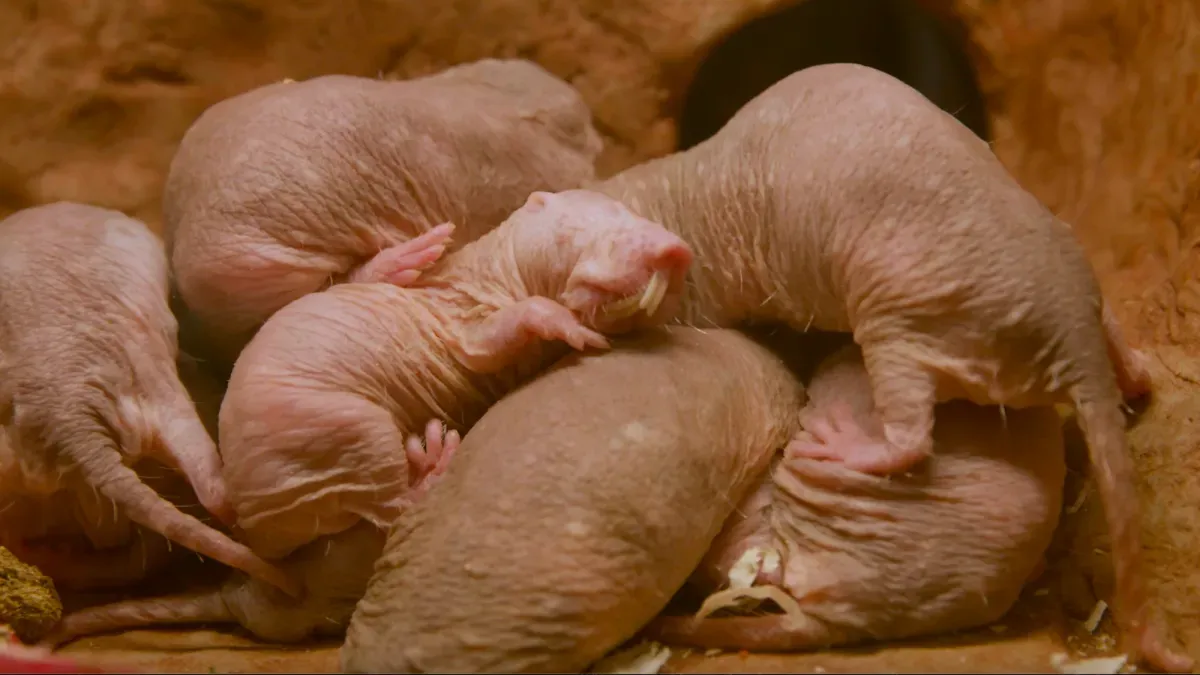
Naked mole-rats (Heterocephalus glaber) live like termites, ants, and bees—in eusocial colonies where individual animals sacrifice independence for group survival. They're also the longest-living rodents on the planet, with lifespans exceeding 30 years.

In each colony, a single queen breeds with several males and can suppress the sexual development of other females through hormonal signals, possibly transmitted via feces. This means she wins every breeding opportunity—but at a cost. "The Queen gets to tell everyone what to do, and she chooses a few males to breed with," explains Kenton Kerns, a curator and biologist at the Smithsonian. "However, she can have one of the largest litters of any mammals, over 30 babies at a time. She has 12 nipples to feed all those babies." She may also have to fight pregnant rivals to defend her position. Because naked mole-rats stay in their birth colony rather than dispersing to find mates, incest is common—queens often breed with their brothers and, if they reign long enough, their own sons.
The den master's domain
Japanese giant salamanders (Andrias japonicus) can reach 5 feet long and weigh over 50 pounds, making them among the largest amphibians on Earth. For these creatures, size determines breeding success. Each male stakes out an underwater den and becomes the "Den Master"—the largest, most dominant male at that site.

Multiple females enter the den to lay eggs, which the Den Master fertilizes externally. Each female typically deposits 400 to 600 eggs, then leaves. The male stays behind to protect them from predators and uses his tail to fan oxygen over them for 2-3 months until they hatch. It's a division of labor that works: the female invests in egg production, the male invests in care.
Corals: broadcast and hope
Among roughly 6,000 coral species, reproduction happens on a schedule dictated not by individual choice but by environmental cues. Corals bud year-round but reproduce sexually during warmer months through "mass spawning"—a coordinated event where thousands of corals simultaneously release sperm and eggs into the water column.

"A major benefit of mass spawning is genetic diversity, which helps corals adapt to disease and environmental stress," says Thomas Wippenbeck, a marine biologist at the Smithsonian. "Releasing large numbers of eggs at once also reduces losses to predators." The downside is fragility: if temperature or seasonal cues shift even slightly, spawning becomes unsynchronized, and fertilization success plummets. This sensitivity to environmental conditions makes corals both ancient survivors—they've endured hundreds of millions of years of change—and increasingly vulnerable to the rapid shifts happening now.
Each strategy reveals something about the tradeoffs evolution makes: protection versus independence, genetic diversity versus synchronization, individual power versus collective survival.





