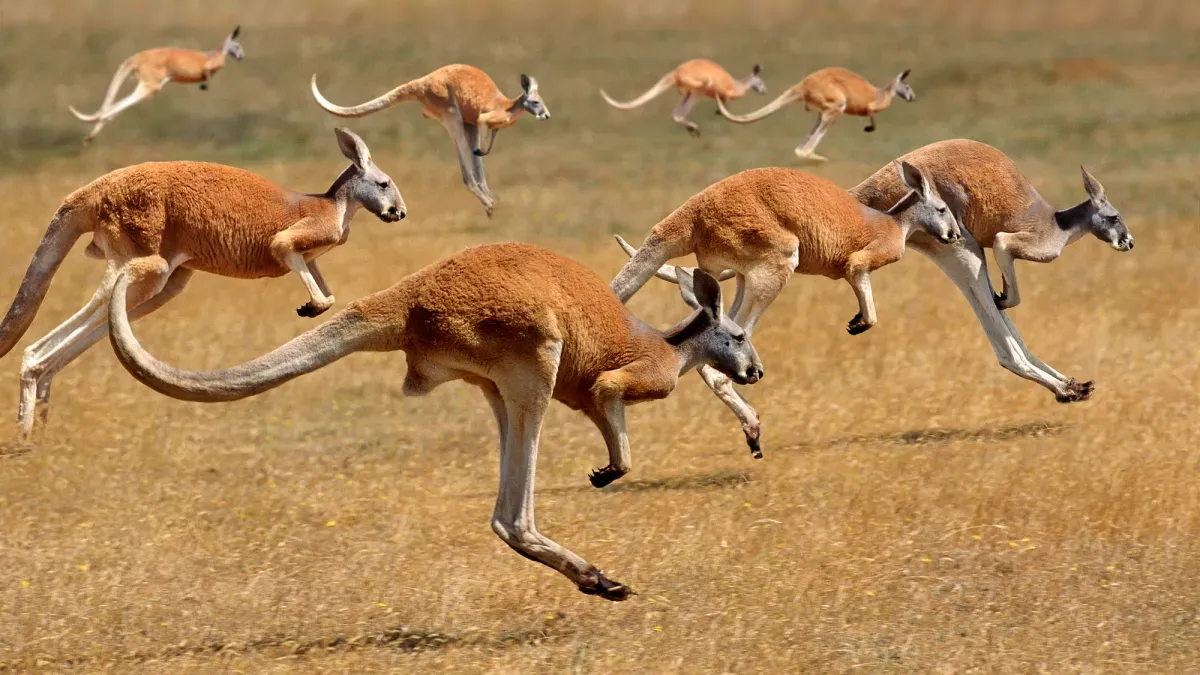
For thousands of years, Australia's red kangaroo has held the title of planet's largest hopping animal. A big male stands over five feet tall, weighs around 200 pounds, and launches itself six feet forward with each leap. But 45,000 years ago, their Ice Age cousins made them look small.
Giant kangaroos from the Sthenurinae subfamily towered at 6.5 feet and weighed upwards of 550 pounds — more than double their modern descendants. The largest species, Procoptodon goliah, was so massive that scientists long assumed hopping became physically impossible at that scale. The math seemed simple: scale up a modern kangaroo's skeleton and the physics breaks down somewhere around 330 pounds.
But a new study from researchers at the University of Manchester and University of Bristol suggests the Ice Age giants weren't just supersized versions of today's kangaroos. They were built fundamentally differently.
We're a new kind of news feed.
Regular news is designed to drain you. We're a non-profit built to restore you. Every story we publish is scored for impact, progress, and hope.
Start Your News DetoxAnatomy That Rewrote the Rules
When evolutionary scientist Megan Jones and her team compared fossil bones with modern kangaroo skeletons, they found crucial differences previous estimates had missed. The giant kangaroos possessed thicker, shorter foot bones and broader heels — structural changes that allowed them to absorb the enormous downward force of hopping without shattering.
These weren't the only adaptations. More powerful tendons in the feet and ankles provided the strength needed to launch half a ton of body weight into the air. But there was a trade-off. "Thicker tendons are safer, but they store less elastic energy," explained Katrina Jones, a biologist at the University of Bristol. "This likely made giant kangaroos slower and less efficient hoppers, better suited to short bursts of movement rather than long-distance travel."
The research, published in Scientific Reports, suggests these short hops served specific purposes. A giant kangaroo could use them to cross rough terrain more easily or escape a predator with a sudden burst of speed — without needing to cover vast distances the way modern kangaroos do.
The picture becomes even more complex when you consider that different Sthenurinae species may have moved in different ways. Some likely hopped for short stretches, then shifted to walking on two legs or all four as the situation demanded. It was a wider "movement repertoire," as the researchers describe it, adapted to the particular challenges of Ice Age Australia.
The finding challenges how paleontologists approach extinct animals — a reminder that bigger doesn't always mean simpler, and that evolution often finds unexpected solutions to seemingly impossible problems.