When the Ice Wins, Briefly
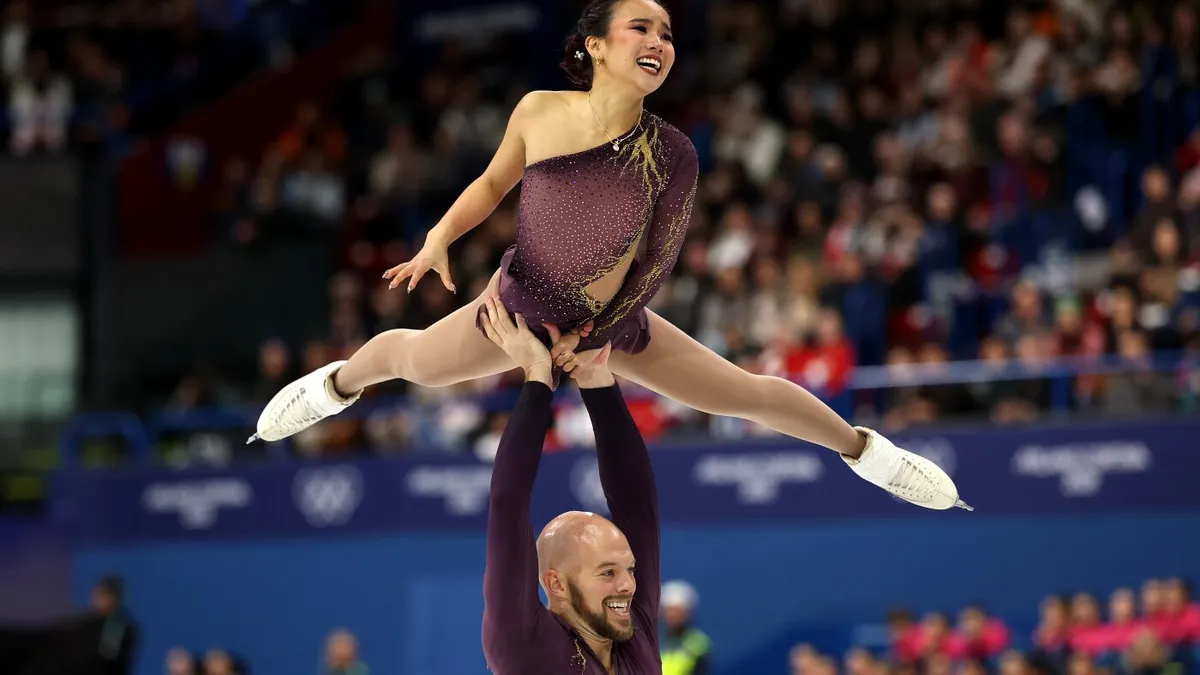
Ellie Kam was 21 years old, on Olympic ice in Milan, skating the pair short program she'd trained for most of her life. Then, faster than a blink, she fell.
What happened next is what made the moment worth watching. Kam got up. She found her partner Danny O'Shey's rhythm. They kept going.
"We wish we were perfect every single time we step out on the ice," Kam said afterward, with what you might call practiced acceptance. "But you know, ice is slippery."
We're a new kind of news feed.
Regular news is designed to drain you. We're a non-profit built to restore you. Every story we publish is scored for impact, progress, and hope.
Start Your News DetoxIt's a simple statement that contains something deeper: the difference between a single fall and a failed performance. One is physics. The other is choice.
The Recovery Is the Skill
O'Shey, 34, watched Kam get up without needing help. "She didn't need me to pick her up. She got up and went after the next thing," he said. "We put the past in the past, and stepped right into the next element."
This is the part coaches actually teach. Not how to land a jump—that's muscle memory. But how to land a jump after your body has already failed once, when your mind is cataloging what went wrong, when the crowd has seen you fall.
Kam's explanation was straightforward: relentless practice. "We focus [in training], so that if something does go wrong in competition, we don't have to question anything. I'm going to be where he is." The mental blueprint is so worn into her brain that falling becomes a minor interruption, not a crisis.
O'Shey added the other piece: communication. "We definitely look at each other. I do a lot of talking throughout our program. In that moment, it's a deep breath. It's like, all right, calm, one more thing, spin."
They weren't alone on Friday. China's Sui Wenjing and Han Cong—gold medalists at the 2022 Beijing Olympics—also fell during their team program. But they, too, framed it as recoverable. "We have time now to prepare for the next [event]," Han Cong said. Not catastrophe. Adjustment.
When Falling Leads Somewhere
Sometimes the story goes further. In 2006, at the Torino Winter Games, Chinese pair Zhang Dan and Zhang Hao attempted a throw that had never been landed in major international competition. It was risky. Zhang Dan fell hard and injured her knee. They came back and won silver anyway.
In 2018, Nathan Chen fell repeatedly early in his free skate program, then landed six quadruple jumps in a single routine—an Olympic first. "I was like, I already fell so many times, I might as well go out and throw everything down and see what happens," he told NPR.
American Alysa Liu, 20, made a small error during Friday's women's single skating but recovered with enough composure to laugh about it afterward. "I was like, whoopsies," she said. She stuck her next landings and helped the U.S. team take first place overall.
The Invisible Skill
What these skaters have learned—through thousands of hours of repetition, through falls that hurt, through competition where everyone is watching—is that falling is not the end of the story. It's a sentence in the middle.
The goal isn't perfection. It's grace under pressure. It's the ability to reset in two seconds. It's knowing, before you even hit the ice, that you'll get up again.