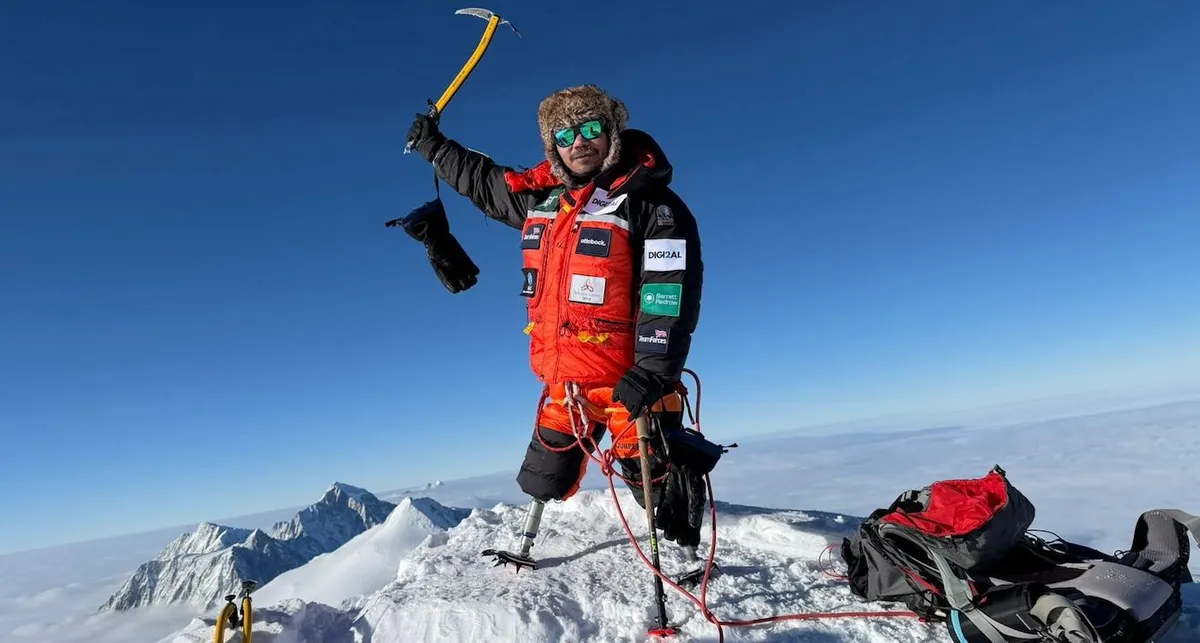
Hari Budha Magar reached the summit of Mount Vinson in Antarctica on Tuesday—the final peak in a journey that made him the first above-the-knee double amputee to climb the highest mountain on every continent. At 46, the British veteran had just completed what fewer than 500 people in the world have ever done. The last three days had been brutal: temperatures at 13 below zero, crawling on all fours through conditions that tested every part of his body and mind.
Fifteen years earlier, an IED explosion in Afghanistan had taken both his legs. For years after, Hari struggled with the weight of that loss—with suicidal thoughts, with addiction, with the question of what a life without legs could still become. But somewhere in that darkness, he found a different kind of climbing.
It started small. A skydive. Then skiing. Then a childhood dream that had never left him: Mount Everest. When Nepal's authorities initially refused to let climbers with disabilities attempt the mountain, Hari didn't accept the answer. He challenged the ruling in court. Four years after that first application, he stood at 29,032 feet—almost exactly 13 years after the day he lost his legs.
We're a new kind of news feed.
Regular news is designed to drain you. We're a non-profit built to restore you. Every story we publish is scored for impact, progress, and hope.
Start Your News DetoxThe seven summits took him six years total. Each peak brought different obstacles. The cold of Antarctica required a specially designed suit, developed with para-jumpers. The prosthetics themselves—new legs, feet, and sockets—were engineered by specialists at Ottobock to handle conditions no standard prosthetic was built for. But the real engineering was something else: the way Hari learned to adapt, to ask for help, to think differently about what his body could do.
"A disability shouldn't limit the size of your dream, or your ability to achieve it," he told reporters after Vinson. "Yes, you might need to adapt your approach, get help, or think differently, but you can do it."
His work has been recognized beyond mountaineering. He's been named a Member of the Order of the British Empire, and celebrated by the Pride of Britain, an annual event honoring extraordinary achievements by ordinary people. More importantly, his seven summits challenge has raised money for disability and veterans' charities—work that's become, in his words, his real mission now.
"If I had the opportunity to bring my legs back today, I would actually decline," Hari said, "because my mission in life is now to help, inspire and empower others."
What happens next isn't another peak. It's the slower, steadier climb of changing how the world thinks about disability—one conversation, one barrier challenged, one person inspired at a time.