
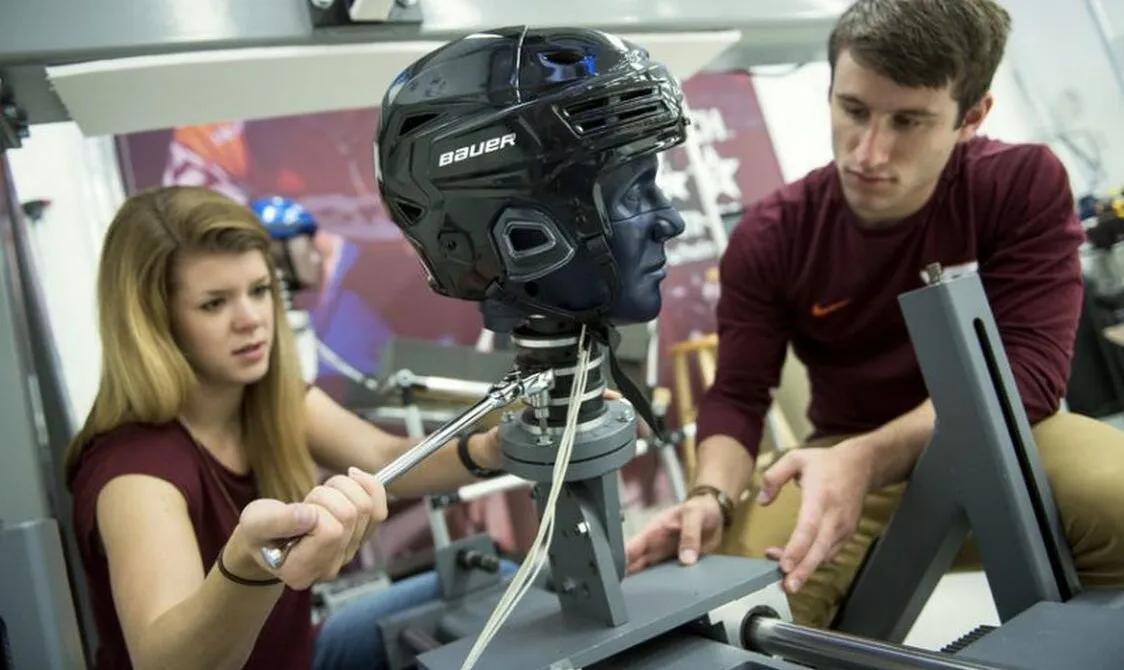
In 2011, Steve Rowson and his engineering students at Virginia Tech got an unusual request: test the football helmets the Hokies actually used and figure out which ones actually worked. What they discovered was stark. The helmets on the market varied wildly in how much force they transmitted to a player's head during impact. That finding didn't stay in a lab notebook — it became the foundation for something that would quietly reshape an entire industry.
Today, the Helmet Lab rates helmets across seven sports: football, cycling, snowsports, construction, baseball, hockey, and equestrian. They use the same rigorous approach for each. Rather than dropping a crash test dummy and calling it done, they account for the specific physics of each sport — the type of impact (head into wall versus wall into head), the surface (ice versus asphalt versus sand), the materials involved. Testing machines measure both linear and rotational forces, the two types of impact that damage the brain. A helmet that lets less force through gets a higher star rating.
The 5-star VA Tech Helmet Rating sounds like just another label. But manufacturers noticed something: safety sells. Once Rowson and his team started publishing their findings publicly, helmet makers realized they could use a top rating as a selling point. Parents buying helmets for their kids suddenly had unbiased data. Athletes could choose based on actual protection, not marketing. The incentive structure flipped. Instead of racing to the bottom on cost, manufacturers started competing on the metric that actually mattered.
We're a new kind of news feed.
Regular news is designed to drain you. We're a non-profit built to restore you. Every story we publish is scored for impact, progress, and hope.
Start Your News Detox"When we started publicizing that information, it was like a light bulb to manufacturers," Rowson told CNN. "Safety sells."
The impact has been quiet but consistent. Across every sport the lab has tested, manufacturers have responded by improving their designs. Students get hands-on experience in biomechanics and materials science with direct real-world application. Parents make better decisions. And the cumulative effect is fewer preventable head injuries in youth sports and beyond.
What started as a single question — which helmet is actually safest — became a template for how consumer pressure and transparent testing can drive industry-wide improvement. The Helmet Lab is now training the next generation of engineers to keep asking those questions across other protective equipment and safety domains.