

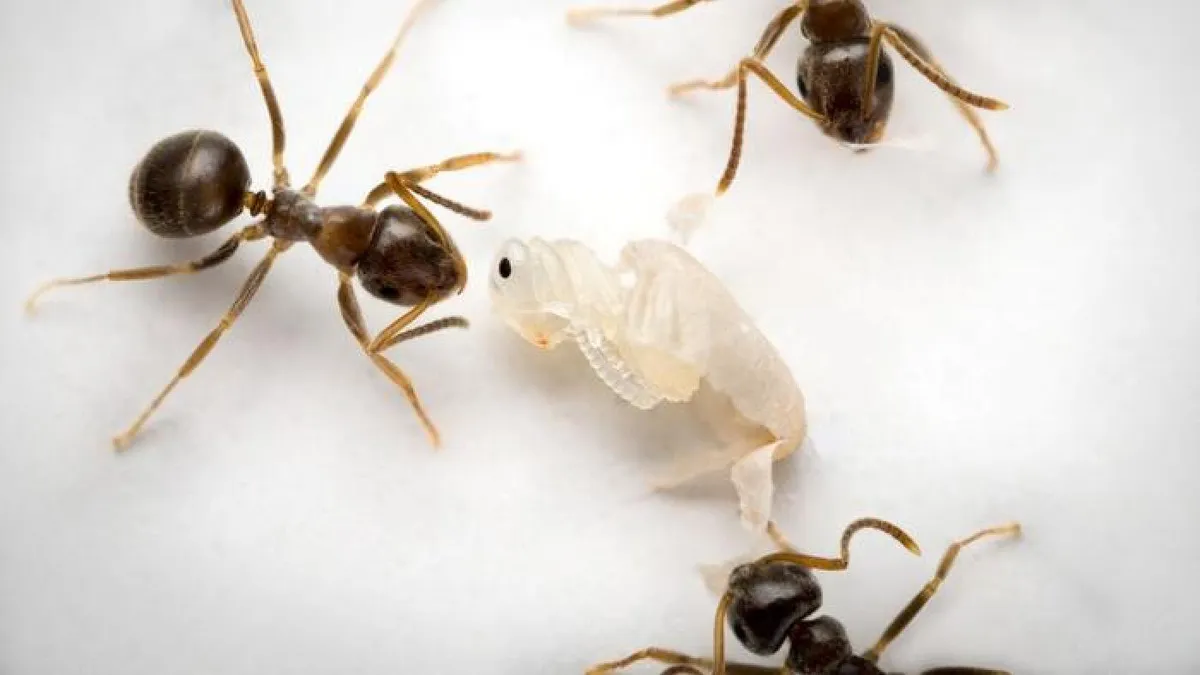
When a young ant becomes terminally ill inside its cocoon, it does something that sounds like science fiction: it releases a chemical signal essentially asking the worker ants to unpack it and kill it.
This isn't suicide in the human sense. It's a form of disease control so efficient that it's reshaping how scientists think about collective survival. The infected pupa can't move, can't flee, can't isolate itself. So it broadcasts a message: remove me before I become contagious. The worker ants respond by opening the cocoon, applying a disinfectant, and in the process, ending the infection before it spreads.
Researchers at the Max Planck Institute, publishing their findings in Nature Communications, discovered this behavior while studying the invasive garden ant Lasius neglectus. They found that sick pupae only emit the signal when adult workers are nearby—suggesting the young ants aren't just passively leaking chemicals, but actively communicating. In experiments, even the smell alone triggered the worker ants' disinfection response, even on healthy pupae.
We're a new kind of news feed.
Regular news is designed to drain you. We're a non-profit built to restore you. Every story we publish is scored for impact, progress, and hope.
Start Your News DetoxA Colony-Scale Solution to an Ancient Problem
Ant colonies are epidemiologically fragile. Thousands of genetically similar insects living in close quarters create perfect conditions for disease to spread rapidly. A single infected individual can become a colony-wide catastrophe. Over millions of years, ants have evolved a toolkit of defenses: restructuring their nests to isolate sick areas, queens eating infected larvae, and sick adults literally walking away from the colony.
But pupae are trapped. They can't move. They can't distance themselves. They're vulnerable for weeks while they develop. The "kill me" signal solves this in a way that feels almost brutal in its logic: the individual sacrifices itself to protect the genetic relatives it will never meet. Most ants are sterile workers, so their genes live on through the colony's survival, not through their own offspring.
Sylvia Cremer, the study's senior author, emphasizes that this isn't altruism in the way humans understand it. It's a form of genetic self-interest operating at the colony level. By removing itself, the sick pupa ensures the survival of its siblings and the queen—the only ants that will reproduce and pass on shared genes.
This research sits at the intersection of two growing realizations: that insects have far more sophisticated communication and decision-making systems than we once thought, and that disease management in densely packed populations requires strategies we're only beginning to understand. As human cities grow denser and pandemics remain a genuine threat, studying how ants have solved this problem for 100 million years might offer unexpected insights.





