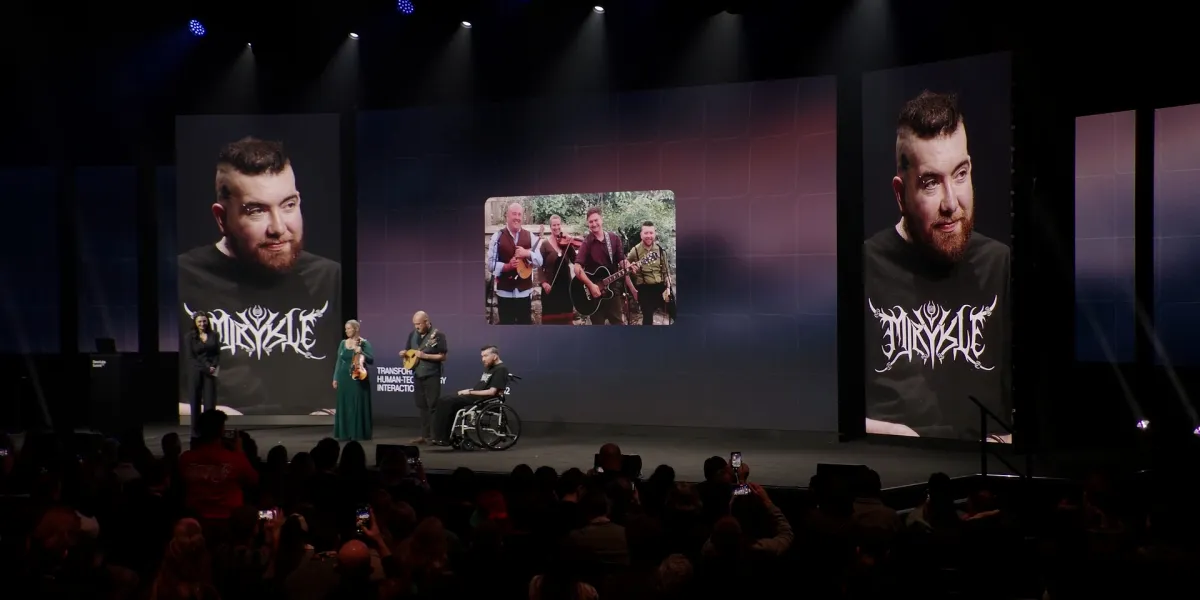
Patrick Darling stood on stage in London last month, two years after he'd thought his performing days were over. His bandmates played mandolin and fiddle. The audience heard him sing. But Darling wasn't singing—he was listening to his own voice, recreated by artificial intelligence, playing through the speakers.
Darling was diagnosed with amyotrophic lateral sclerosis (ALS) at 29. The disease attacks the nerves that control muscles, gradually stealing movement, speech, and breath. By mid-2024, he couldn't play guitar or banjo anymore. He couldn't stand on stage. His voice had changed so much that even recording it felt pointless.
Then a speech therapist introduced him to voice cloning technology. ElevenLabs, an AI company, had launched a program offering free voice clones to people losing their voices to ALS and similar diseases. The tool needed only minutes of audio—old recordings, videos shot in noisy pubs, singing in his kitchen. From those fragments, it reconstructed Darling's voice as it had been.
We're a new kind of news feed.
Regular news is designed to drain you. We're a non-profit built to restore you. Every story we publish is scored for impact, progress, and hope.
Start Your News Detox"The first time I heard it, I thought it was amazing," Darling said at the ElevenLabs summit, using his voice clone. "You literally wouldn't be able to tell the difference."
From Voice to Music
Recreating his singing voice was trickier. The audio was imperfect—raspy, slightly off on some notes. But that's what made it work. The voice clone inherited those qualities, sounding human rather than polished.
Then came the harder part: making new music. ElevenLabs had built a music generator that lets users compose tracks using text prompts. Darling and Richard Cave, the speech therapist who'd guided him through the process, spent six weeks fine-tuning a song Darling had written for his great-grandfather—someone he'd never met.
When Nick Cocking, Darling's bandmate of over a decade, first heard the finished track, he had to stop it after a few words. "I was just in bits, in tears," he said. It took him half a dozen attempts to listen all the way through.
Cocking and another bandmate, Hari Ma, learned their parts in two weeks. They rehearsed together, then took the stage with Darling for the first time since June 2024.
"I wheeled him out on stage, and neither of us could believe it was happening," Cave said. "He was thrilled."
What matters here isn't the technology's perfection. It's what it returned: not a cure, but agency. Darling still has ALS. He still can't move as he once did, can't breathe as easily. But he can compose. He can perform. He can feel like a musician again, not just someone who used to be one.
Gabi Leibowitz, who leads ElevenLabs' impact program, puts it plainly: "We're not really improving how quickly they're able to communicate... But what we are doing is giving them a way to create again, to thrive." Users stay in their jobs longer. They keep doing the things that make them feel human.
Darling plans to keep making music. Cocking hopes they'll perform together again, though he knows the nature of ALS makes long-term plans fragile. For now, there's the memory of that night in London—Darling's voice filling the room, his bandmates playing beside him, two years of silence broken.