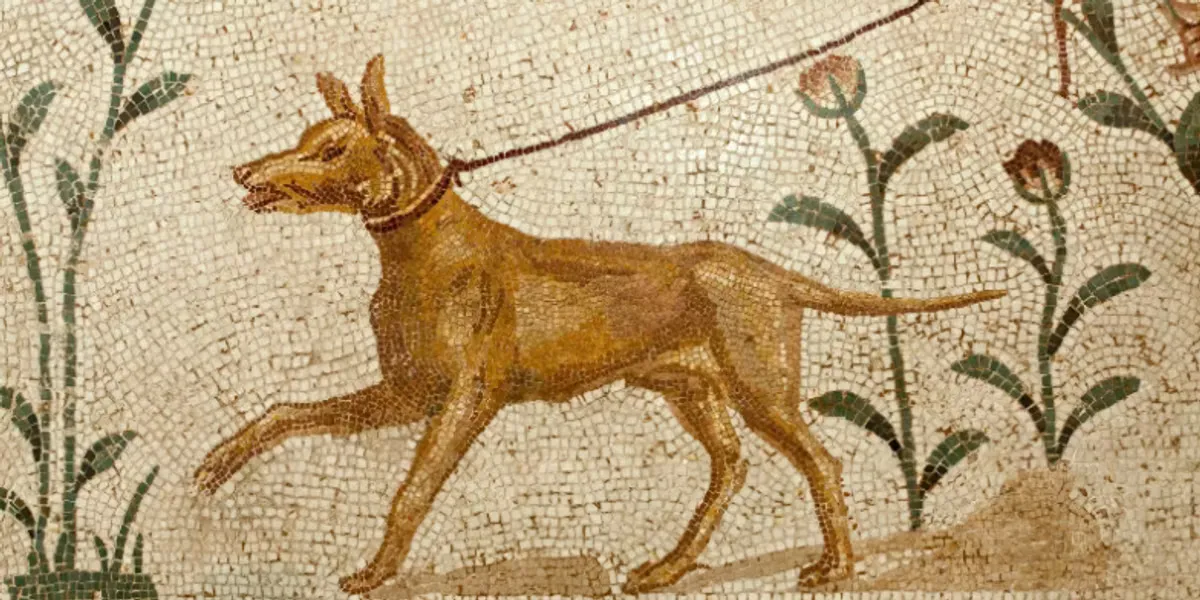
Two thousand years ago, a Roman named Eumelus buried his dog Bull and carved these words into stone: "Here the stone says it holds the white dog from Melita, the most faithful guardian of Eumelus. Bull, they called him when he was yet alive. But now his voice is imprisoned in the silent pathways of the night."
It's the kind of thing you'd expect to find on a modern pet memorial website, not in the ruins of ancient Rome. Yet scattered across archaeological sites are dozens of epitaphs that prove the Romans grieved their dogs with the same raw, specific ache we feel today.
Pliny the Elder, the Roman naturalist and scholar, wrote in the first century A.D. that dogs were "man's most faithful companion." He noted something that still rings true: "The dog alone knows his master, and he alone recognizes his own name. He alone, too, in his master's defense, will lay down his life; and, let his master die, he will remain on the watch by the body."
We're a new kind of news feed.
Regular news is designed to drain you. We're a non-profit built to restore you. Every story we publish is scored for impact, progress, and hope.
Start Your News DetoxBut the epitaphs tell a more intimate story. One owner carved: "My eyes were wet with tears for our little dog, when I bore you to the grave. So Patricus, never again shall you give me a thousand kisses. Never can you rest contentedly in my lap." Another simply wrote: "Myia never barked without reason. But now she is silent." The weight of that sentence — the absence where sound used to be — carries across centuries.
Some epitaphs capture personality with startling precision. A dog named Margarita was described as trained to hunt through forests, never chained, never beaten, accustomed to sleeping on soft mattresses and "given a silent mouth." Her owner documented not just her death but her specific gentleness — a dog who didn't bark more than necessary, who knew when to rest. Another epitaph describes a dog who would bark if a rival came near her lady's bed, "wanton one," suggesting an owner who saw humor and sass in their companion, not just loyalty.
David Ian Rowe, an anthropologist who specializes in ethnocynology (the study of dogs in human culture), has documented these inscriptions. What they reveal is that the Romans didn't just own dogs — they noticed them. They remembered the exact pressure of a dog's weight in their lap, the specific way they'd rest their head, the particular timbre of their bark.
The epitaphs also suggest something about Roman society itself. These weren't just working animals. They were lap dogs, hunting companions, household members whose absence left a hole specific enough to carve into stone. One owner wrote: "Ye who pass this monument laugh not, I pray thee, for this is a dog's grave. Tears fell for me and dust was heaped above me by a master's hand."
That defensive tone — don't you dare mock this — suggests the Romans understood something we're still learning: that grief for a pet is real grief, and it deserves to be witnessed without judgment.