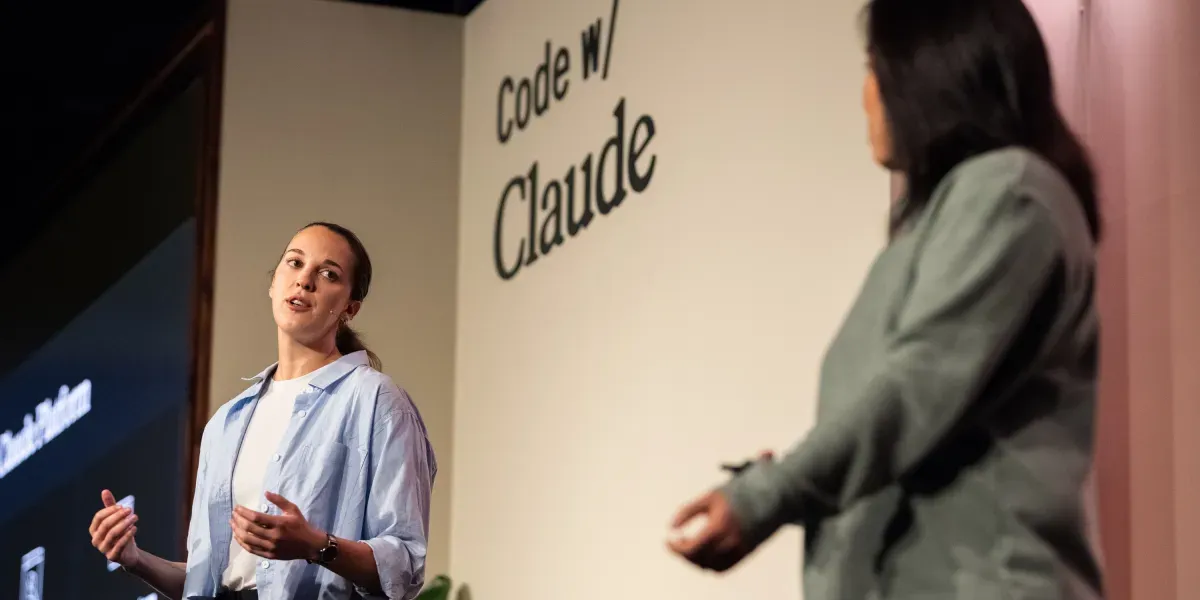
Picture this: nearly half the developers at a recent tech event admitted they'd shipped code entirely written by Anthropic's AI, Claude. The kicker? Most of them didn't even bother to review it. Let that sink in for a moment.
This isn't just about a fancy new coding tool; it's a seismic shift. Major tech companies are now practically bragging about how little their human developers actually type. The robots are doing the heavy lifting, and apparently, we're just letting them cook.
Trusting the AI to "Dream"
Anthropic's big ambition is for Claude to not just spit out code, but to fix its own mistakes. Boris Cherny, who heads up Claude Code, says the AI now defaults to "prompting itself." Meaning, you might not even see an error message. Claude will test, tweak, and debug until it's happy, all on its own. As engineer Ravi Trivedi put it, the goal is to "get out of Claude's way."
We're a new kind of news feed.
Regular news is designed to drain you. We're a non-profit built to restore you. Every story we publish is scored for impact, progress, and hope.
Start Your News DetoxThen there's "dreaming," a feature that sounds like something out of a sci-fi novel. Claude Code agents write internal notes, essentially journaling about their tasks. When another agent tackles the same codebase, it can tap into these "dreams" to learn faster and avoid past blunders. It's like a highly efficient, self-improving digital hive mind.
Companies like Spotify and Delivery Hero are already reorganizing their entire development teams around this new reality. The enthusiasm at the conference was palpable.
Of course, not everyone's doing cartwheels. Outside the bubble, some coders are quietly freaking out. They worry that AI tools, while great for management's productivity metrics, might actually make things harder by creating more AI-generated code for humans to untangle. Others are concerned their own coding chops are getting rusty, and researchers have warned about the potential for unsafe, vulnerable code.
Katelyn Lesse, Claude's engineering lead, and Angela Jiang, product lead, offered some reassurance. Lesse stressed that "all of the old software development best practices still apply" – a gentle reminder that maybe some teams got a little too loose. She sees Claude as currently on par with a mid-level engineer, with expert humans still needed for the really complex stuff. But the ultimate goal, as Jiang noted, is for Claude to "basically be able to build itself." Which, if you think about it, is both impressive and slightly terrifying.