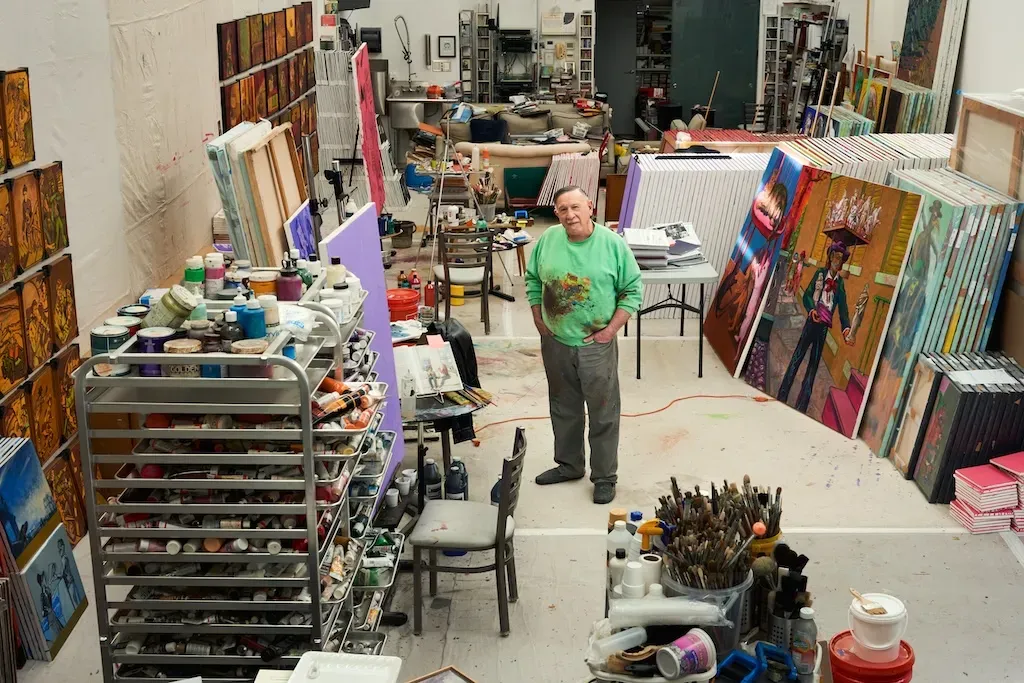
Archie Rand, a painter who's been at it for decades, still clocks in daily at his sprawling Brooklyn studio. He’s 77, and apparently, still just getting started. The jazz and classical tunes are usually playing, the canvases are stacked, and the grand piano (a relic from his pre-Billy Joel band days) sits ready.
But how does an artist know when a painting is done? For Rand, it’s not about perfection or a final flourish. He points to a half-finished canvas: a street vendor, two kids, a fiery red sunset. "You know what the most important part of this painting is?" he asks, gesturing to where a building meets that crimson sky. "This, right here."
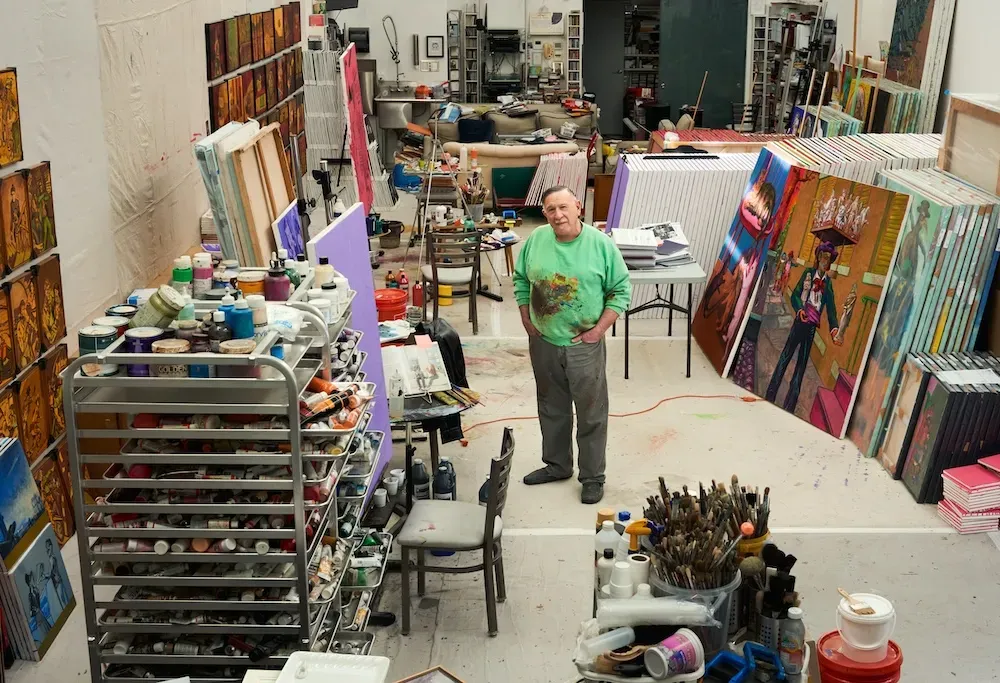
It’s the part that makes him wonder. What’s around the corner? Where are those people headed? "If I can say, 'What's over there,' then it's working. That's when I can put the brush down." The vendor, he adds, is necessary but "least important." Without the mystery, it’s just a picture.
We're a new kind of news feed.
Regular news is designed to drain you. We're a non-profit built to restore you. Every story we publish is scored for impact, progress, and hope.
Start Your News DetoxNot Riffing, Just Painting
Rand’s latest exhibition, "Heads," is a collection of new paintings that look like vibrant, slightly surreal stills from a very imaginative dream. Think a boy playing a trumpet in a floral chair, or two kids sailing with a smiling mallard as their figurehead, plunging into rough seas. It’s the kind of art that drops you in the middle of a story and trusts you to figure out the rest. Or, more accurately, to invent the rest.
Co-curator Max Werner, who first encountered Rand’s work at the tender age of eight, observes that Rand is "ahead of his time and somehow still in it." Which, if you think about it, is both impressive and slightly terrifying. Rand, he says, isn't "riffing" on trends. He’s just doing his own thing. Lindsay Jarvis, the other co-curator, calls his visual language "truly singular and idiosyncratic." So, basically, he’s an original, which is a rare commodity these days.
Born in Brooklyn in 1949, Rand started showing his work at 17. He was a prodigy, initially dabbling in Abstract Expressionism until he realized he didn't want to be confined to anyone else's box. The big turning point? Seeing Philip Guston’s show in 1970, where Guston famously ditched abstraction for figurative work. It split the art world, but for Rand, it was a revelation. He and his poet friend Ross Feld talked about it for hours, then spent three days talking with Guston himself. Rand remembers Guston’s way of moving through ideas, making painting feel like an exploration.
Rand is a passionate reader with a memory for poets and philosophers, describing his thought process as "very Talmudic" — a digressive, exploratory Jewish way of thinking. When asked about not fitting into current art categories, he recalls a letter from Einstein to Niels Bohr. Bohr asked how Einstein developed relativity. Einstein’s reply: "I simply chose to ignore an axiom." Rand took that to heart. "I'm just doing what I have to do."
He’s also a dedicated teacher, having chaired the visual arts department at Columbia and now serving as Presidential Professor of Art at Brooklyn College. He doesn't critique or talk aesthetics. He just watches as students, initially painting like Vermeer, eventually find their own completely distinct paths. "At the end of the semester, every one of them becomes a painter, and they are all different. It's beautiful."
Rand seems perfectly content with his role: to create, not to chase fame. "I've accepted that and I'm happy with my life," he says. "I've done what I had to do." And if that's not a mic drop, we don't know what is.