Scientists at Hong Kong University of Science and Technology have cracked one of the stubborn problems blocking calcium-ion batteries from competing with lithium: getting calcium ions to move reliably through the battery without degrading.
It's a technical fix that matters because lithium is scarce, expensive, and geographically concentrated. Calcium sits everywhere — it's the fifth most abundant element on Earth. If researchers can make calcium-ion batteries work at scale, it reshapes the economics of renewable energy storage.
The Problem With Calcium (Until Now)
Calcium-ion batteries have looked promising in theory for years. The chemistry works. The electrochemical window is comparable to lithium. But in practice, calcium ions moved sluggishly through the battery's interior, and the whole system degraded quickly under repeated charging. After a few hundred cycles, performance collapsed. That's a deal-breaker for grid storage or electric vehicles, where batteries need to survive thousands of charge-discharge rounds.
We're a new kind of news feed.
Regular news is designed to drain you. We're a non-profit built to restore you. Every story we publish is scored for impact, progress, and hope.
Start Your News DetoxProf. Yoonseob Kim's team at HKUST attacked the core issue: ion transport. They engineered something called a redox covalent organic framework — essentially a synthetic material with ordered pores lined with carbonyl groups that act like a highway for calcium ions. The ions move faster along these aligned structures, and the whole battery stays more stable.
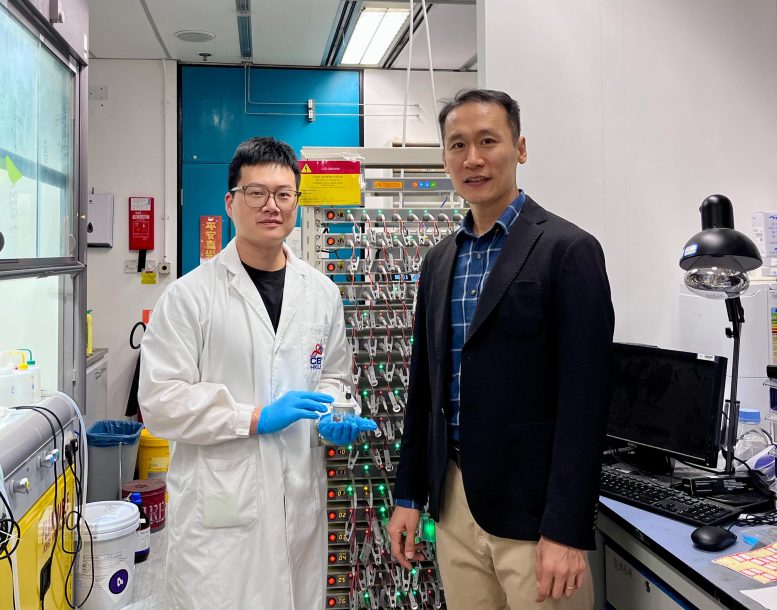
Prof. Yoonseob Kim (right) and PhD student Zhuoyu Yin with an electrochemical cell. Credit: HKUST
The results are concrete. A full calcium-ion battery cell they built held 74.6% of its capacity after 1,000 charge-discharge cycles at high current. That's not yet lithium-ion performance — commercial lithium cells often retain 80–90% after the same test — but it's the first time calcium-ion technology has demonstrated this kind of durability. Five years ago, calcium-ion batteries were fading after a few hundred cycles.
What This Means Next
The breakthrough doesn't mean calcium-ion batteries will replace lithium overnight. Lab results rarely translate directly to mass production. But this work suggests the technical barriers aren't fundamental — they're solvable with better materials design. Multiple research groups worldwide are now pursuing similar approaches, and the competition is accelerating. Within the next 3–5 years, expect to see calcium-ion prototypes in real-world testing: grid storage, maybe early EV applications in regions where lithium supply is constrained.
For now, this is a signal that the battery landscape is diversifying. Lithium won't be the only option much longer.