
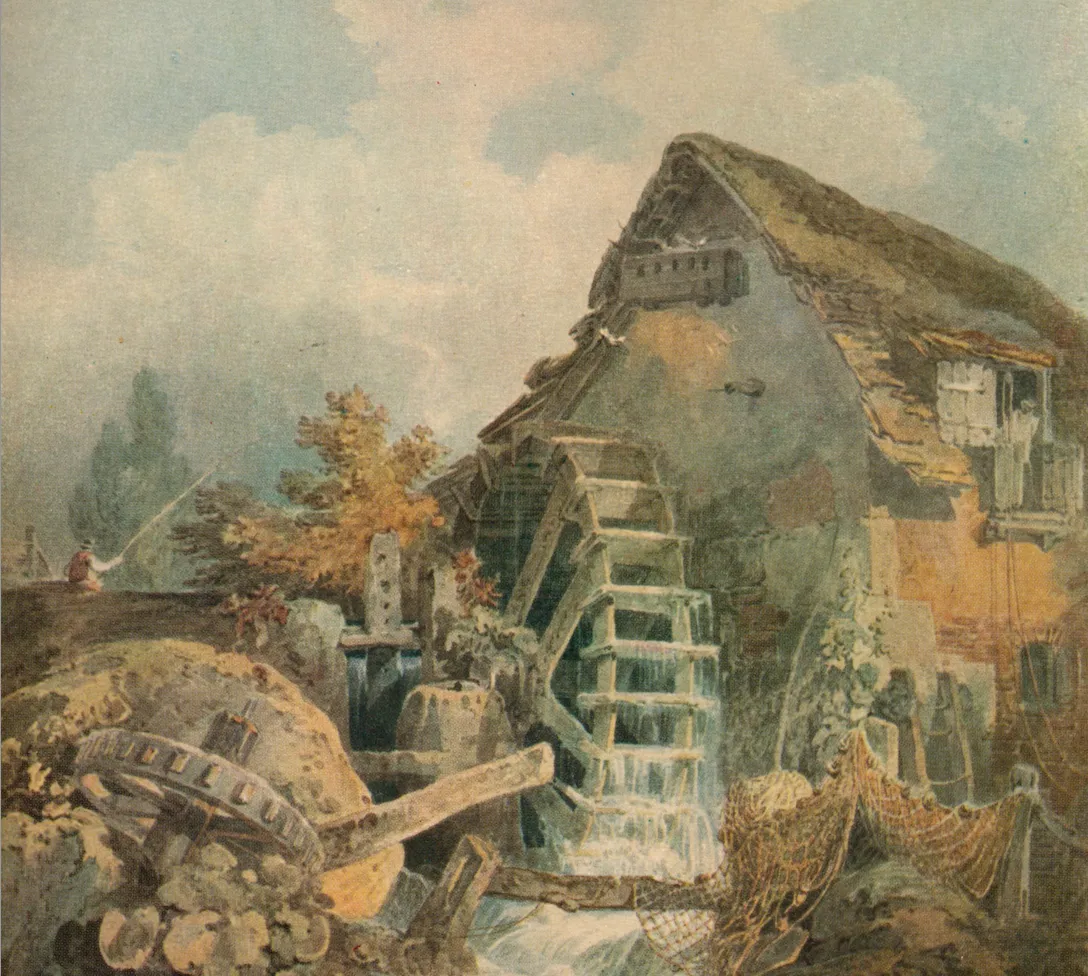
When Brendan and Celia Wilson first spotted Rossett Mill 17 years ago, it was boarded up and scheduled for demolition. The Grade II-listed watermill in Wrexham, Wales, had been abandoned for decades. They saw what others had given up on: a 1588 building with enough character and bones to justify the work.
They bought it for £660,000 and spent the next two years rebuilding it from the inside out. The restoration cost another £250,000, but the couple were careful to preserve what made the place worth saving in the first place. They sourced reclaimed oak beams from a barn in France, installed modern heating and a functional kitchen, and—most remarkably—got the undershot waterwheel working again. Brendan taught himself how to run the mill from books and online tutorials, learning to harness the River Alyn's flow just as millers had done for centuries.
What makes Rossett Mill historically significant isn't just its age. In 1795, the landscape painter J.M.W. Turner visited and painted it, capturing the mill in "Marford Mill." Turner was drawn to such places because they held stories—layers of human labor, industrial purpose, and natural beauty compressed into a single scene. According to Tate Britain curator Nicola Moorby, Turner used these picturesque sites as laboratories for the technical ambition and philosophical depth that would eventually define his work.
We're a new kind of news feed.
Regular news is designed to drain you. We're a non-profit built to restore you. Every story we publish is scored for impact, progress, and hope.
Start Your News DetoxNow, after 15 years of stewardship, the Wilsons are selling Rossett Mill for £1.5 million. They're ready to move closer to their children, and the property is ready for its next chapter. "There is history in every corner of this building," Brendan said. "We just happened to be the first people to live in it."
What's striking isn't just that they saved a building from demolition. It's that they did it thoughtfully—respecting what was old while making it livable for now. The mill's deeds still include an ancient water right, the wheel still turns, and the building still stands in the same landscape Turner painted more than 200 years ago.