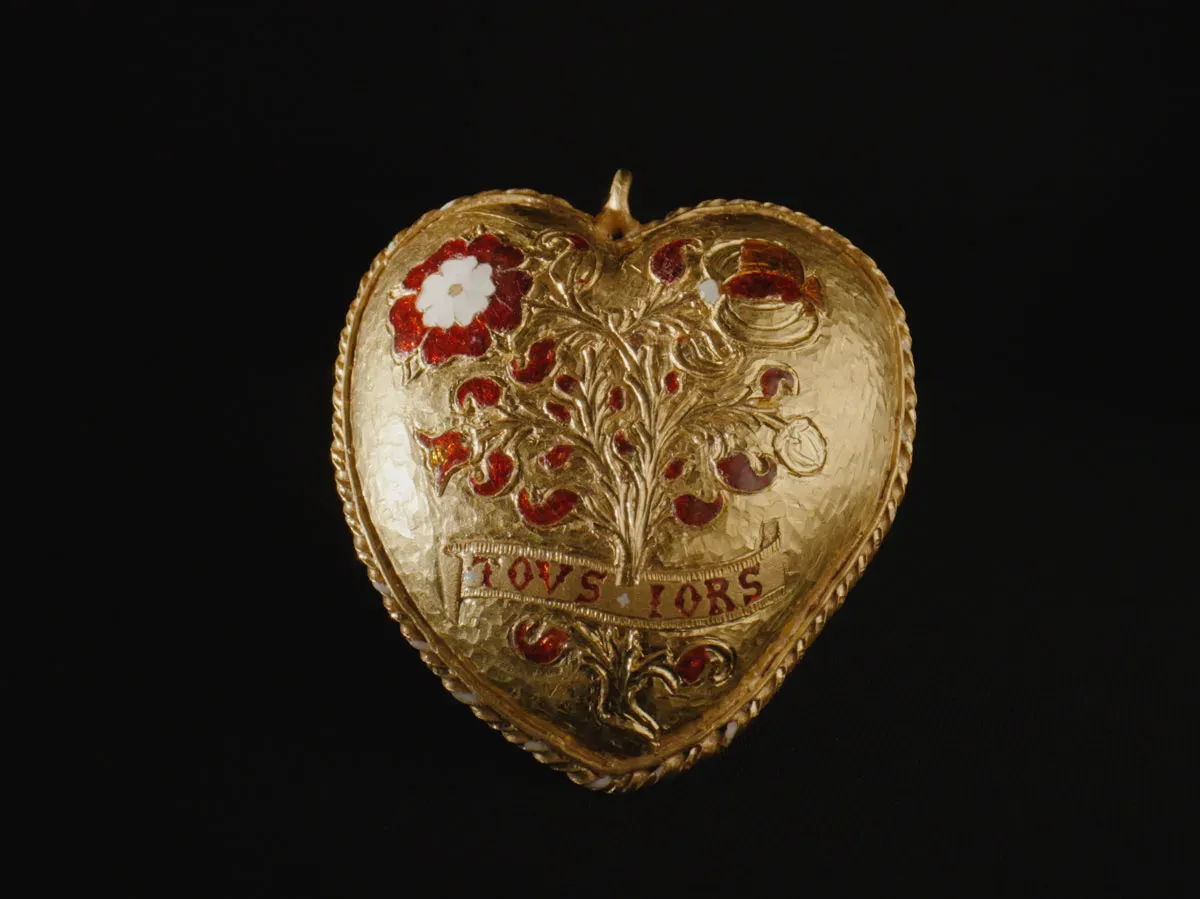
A gold pendant small enough to hold in your palm just cost a museum $4.8 million to keep. But then again, this isn't just any pendant — it's the only piece of jewelry known to survive from Henry VIII's 24-year marriage to Katherine of Aragon, and it's a window into a moment of royal intimacy that most objects simply don't capture.
The "Tudor Heart" is a 24-carat-gold locket, palm-sized, with a 75-link chain. One side shows the Tudor rose intertwined with a pomegranate bush — Katherine's personal emblem, symbolizing fertility and her Spanish home. Flip it over and you find the initials "H" and "K" linked by a tasseled cord, with the Old French word "tousiors" (always) engraved below. It's the kind of object that makes you pause: someone made this, someone wore this close to their body, someone meant it to say something permanent about a bond that would, historically, turn out to be anything but.
The British Museum launched its fundraising campaign last October with a specific goal: keep this object in the UK rather than let it disappear into a private collection. The response was striking. Over 45,000 people contributed to a public appeal, raising £380,000 ($519,000). The Julia Rausing Trust donated £500,000. The Art Fund gave £400,000. The American Friends of the British Museum contributed £300,000. The National Heritage Memorial Fund provided the final £1.75 million.
We're a new kind of news feed.
Regular news is designed to drain you. We're a non-profit built to restore you. Every story we publish is scored for impact, progress, and hope.
Start Your News DetoxWhat's worth noting here isn't just the money — it's the breadth of it. This wasn't a wealthy collector's whim or a government decision handed down. It was a distributed effort across institutions, trusts, and tens of thousands of ordinary people who decided that this particular artifact mattered enough to pool resources for.
"The Tudor Heart is an extraordinary insight into the culture of Henry VIII's court," said Simon Thurley, chair of the National Heritage Memorial Fund. Rachel King, the British Museum's curator of Renaissance Europe, called the public response "spectacular generosity."
The museum is now planning a national tour that will bring the pendant to Warwickshire, near where it was discovered. So unlike most royal treasures locked behind glass in London, this one will travel — a small gold heart moving through the country that once held the court it commemorates.