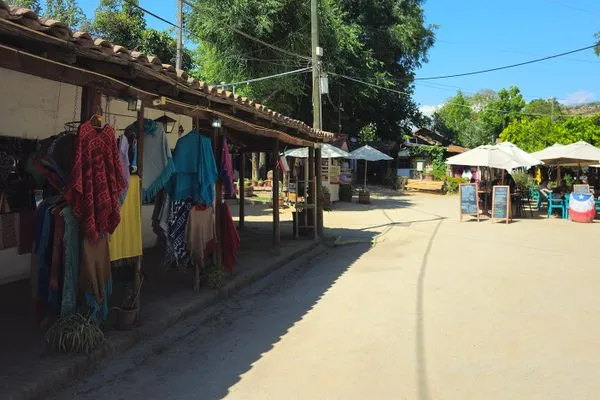
Walk into Centro Artesanal Los Dominicos on a Saturday afternoon and you're stepping into a pocket of Santiago that feels deliberately removed from the surrounding metropolis. The complex of low, earth-toned buildings clustered around a centuries-old church creates the kind of space where time moves differently — where someone might spend two hours browsing alpaca wool blankets and lapis lazuli jewelry without checking their phone.
But this isn't a theme park recreation. The history here is genuine, layered across five centuries.
The story begins in 1541, when Santiago was founded. The eastern lowlands near the city center were rural then, used mostly for farming. The area now called Los Dominicos was part of an encomienda — a land grant given to wealthy families. For centuries, it remained agricultural, unremarkable except to the people who worked it.
We're a new kind of news feed.
Regular news is designed to drain you. We're a non-profit built to restore you. Every story we publish is scored for impact, progress, and hope.
Start Your News DetoxIn 1803, the last owner of the encomienda was an Irish immigrant named Don Juan Cranisbro (originally Gainsborough). He did something unexpected: he donated the land and his house to the Dominican Order, along with a chapel he'd built in memory of his two children. The priests arrived and expanded what they'd inherited, eventually creating the Iglesia de San Vicente Ferrer (Church of Saint Vincent Ferrer). During the Chilean War of Independence and the Civil War of 1891, the church became a hiding place — a quiet sanctuary in times of upheaval.

By the 20th century, Santiago had grown around Los Dominicos. The rural margins became urban center. Facing this transformation, landscaper and architect Gonzalo Beltrán Repetto proposed something to preserve the area's character: an artisanal crafts market. Between 1979 and 1983, workers built the Pueblita Los Dominicos using mud, straw, and traditional building techniques — deliberately choosing methods that connected the new market to the old place it occupied. In 1983, the church was officially recognized as a historical monument, and the surrounding area was designated a historical zone.
Today, the Centro Artesanal Los Dominicos operates under the Las Condes Municipality's Cultural Corporation. It's become one of Santiago's most reliable places to find genuine artisanal work: copper wares, pottery, lapis lazuli from Chile's northern mines, alpaca wool clothing. Beyond the shops, there are cafés, galleries, an exhibition hall, a theatre, and a wax museum. The whole thing — the low buildings with their traditional construction, the church anchoring the space — creates what locals and visitors describe as a feeling of stepping out of the modern city entirely.
What makes this work is that it wasn't imposed from above as a heritage attraction. It grew from a real question: how do you let a place keep its character when the world around it changes completely. The answer, it turned out, was to let people make things there — to give artisans a place to work and sell, and to let visitors come find them. The history stays alive because it's still being used.