In 1778, a five-year-old girl named Frances Slocum was captured by Delaware Indians from her home in Wilkes-Barre, Pennsylvania. She was taken west into what would become Ohio and Indiana — a displacement that could have ended in erasure. Instead, it became a story about the power of choosing who you become.
Frances was adopted into Delaware culture, then married a Delaware man who treated her poorly. After leaving him, she encountered Shepocanah, a Miami warrior recovering from battle wounds. Her father gave both Frances and her mother to him as a gesture of respect. She married Shepocanah and received a new name: Maconaquah. She lived along the Mississinewa River near present-day Peru, Indiana, raising four children and building a life that was entirely her own.
For nearly 60 years, no one from her birth family knew what had happened to her. Then, in 1835, a traveler passing through the region spoke with an older woman who revealed she had been born white, a Quaker child from Pennsylvania named Slocum. The traveler's letter eventually reached her brother Joseph in Lancaster. In September 1837, Joseph arrived with two siblings and interpreters to find the sister they had lost. They didn't recognize her face — she had lived nearly her entire adult life as someone else — but they identified her by a damaged forefinger, an injury from childhood.
We're a new kind of news feed.
Regular news is designed to drain you. We're a non-profit built to restore you. Every story we publish is scored for impact, progress, and hope.
Start Your News DetoxThey asked her to come home. She refused. Maconaquah chose to remain with her daughters and grandchildren, in the life and identity she had built. She died in Deaf Man's Village in 1847, ten years after that reunion.
A Place Remembered
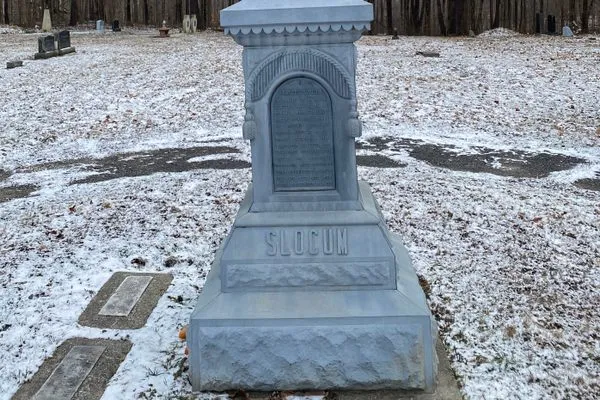
When the Army Corps of Engineers built the Mississinewa Reservoir in 1965, they relocated 80 graves and an entire town — Somerset — to make room for the water. Maconaquah's grave was moved with them. Today, the Slocum Cemetery in Wabash, Indiana marks where she and her family now rest, though not where they were originally buried.
Her story didn't disappear with the rising water. Schools, parks, and trails across Indiana and Pennsylvania bear her names — both of them. Frances Slocum State Park in Wyoming, Pennsylvania. Maconaquah High School in Bunker Hill, Indiana. The memorials honor both the girl she was born and the woman she chose to become. History tends to remember her as Frances Slocum, the white child taken by Indians. But the more complete truth is quieter: she was Maconaquah, who decided that the life she had built was worth keeping.