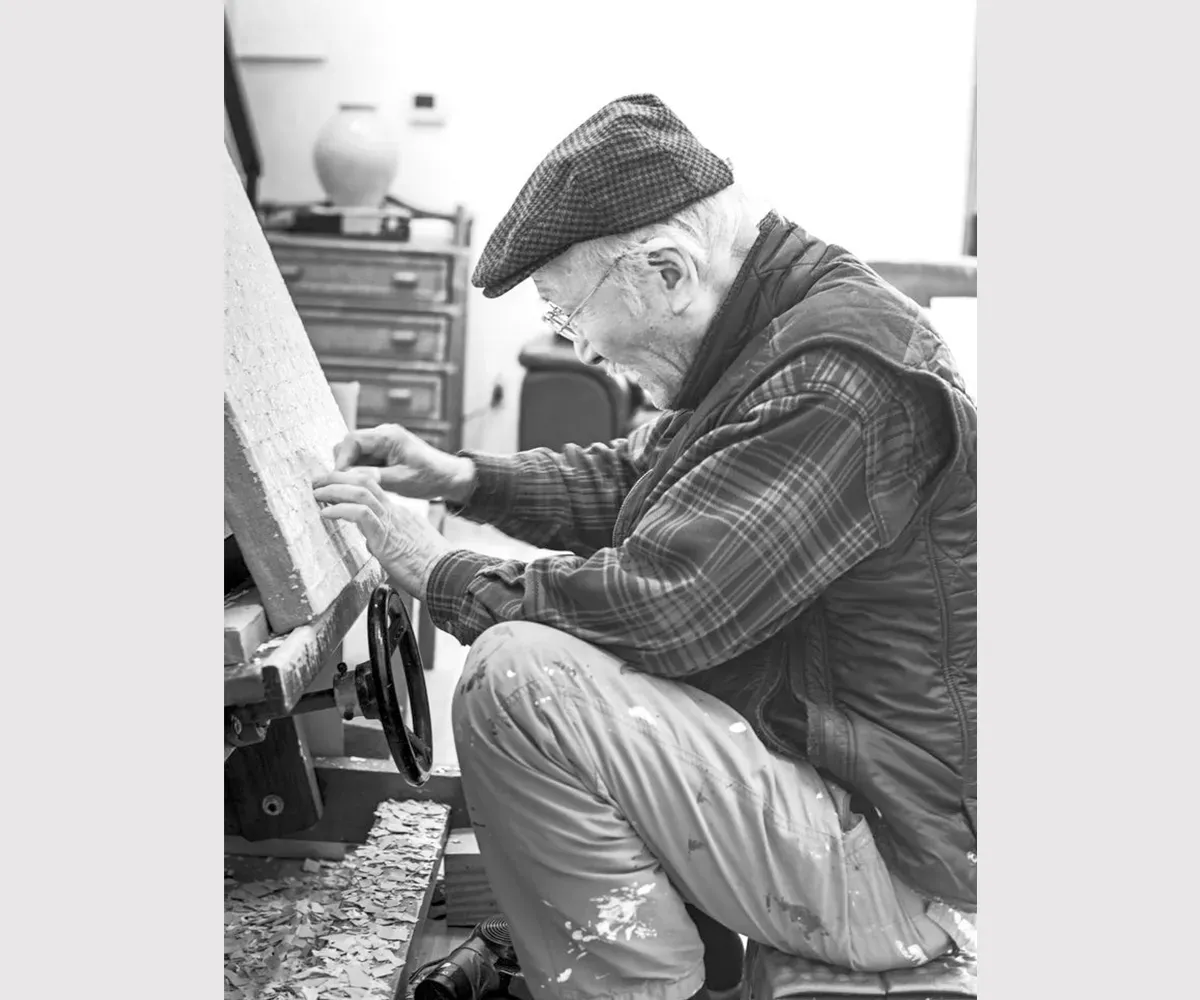
Chung Sang-hwa, one of the defining voices of Korean modern art, died on January 28 after a prolonged illness. He was 93. His death marks the end of a seven-decade creative practice that quietly reshaped how the world understood abstraction.
Chung became central to Dansaekhwa—a movement of monochrome painting that emerged in mid-1970s Korea and only recently found serious Western attention. The movement grew from Korea's earlier Informel tradition of the 1950s and 60s, but where Informel was expressive and gestural, Dansaekhwa was meditative and process-driven. Repetitive gestures, labor-intensive techniques, a restrained palette—these weren't shortcuts. They were the point.
Chung's mature work embodied this philosophy entirely. He would apply paint layer upon layer, fold the canvas, peel it back, fold again. A single painting could take six months, sometimes a year. He worked alone, refusing assistants, treating each piece as a record of time itself passing through his hands. The result was a surface marked by broken grids and subtle variations—paintings that looked minimal from across the room but revealed their complexity the closer you stood.
We're a new kind of news feed.
Regular news is designed to drain you. We're a non-profit built to restore you. Every story we publish is scored for impact, progress, and hope.
Start Your News Detox"Performing the same action over and over again to the point of absurdity, that's what defines my work," he said during a 2023 solo exhibition at Gallery Hyundai in Seoul, still creating in his early 90s.
Born in 1932 during Japanese colonial rule, Chung studied at Seoul National University starting in 1953, just after the Korean War ended. His early abstractions absorbed the gestural language of Informel. But in 1969, after moving to Kobe, Japan, something shifted. He began thinking of painting not as expression but as evidence—a trace of time, process, and repetition. By the late 1970s, after moving to Paris following his wife's death, he had developed the monochrome gridded canvases that would define his legacy.
He returned to Korea in 1992 and worked steadily until his final illness. Major retrospectives at the Musée d'art moderne et d'art contemporain de Saint-Étienne in 2011 and the National Museum of Modern and Contemporary Art, Korea, in 2021 cemented his influence on a generation of artists exploring abstraction's quieter possibilities.
Chung's death closes a chapter in Korean modernism, but his work—those layered, folded surfaces that capture time made visible—remains.