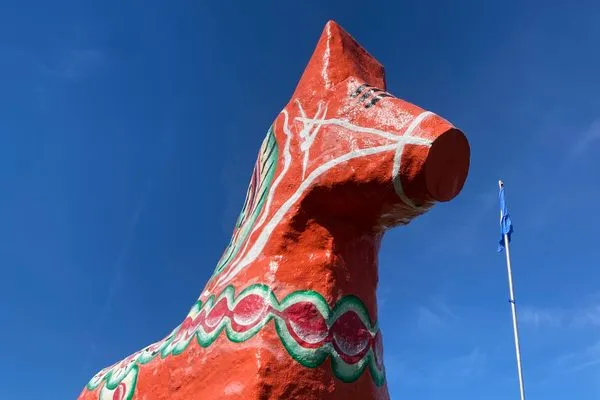
In 1971, the Mora Jaycees decided their small Minnesota town needed a monument to its roots. They built a Dala horse—that instantly recognizable Swedish symbol, painted in red and blue—and made it enormous: 22 feet tall, 17 feet long, weighing 3,000 pounds.
Mora, Minnesota, was named after Mora, Sweden, and the two towns have been sister cities for decades. The horse was meant as a mirror to the one in Sweden's Mora, a way of saying: we came from there, we built something here, and we're not forgetting where we come from. It arrived 18 years before the world's largest Dala horse would be built in Avesta, Sweden—so for a brief moment in the 1980s, Minnesota held the record.
The town itself makes sense as the home for this monument. Minnesota has more Swedish immigrants per capita than any other U.S. state. Walk through Mora and you'll feel it in the names on storefronts, the food in local restaurants, the way winter is treated not as something to endure but as a season to celebrate. Every February, the town hosts the Vasaloppet U.S. ski races, another Swedish tradition transplanted and thriving.
We're a new kind of news feed.
Regular news is designed to drain you. We're a non-profit built to restore you. Every story we publish is scored for impact, progress, and hope.
Start Your News DetoxThe horse still stands on the edge of town, free to visit, with a small parking lot beside it. It's the kind of landmark that doesn't announce itself with fanfare—no admission fee, no gift shop, just a 3,000-pound reminder that culture doesn't fade when people move. It gets passed down, built into new ground, and sometimes painted on the side of a barn-sized wooden horse.
If you're driving north from Minneapolis on Highway 65, it's about 70 miles—roughly an hour and a quarter—before you'll see it.