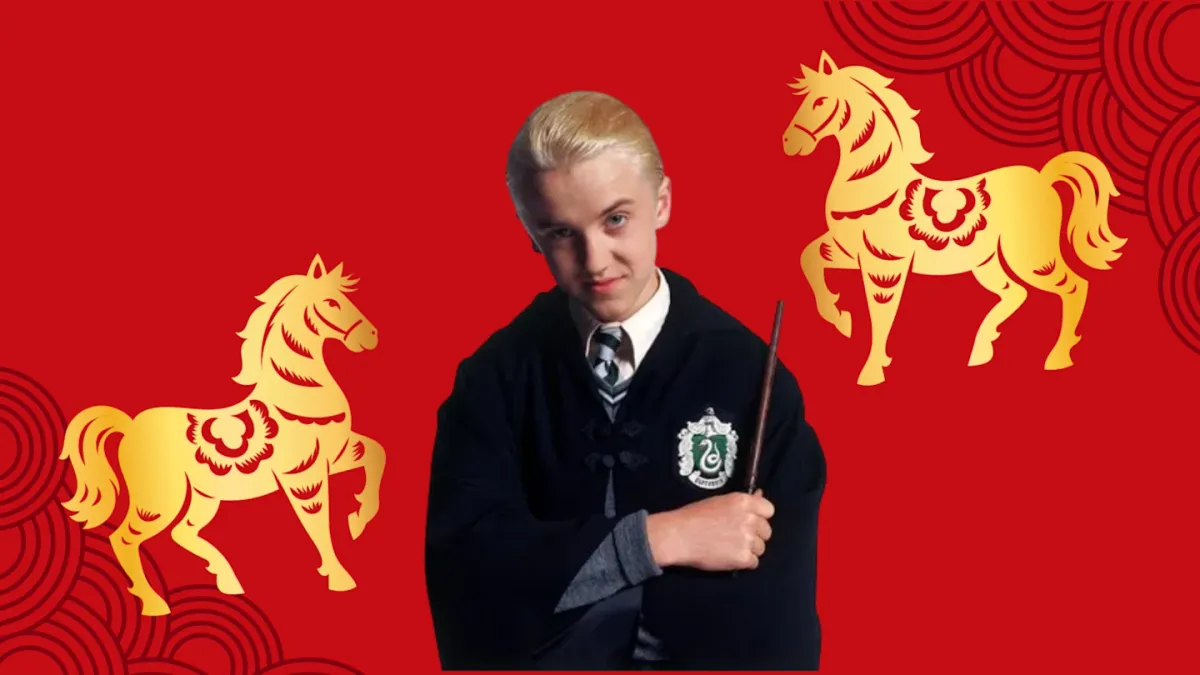
A fictional villain has unexpectedly become one of 2026's most charming Lunar New Year mascots—and it all comes down to how his name sounds in Chinese.
Draco Malfoy's Chinese name, "马尔福" (mǎ ěr fú), contains two characters that align perfectly with the zodiac calendar and New Year tradition. "马" (mǎ) means "horse"—the zodiac animal for 2026—while "福" (fú) means "fortune" or "blessing," a word that appears everywhere during Lunar New Year celebrations. Together, the name echoes "马来福" (mǎ lái fú), a celebratory phrase that welcomes good fortune. It's the kind of linguistic accident that feels almost intentional.
From Internet Joke to Household Decoration
What started as fan art and memes on Chinese social media has moved offline. Homes across China now display Draco Malfoy alongside traditional New Year imagery—on phone cases, fridge magnets, and red paper squares that usually carry lucky characters. Some follow customary practices exactly: hanging posters upside-down, for instance, because the Chinese word for "upside-down" sounds like "arriving," turning it into a visual wish for good fortune to arrive at your door.
We're a new kind of news feed.
Regular news is designed to drain you. We're a non-profit built to restore you. Every story we publish is scored for impact, progress, and hope.
Start Your News DetoxThe trend caught even Tom Felton, the British actor who plays Malfoy, off guard. He reposted fan content on Instagram acknowledging he'd become a "symbol of #ChineseNewYear," turning an inside joke into something the actor himself had validated.
What makes this genuinely interesting isn't just the wordplay—it's how it shows culture moving fluidly across borders. A character designed as a villain in a British fantasy series has been adopted, remixed, and integrated into one of the world's oldest celebrations. The fans aren't abandoning tradition; they're expanding it, finding new ways to express the same hopes for luck and prosperity that have driven these decorations for centuries. Malfoy's unlikely ascent suggests that cultural symbols can come from anywhere now, and that a good pun in translation might be all it takes to change how millions of people see a character.