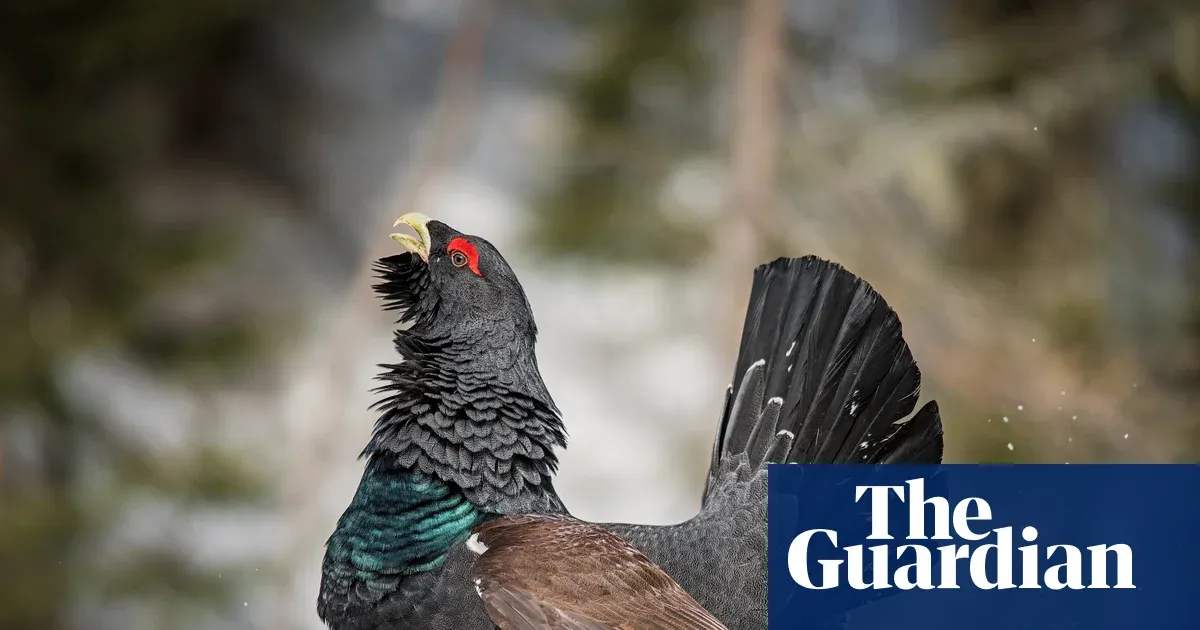
At a remote forest in the Scottish Highlands, something small but significant is happening. This spring, conservationists counted 30 male capercaillies performing their elaborate courtship displays—up from 20 just five years ago. For a bird that nearly vanished, this 50% jump matters.
The capercaillie, a black and red grouse found nowhere else in Britain, has been in freefall for decades. There were over 20,000 in the 1970s. By 2020, only 532 remained in the wild—the lowest count since surveys began more than 30 years ago. At RSPB Abernethy, the reserve now holds more than 20% of the 143 lekking males recorded across Scotland in 2025's national count.
The bird's collapse came from multiple directions at once: wetter springs that killed eggs and chicks, loss of forest habitat, predation, collisions with deer fences, and even the unintended consequence of social media—crowds gathering to photograph the birds at their spring "leks" (Old Norse for play), where males perform spectacular flutter jumps and make popping, clicking sounds to attract females.
We're a new kind of news feed.
Regular news is designed to drain you. We're a non-profit built to restore you. Every story we publish is scored for impact, progress, and hope.
Start Your News DetoxWhat's Actually Working
At Abernethy, the recovery isn't accidental. Conservationists have been methodical. They've deployed remote-controlled mowers to clear dominant heather from steep, inaccessible terrain, letting blaeberry—a crucial food source—flourish. The mowing also creates bare patches where chicks can dry off and warm up after rain, a small detail that turns out to matter for survival.
They've also fitted virtual fence collars on cattle, allowing targeted grazing in areas where physical fences would either be impossible to build or would pose collision risks to flying birds. It's the kind of low-tech, high-thought intervention that works because it addresses the actual problem rather than imposing a one-size-fits-all solution.
Richard Mason, conservation manager at RSPB Abernethy, describes the shift plainly: "The combination of cutting and extensive cattle grazing has dramatically improved conditions in the forest. We are seeing many chicks reaching full size."
Other forests are showing similar movement. Strathspey recorded increases in male capercaillies in 2023. The trajectory is still fragile—low genetic diversity in the surviving population remains a concern, and the future remains genuinely uncertain. But for the first time in a generation, the direction is up rather than down.
The work now spreads beyond Abernethy. Across all capercaillie sites in Scotland, the same principles are being tested: restore the native pinewood forests, and the birds follow. It's a slow recovery, measured in tens rather than thousands. But after decades of watching a species slip toward extinction, slow recovery feels like something worth noting.