

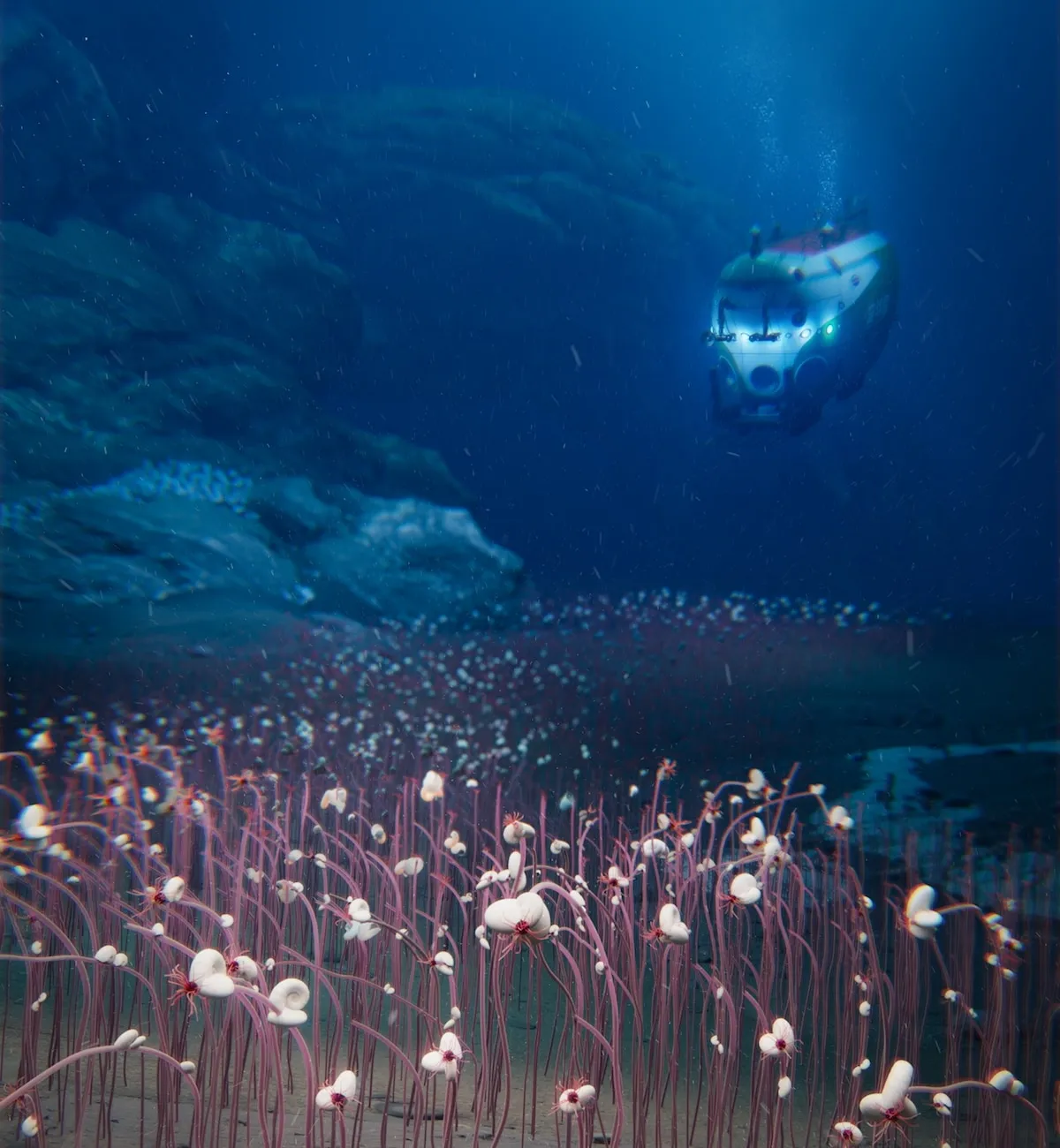
A Chinese submersible has discovered thousands of mollusks and worms living in near-total darkness at the bottom of the Mariana Trench—almost six miles below sea level. It's the deepest animal community ever documented, and it suggests that life in Earth's most extreme environments may be far more abundant than scientists thought.
The Fendouzhe submersible made 23 dives into the western Pacific trench last year, capturing video of fields of tubeworms stretching a foot long, mounds of clams, and creatures most of us have never seen: spiky crustaceans, sea lilies, sea cucumbers, free-floating worms. The colonies span roughly 1,553 miles across depths ranging from 3.6 to nearly 6 miles down—a scale that caught even the research team off guard.
"What makes our discovery groundbreaking is not just its greater depth – it's the astonishing abundance and diversity of chemosynthetic life we observed," said Mengran Du, a marine geochemist with China's Institute of Deep-sea Science and Engineering. "Unlike isolated pockets of organisms, this community thrives like a vibrant oasis in the vast desert of the deep sea."
We're a new kind of news feed.
Regular news is designed to drain you. We're a non-profit built to restore you. Every story we publish is scored for impact, progress, and hope.
Start Your News DetoxHow life survives in the abyss
At depths where no sunlight penetrates, these creatures don't eat the way surface animals do. Instead, they've evolved to live off chemicals. Hydrogen sulfide and methane seep through cracks in the ocean floor, and microbes convert these compounds into energy through chemosynthesis—the deep-sea equivalent of photosynthesis. The tubeworms cluster around snow-like microbial mats, essentially farming the bacteria that sustain them.
This wasn't a chance discovery. Scientists have long suspected that hadal trenches—the deepest underwater valleys on Earth—harbored these kinds of communities. But actually finding them, mapping them, and documenting their scale has remained exceptionally rare until now. The research, published in Nature, provides the first solid evidence that chemosynthetic oases aren't scattered anomalies but potentially widespread features of the deep ocean.
"Given geological similarities with other hadal trenches, such chemosynthesis-based communities might be more widespread than previously anticipated," said lead author Xiatong Peng. If that's true, it means the deep ocean floor may support far more life than we've accounted for—entire ecosystems operating in conditions that would kill most surface organisms within minutes.
The discovery opens a humbling reminder: we've mapped the surface of the moon more thoroughly than we've explored Earth's own ocean floor. Each dive into these trenches feels less like routine science and more like first contact with an alien world that's been here all along.





