Division was four years old when he died—young even by the grim standards now applied to North Atlantic right whales. His body washed up off North Carolina in late January, too damaged by weather and time for anything more than confirmation of what scientists already knew.
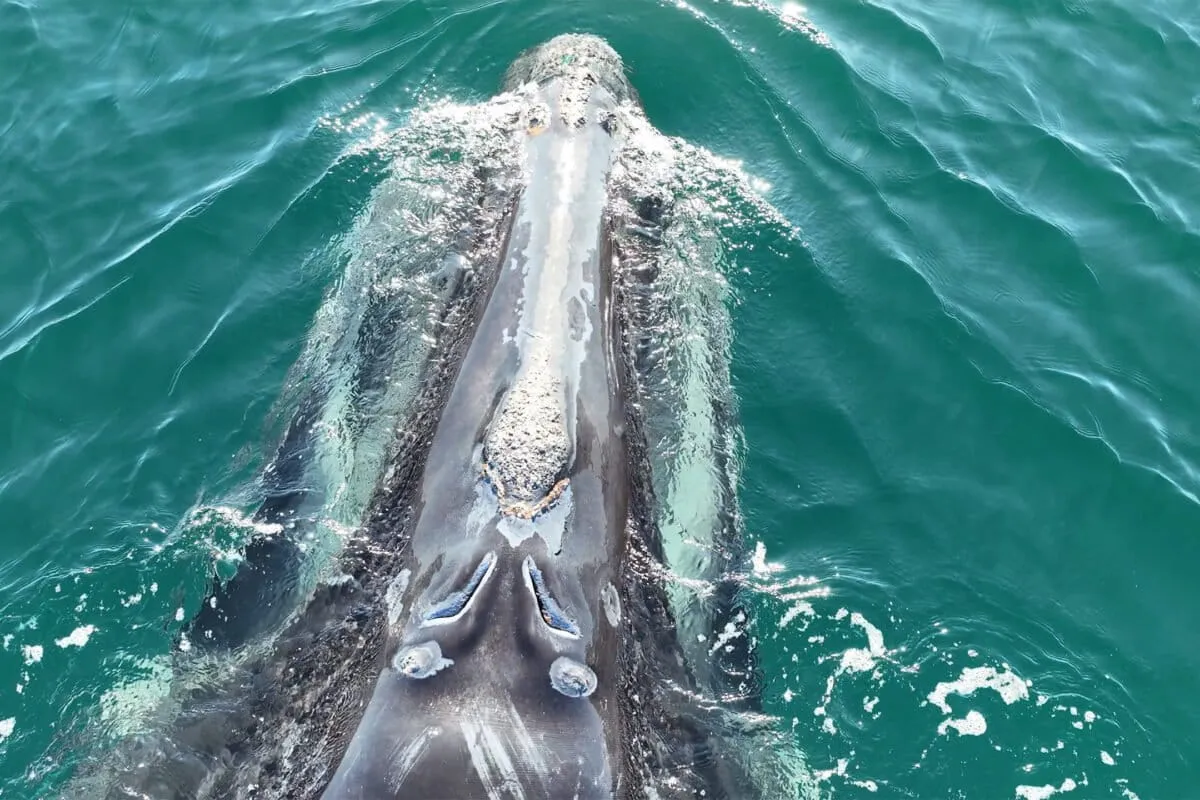
The story began in early December, when Division was first spotted entangled in fishing line. The gear wrapped tightly around his head and mouth, cutting into his blowhole and lodging in his upper jaw. Rescuers removed some of it, but enough remained. Enough to slow him down. Enough to invite infection. Enough to drain energy from a body that should have been growing.
Scientists who tracked him in those final weeks saw the markers of decline: weight loss, altered swimming patterns, the physical vocabulary of a young animal running out of time. Division had a catalog number—5217—and a name derived from the pale markings on his head, callosities arranged like a mathematical division sign. To the researchers who knew him through photographs and survey logs, he was one data point among many: 68 recorded sightings, 23 photographs, a few clinical notes about tooth decay. One image captured him leaping, most of his body briefly clear of the water.
We're a new kind of news feed.
Regular news is designed to drain you. We're a non-profit built to restore you. Every story we publish is scored for impact, progress, and hope.
Start Your News DetoxFrom first sighting to death was less than two months. From last sighting alive to recovery was six days.
Division's death is not unusual in the context of North Atlantic right whales. The population—fewer than 340 individuals—faces two primary threats: ship strikes and entanglement in fishing gear. Both are human-caused. Both are preventable. Yet they remain the leading cause of death for a species already pushed to the edge of extinction.
What makes Division's case worth dwelling on is not its rarity but its specificity. He was not a statistic in a population assessment. He was a young animal with a documented life, tracked through time, whose decline was observable and measurable. Scientists watched it happen. And they could do nothing to stop it.
The North Atlantic right whale population has been in slow decline for years, a trajectory that accelerated sharply after 2017. Entanglement events have increased. Ship strikes continue. The species' recovery—once considered possible—now feels uncertain. Some researchers worry the population may be approaching a tipping point beyond which recovery becomes mathematically impossible.
Division's final journey—from entanglement to death in the span of weeks—is a compressed version of a longer story: a species caught between the world's need for food and transportation, and its own need to survive. The question now is whether Division's death, and the deaths of others like him, will finally prompt the kind of systemic change that might alter that trajectory.