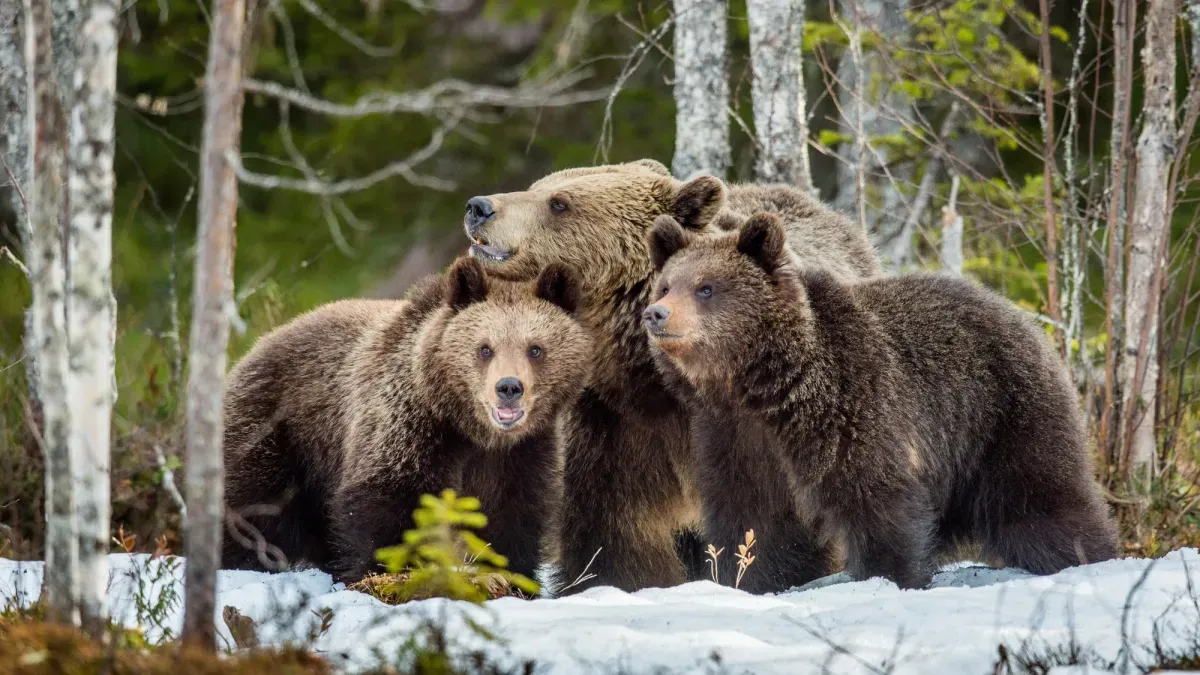
Wildlife biologists have always struggled with a deceptively simple problem: telling one bear from another. Even experts squint at photos, uncertain whether they're looking at the same individual or a different one—especially when a bear might weigh 300 pounds in autumn and half that after winter hibernation.
Now, researchers at Switzerland's EPFL and Alaska Pacific University have trained an AI system called PoseSwin to do what humans find nearly impossible. The machine learning program learned to recognize individual brown bears by studying their unchanging facial features: the angle of the brow bone, the placement of ears, the shape of the muzzle. It's the kind of detail that stays consistent across a bear's lifetime, even as their body swells and shrinks with the seasons.
The training data came from 72,000 photographs of 109 different brown bears, collected by APU researcher Beth Rosenberg over five years. But the innovation wasn't just in the volume—it was in how the researchers thought about the problem. "Our biological intuition was that head features combined with pose would be more reliable than body shape alone," explained Alexander Mathis, a researcher at EPFL's Brain Mind Institute. "The data proved us right."
We're a new kind of news feed.
Regular news is designed to drain you. We're a non-profit built to restore you. Every story we publish is scored for impact, progress, and hope.
Start Your News DetoxTracking bears without disturbing them
When the team tested PoseSwin in the field at Katmai National Park—famous for its annual Fat Bear Week—the system successfully matched photos of individual bears to those already in its database. That might sound simple, but it's transformative for conservation. Researchers can now analyze thousands of visitor photos each year and map how brown bears move through the landscape in search of seasonal food, all without tranquilizing or tagging a single animal.
Rosenberg and her colleagues are now using PoseSwin to monitor over 100 bears around McNeil River State Game Sanctuary. The ability to track individuals over time reveals crucial information about their health, movement patterns, and how they're adapting to environmental change. "Bears are at the top of the food chain and ensure the proper functioning of their ecosystem," Rosenberg noted. "They are critical to maintaining healthy systems."
The system works so well with brown bears that it's already being adapted for other species. Early tests on macaques suggest PoseSwin could eventually identify everything from mice to chimps. The researchers have released the algorithm as open-source software, meaning conservation teams worldwide can train it on their own animals—though Mathis suspects they'll find their species easier to work with. "Bears are perhaps the hardest species to recognize individually," he said.
As conservation budgets tighten and populations face mounting pressure, the ability to monitor wildlife without physical intervention could reshape how ecologists track endangered species across decades.