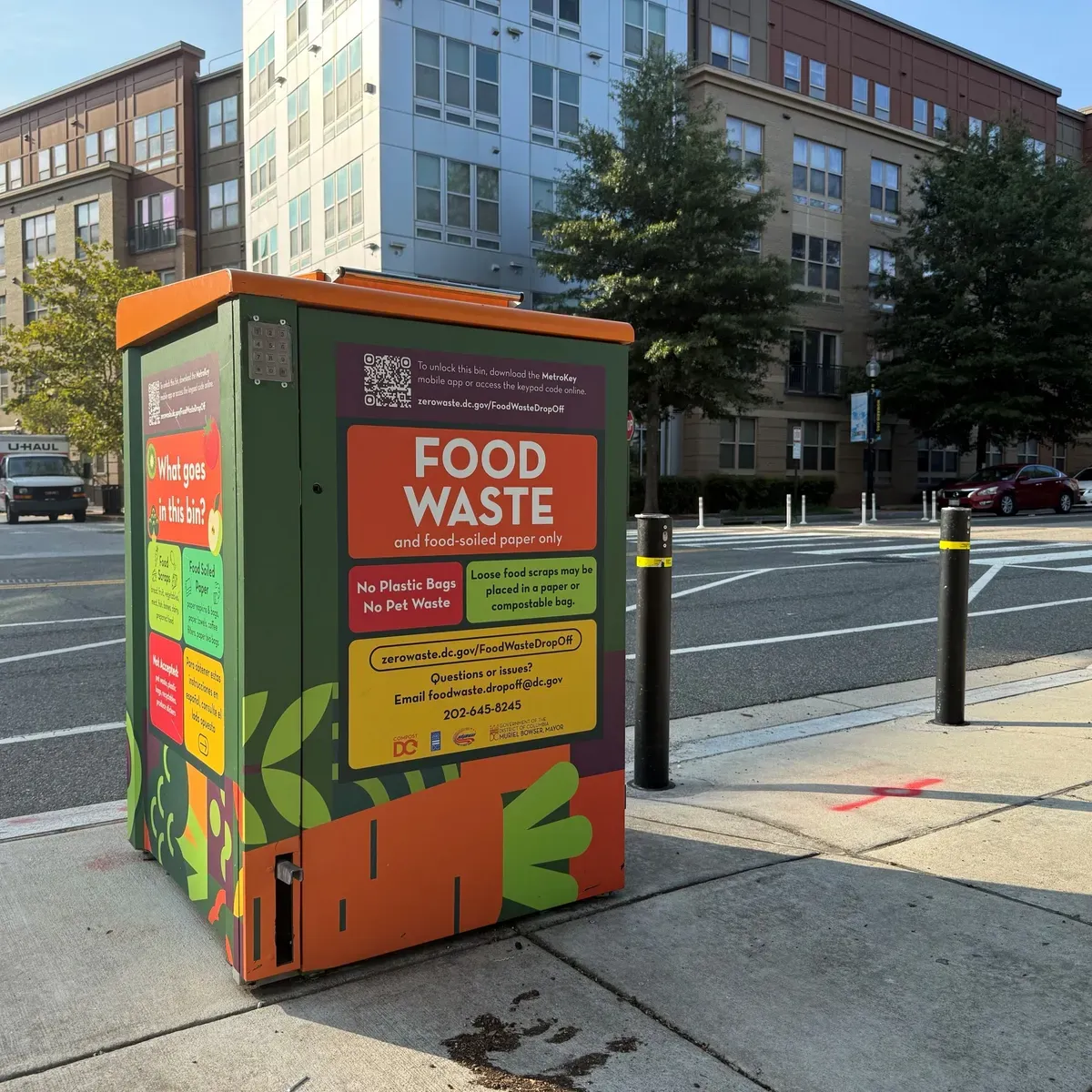
Washington, D.C., is making it even easier for its apartment dwellers to ditch their food scraps. The city's rather clever "smart bin" program, which lets residents drop off food waste 24/7, is expanding this fall with 20 new bins. That brings the grand total to 51 across the city, because apparently, even rotting vegetables deserve a high-tech home.
Since the program kicked off in 2024, D.C. residents have collectively deposited over 1 million pounds of food waste into these bins. Let that satisfying number sink in. It's all part of the city's ambitious plan to divert 80% of its waste from landfills and incinerators by 2040. Because nobody wants to live next to a mountain of last week's leftovers.
Composting, Unlocked
For those of us not blessed with a backyard compost pile, or the time to hit up a farmers market on a Saturday, these sealed smart bins are a godsend. You find one on an interactive map, punch in a key code, and voila — your wilting lettuce is off to a better place. About 10,000 residents have already signed up for access, according to John Johnson, program manager for D.C.'s Office of Waste Diversion.
We're a new kind of news feed.
Regular news is designed to drain you. We're a non-profit built to restore you. Every story we publish is scored for impact, progress, and hope.
Start Your News DetoxHe notes the goal is "equitable distribution," meaning these bins are popping up in neighborhoods where they're actually needed, not just where it's convenient. So far, the smart bins have gobbled up 10% of the 11 million pounds of food waste composted in D.C. since 2014. The actual composting is handled by Maryland Environmental Services, after Compost Crew does the heavy lifting (literally) of collecting it all. For the truly dedicated, D.C. even offers workshops and rebates for home composting gear.
But wait, there's more. D.C. is leveraging this successful system to tackle other household headaches. They've started a pilot program at eight farmers market drop-off sites where you can now offload used batteries. Because apparently, once you get people in the habit of responsibly disposing of their banana peels, they're ready to tackle the slightly more hazardous stuff.
The city's updated 2024 zero waste plan aims to slash the citywide solid waste stream by 18% and cut greenhouse gas emissions by a cool 1.38 million metric tons of carbon dioxide equivalent. Most of D.C.'s trash currently takes a scenic route to a waste-to-energy facility in Virginia. But the future looks greener.
Anthony Crispino, Director of D.C. Department of Public Works, says they're rebuilding the Benning Road transfer station (which, sadly, was decommissioned after a fire) into a "new green facility." This means more capacity for composting, recycling, and pretty much anything else residents want to drop off as the city's population continues to swell. Because clearly, D.C. wants to be known for its monuments, not its landfills.