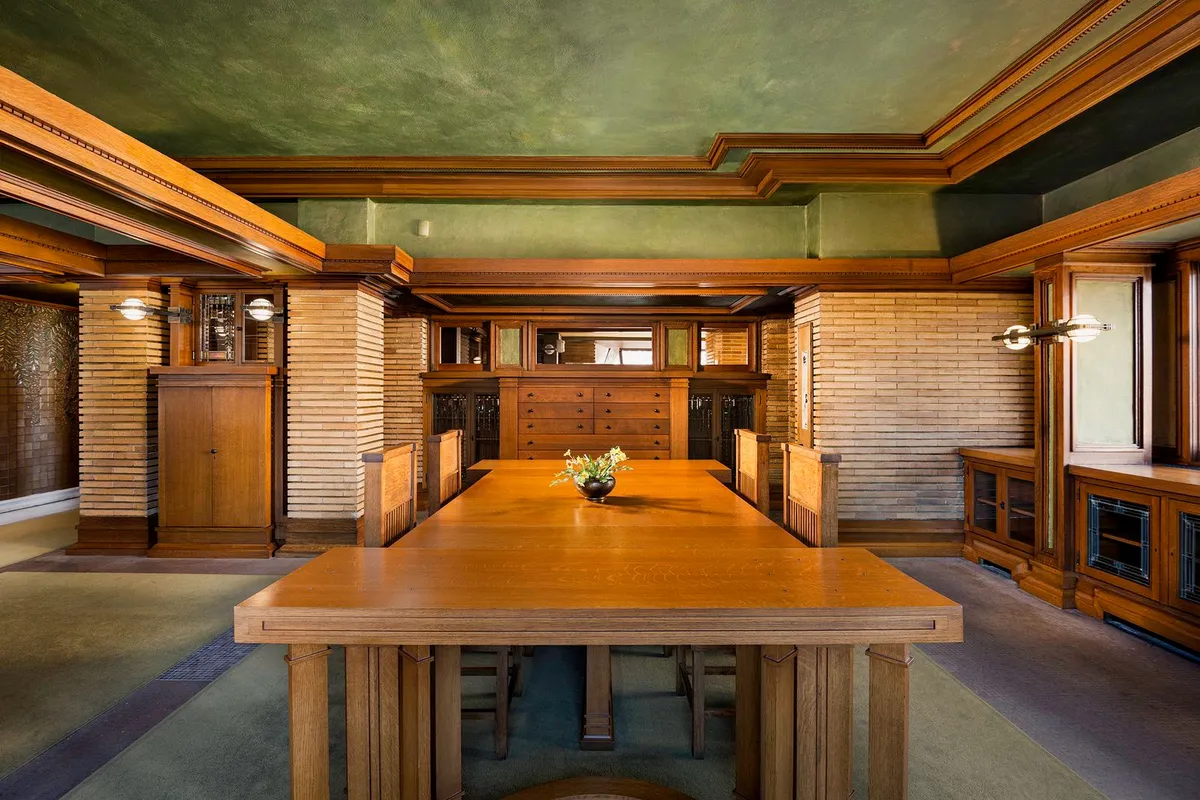
When Frank Lloyd Wright designed the Martin House in Buffalo, New York, he imagined more than just its structure. He also created the home's interior, including furniture, artworks, and decorative glass. Wright called his Prairie-style design a "domestic symphony."
The house was finished in 1905. Over time, it fell into disrepair, and many unique items were sold off. Now, after a major restoration, many of these original pieces have returned to the Martin House, which is now a museum. A new exhibit, "Collecting Ourselves—The Objects of Martin House," shows how these items were found and brought back.
Jessie Fisher, the executive director of the Martin House, explained that the exhibit shares the full story of how these objects left the house. It also details how they were tracked down and returned through ethical practices, care, and teamwork. Fisher noted that the exhibition is as much about careful management as it is about architecture.
We're a new kind of news feed.
Regular news is designed to drain you. We're a non-profit built to restore you. Every story we publish is scored for impact, progress, and hope.
Start Your News DetoxBringing the Vision Back to Life
The exhibit features original furnishings like a dining room table support, a Tiffany & Co. floor lamp, and a table and chairs designed by Wright. It also includes old letters, drawings, and other documents that show Wright's detailed plans for the furniture and interiors.
Some original Martin House furnishings are on loan from other institutions for the exhibit. They are displayed with explanations of their importance. Museum officials hope to give visitors a behind-the-scenes look at the research that made the restoration possible.
Susana Tejada, the Martin House's curator, told Artnet that restoration is not just about the building itself. Wright believed that everything in the house was part of the design, but often the objects are not the main focus of restoration stories. She added that they are recreating Wright's entire vision by putting the building pieces together and bringing the objects back into the story.
Wright, born in Wisconsin in 1867, was a leader of the Prairie style. This style is known for horizontal lines, open layouts, and a connection to nature. In the early 1900s, Buffalo businessman Darwin D. Martin asked Wright to design his company's new office and a home for his family.
The house is nearly 15,000 square feet and has an open floor plan with few walls. Its interior is centered around a fireplace and decorated with custom art glass. A walkway connects the house to a conservatory filled with rare plants and a replica of the Winged Victory of Samothrace. The museum states that none of Wright's Prairie houses were as carefully detailed as the Martin House.
Fisher noted in 2025 that the Martin House is one of Frank Lloyd Wright's most famous designs. People interested in architecture and modern design come from all over the world to see it.
The Martin House estate covers 1.5 acres. Besides the main house and conservatory, it includes the smaller Barton House (for Martin's sister), a carriage house, and a gardener's cottage.
The Long Road to Restoration
In 1967, the University at Buffalo bought the estate and began some restoration work. Decades later, the Martin House Restoration Corporation was formed. This nonprofit was a partnership between the university and New York State's Office of Parks, Recreation and Historic Preservation. The restoration that followed took many years and cost $52 million.
Caption: The rebuilt conservatory features a replica of the Winged Victory of Samothrace. Matthew Digati
Bringing back the Martin House's interior furnishings involved curators, scholars, archivists, collectors, and other institutions. Tejada explained that these groups were dedicated to seeing the place restored. Some objects have traveled from as far as Australia and Scotland. Items continue to return to the house, including three art glass windows recently reinstalled in the master bedroom.
Tejada stated that They continue to collect, care for, and share it, making it part of the community's history for everyone.
The exhibition "Collecting Ourselves—The Objects of Martin House" will be open at the Martin House in Buffalo, New York, from March 27 to September 7, 2026.
Deep Dive & References
Collecting Ourselves—The Objects of Martin House - Martin House, 2026