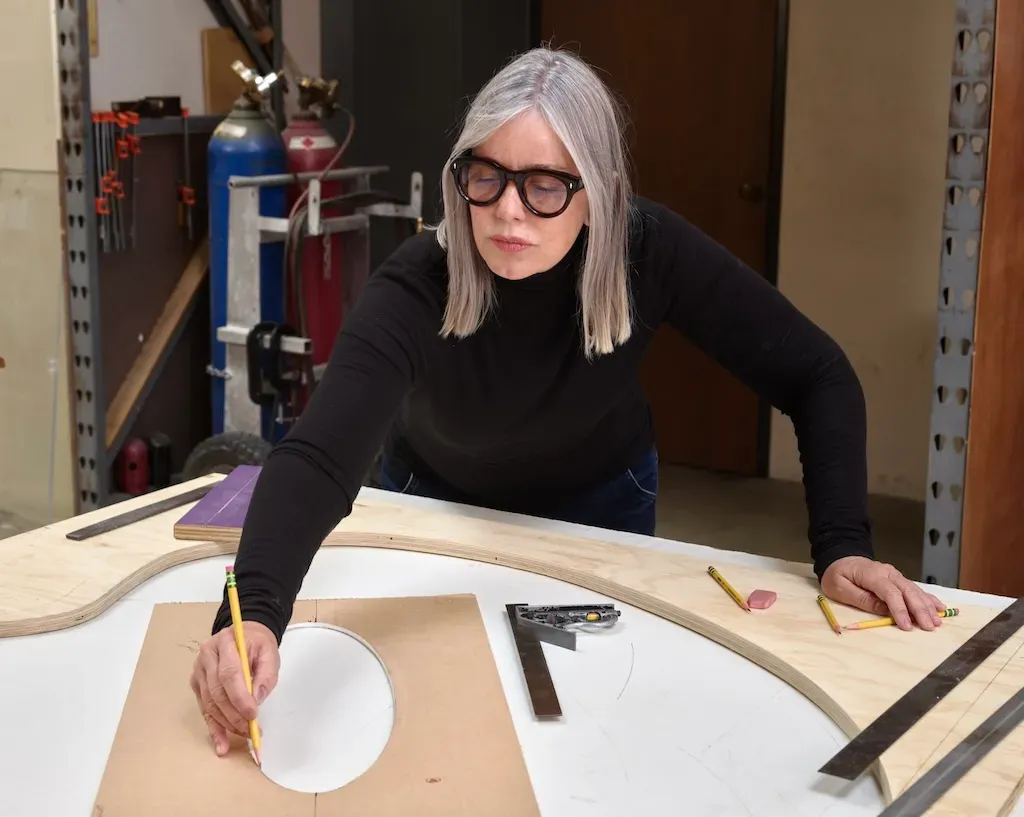
Gisela Colón didn't set out to be an artist. She went to law school, which, given a childhood marked by instability in Puerto Rico, felt like a sensible move. You know, for protection. Art was something her mother taught her, a side hustle to environmental law and raising two sons in California.
Then the kids went to college. And just like that, nearly four decades later, Colón is back. Not just to art, but to Puerto Rico itself, with two major solo exhibitions opening simultaneously. "Radiant Earth" is at the Bruce Museum, and "The Mountain, The Monolith" is at the Museo de Arte Contemporáneo de Puerto Rico. Talk about a homecoming.
Her work, which has graced everything from Desert X AlUla to the foot of the Pyramids of Giza, is now gracing the island that shaped her. Her pieces are in collections like the Los Angeles County Museum of Art, and she's represented by Walter Otero. Not bad for someone who initially chose stability over sculpture.
We're a new kind of news feed.
Regular news is designed to drain you. We're a non-profit built to restore you. Every story we publish is scored for impact, progress, and hope.
Start Your News DetoxThe Geology of Genius
Colón calls her style "organic minimalism," which is a pretty apt description for sculptures that look like they could have been formed by geological forces or perhaps grown in a petri dish. At the Bruce Museum, you'll find her wall-mounted "pods" – cell-like forms that blur the line between design and biology. Then there are the monoliths: tall, sleek, and seemingly simple, until the natural light starts playing across their surfaces, shifting their colors like a mood ring for the gallery.
Margarita Karasoulas, a curator at the Bruce, described the monoliths as a "magical experience." Which, if you think about it, is both impressive and slightly terrifying. Imagine art so compelling it makes people stop and stare without even realizing it. The secret, according to co-curator Danielle O’Steen, is Colón's use of aerospace-grade plastics and engineered pigments. Because apparently, that's where we are now: art made with space-age materials that look like they've been pulled from the earth.
These pieces, while appearing machine-perfect, are meticulously handcrafted. Each layer, each pigment, is linked to a specific place. Some monoliths at the Bruce reference Puerto Rican rivers, caves, and coastlines. Around them, stones from the California desert—near Colón's studio—create a miniature landscape, a little piece of the world brought indoors.
Colón feels such a deep connection to her work, she half-jokes, "I feel like in the past life I was a rock. I was a piece of basalt. I was a mountain. You know, mountains are inside me."
The Volcano Within
That rock-solid connection goes back to her childhood, splitting time between San Juan and Bayamón. Her father, a chemist, and her mother, a painter, taught her about the elements and color. She remembers peeling bark from eucalyptus trees on her grandfather’s farm, watching the layers reveal themselves, then heal. "That was an early lesson," she says, "in how nature transforms."
This lesson in transformation is literally woven into her art. Pigments reference landscapes; forms echo caves and mountains. Her exhibition in San Juan is a full-circle moment, placing her work back into the very landscape that inspired it, among the mineral formations of El Yunque rainforest and the caves of Camuy.
Puerto Rico, Colón notes, is finally getting the cultural attention it deserves, thanks in part to figures like Bad Bunny. But, as she dryly observes, "we’ve always been here." She rattles off names: Roberto Clemente, Rita Moreno, Raúl Juliá, Ricky Martin. A small island, just over 100 miles long, yet it produces an outsized amount of talent.
"How does that happen?" she asks. Her answer is simple, and profound: "Puerto Rico, the actual island, is made of the remains of a sunken volcano that erupted millions of years ago. It’s a lovely metaphor because, sometimes I feel like we’re all about to erupt. People just see just a little bit, only what’s on the surface, but underneath there has always been mountain of energy."
This volcanic energy is palpable in her art. The monoliths look like they've formed over eons, not in a studio. The pods suggest slow, continuous growth. And her newest paintings, incorporating meteorite dust and volcanic material, literally bring the earth and sky together on a single surface. Colón left Puerto Rico thinking she had to, only to realize it was always the bedrock beneath her feet.