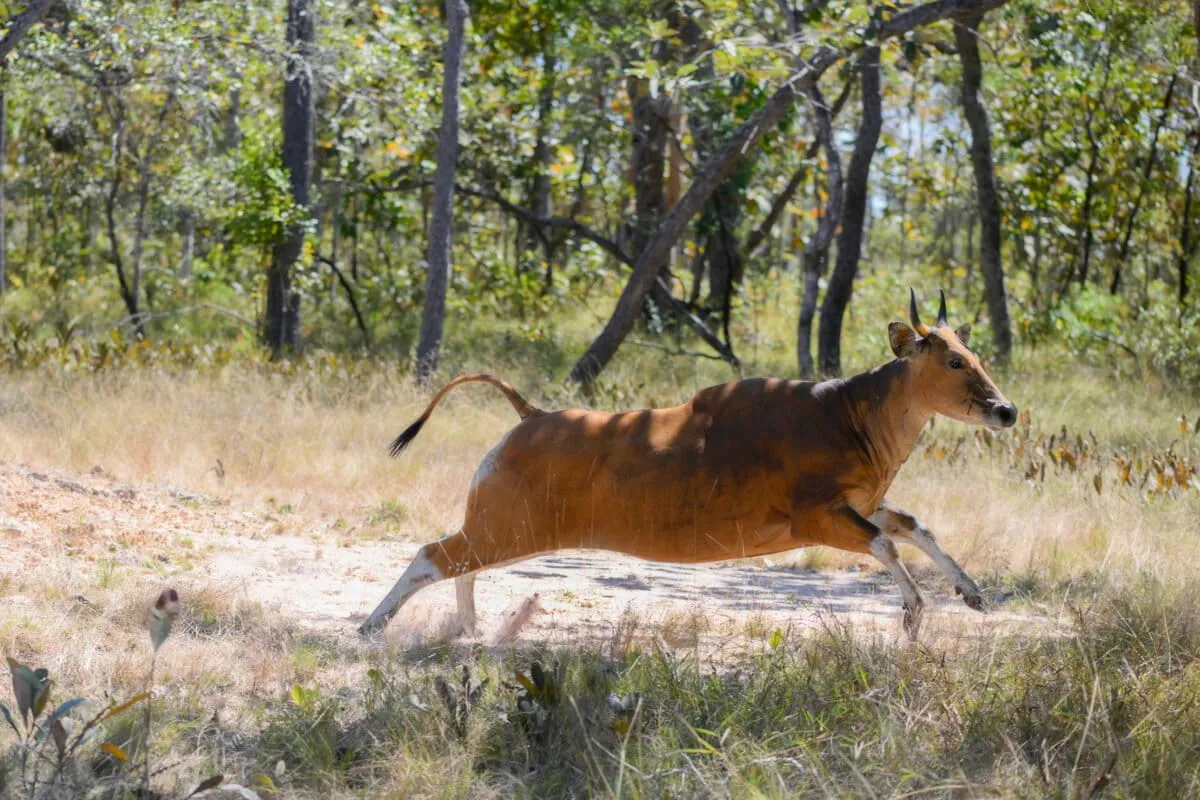
Earlier this month, a team of conservationists airlifted 16 critically endangered banteng—wild cattle with striking white legs and russet coats—into Siem Pang Wildlife Sanctuary in northeast Cambodia. The operation was straightforward in concept but urgent in purpose: move them from an unprotected forest about to be converted to farmland, into a reserve where they might actually survive.
This was the second rescue in a year-long effort led by Rising Phoenix, a Cambodia-based social enterprise working with local wildlife authorities. Combined with a first translocation in May 2025, the sanctuary now holds 32 banteng, including breeding-age adults and calves. For a species that has collapsed to fewer than 8,000 individuals globally, 32 in one protected location is meaningful.
Banteng used to roam across Southeast Asia. Cambodia's dry dipterocarp forests once held a significant chunk of the global population. But decades of deforestation and hunting—for meat, horns, and hides—fragmented what remained into scattered, isolated groups. Today, the species survives in a handful of forest patches, each one precarious.
We're a new kind of news feed.
Regular news is designed to drain you. We're a non-profit built to restore you. Every story we publish is scored for impact, progress, and hope.
Start Your News Detox"The population is going to grow quickly, I'm sure," said Romain Legrand, biodiversity research and monitoring manager with Rising Phoenix. The confidence isn't unfounded. Siem Pang offers what the banteng's former homes no longer do: law enforcement against poaching, stable habitat, and space to breed.
What makes this translocation matter is the specificity of the problem it addresses. Banteng aren't like tigers or elephants—they haven't captured global conservation funding or public imagination. They're scattered, they're small in number, and they're easy to overlook. But they're also a barometer for the health of Southeast Asian forests. If the banteng population in Siem Pang grows as conservationists expect, it signals that protected areas—when properly managed—can actually work.
The next phase is straightforward but demanding: monitoring. Conservationists will track breeding success, juvenile survival, and whether the herd adapts to its new home. If it does, Siem Pang could become a model for consolidating Cambodia's scattered banteng populations into secure, growing herds.