A new exhibition in Philadelphia is pulling Shaker objects and values out of history museums and into conversation with contemporary artists. "The Shakers: A World in the Making" at the Institute of Contemporary Art isn't just displaying historic brooms and oval boxes—it's asking what we can learn from a religious community that believed everyday objects could be sacred.
The Shakers emerged in the late 18th century, founded by an Englishwoman named Ann Lee who emigrated to America with followers committed to shared living and celibacy. By the 19th century, they'd grown to between 4,000 and 6,000 members across multiple communities. Their core belief was simple: if you're making something, make it perfect. Not for profit or prestige, but because the act of crafting with care was itself a form of devotion. A broom wasn't just a broom. It was an expression of their vision of heaven on earth.

The art world has circled back to the Shakers before. In the 1930s, modernists latched onto their principle that "every force evolves a form"—a neat alignment with function-follows-form thinking. Another wave hit in the 1980s. But this exhibition is different. Rather than treating Shaker objects as historical curiosities or design precedents, it's asking what their values—craft, patience, care, attention to the material world—might offer us now, when so much feels rushed and disposable.
We're a new kind of news feed.
Regular news is designed to drain you. We're a non-profit built to restore you. Every story we publish is scored for impact, progress, and hope.
Start Your News DetoxThe show doesn't romanticize the Shakers wholesale. It acknowledges the celibacy, the gender segregation, the complicated reality that this was a community founded by immigrants claiming territory in the expanding West, drawing from Indigenous basket-making techniques while also perpetuating racial discrimination despite claims of equality. But it does center the work of those who complicate that legacy from within.
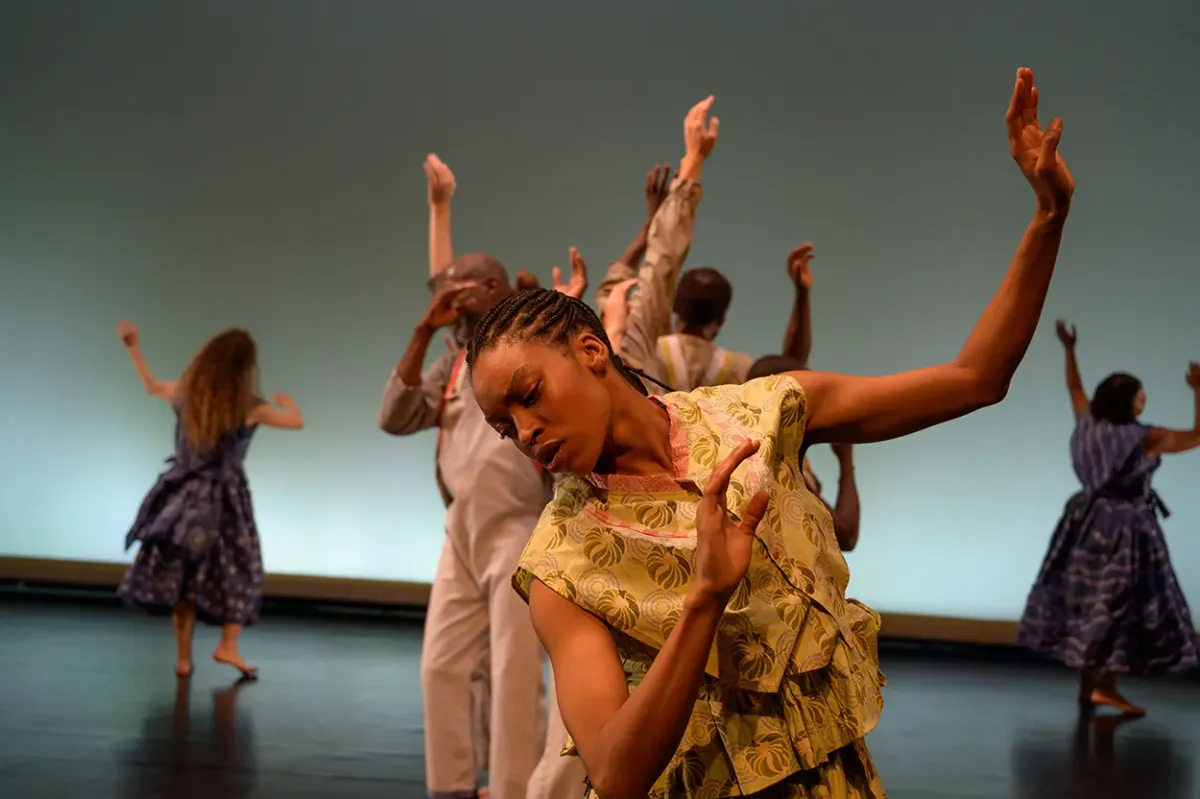
Rebecca Cox Jackson, a Black woman who founded the only urban, Black-led Shaker community in Philadelphia, becomes a crucial figure here. Her presence shapes how two contemporary artists approach the Shaker inheritance. Reggie Wilson's choreographic work reconstructs Shaker dance not as frozen form but as living movement—bodies repeating the gestures that once animated their spiritual practice. Kameelah Janan Rasheed copies glyphs from Jackson's diaries into meticulously stitched embroidery, acknowledging what gets lost in translation across time, what remains illegible.
There's something quietly radical about this. In a culture obsessed with efficiency and optimization, the Shakers offer a counternarrative: that labor itself—the patient, careful making of things—can be a form of resistance. That paying attention to materials, to craft, to the people around you isn't a luxury. It's how you build a world worth living in.
The exhibition travels to other cities through 2026. As it moves, it carries with it an old question made urgent again: what would it look like to approach our own work—whether making objects, building communities, or just getting through a day—with the kind of intention the Shakers brought to a broom.