It's a tough life for an insect these days. Habitat loss, pollution, climate change – they're all ganging up on our six-legged friends, driving about 40% of them toward extinction. But there's another, often overlooked culprit: artificial light. Those glowing streetlights and security lamps aren't just an annoyance; they're insect death traps.
Moths, beetles, flies – they're all drawn to the light like… well, like moths to a flame. They'll circle for hours, exhausting themselves, or get pulled away from crucial tasks like finding food, mating, and generally living their best bug lives. It's a real buzzkill.
The Great Light Experiment
Scientists have known for a while that not all light is created equal when it comes to bug attraction. So, researchers at Germany's Leibniz Institute decided to put some theories to the test. They set up shop at six rural railway stations, conveniently located in a German Dark Sky Reserve – basically, a super-protected area where natural darkness is the star.
We're a new kind of news feed.
Regular news is designed to drain you. We're a non-profit built to restore you. Every story we publish is scored for impact, progress, and hope.
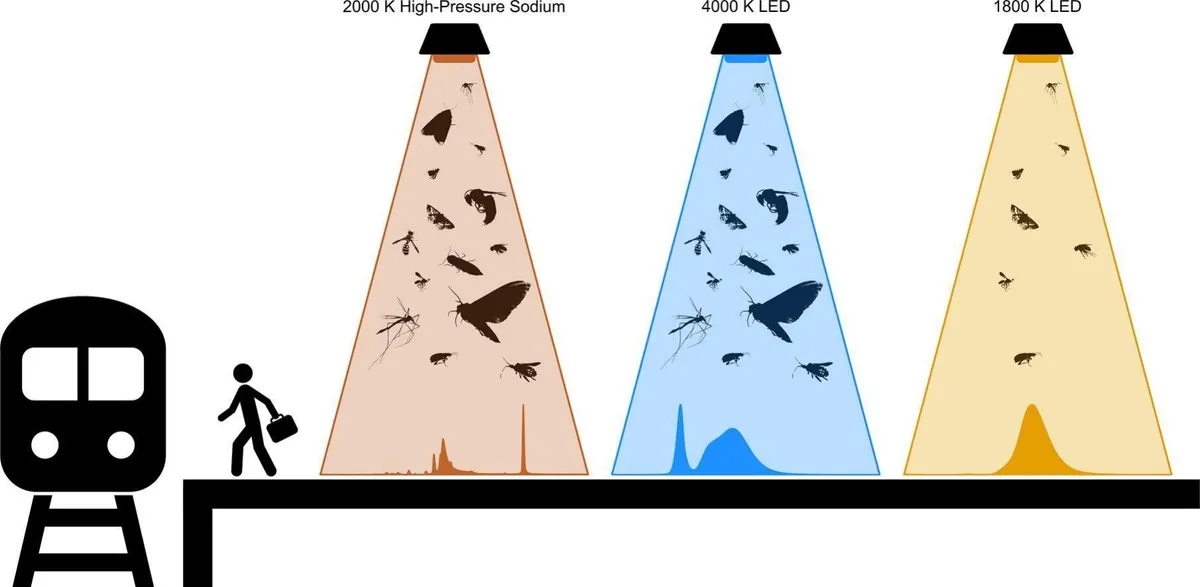
Start Your News DetoxOver 2023 and 2024, they compared three different types of commercial outdoor lights against each other, and against unlit areas (the control group, because even bugs need a baseline). Then, they got down to the nitty-gritty: counting insects, weighing them, and checking out their species diversity. Because apparently, that's where we are now.
The Unsung Hero: Amber LEDs
The results were pretty clear. The undisputed champion for insect-friendliness was the "commercially available amber 1800 K LEDs." Let that satisfyingly specific number sink in.
These warm amber lights cut the total number of insects by a whopping 39% to 51% compared to traditional high-pressure sodium lamps and cool-white LEDs. And if that's not enough, the total weight of captured insects dropped by an even more impressive 51% to 77%. Turns out, bugs aren't big fans of that cozy amber glow.
Interestingly, the study also debunked the myth that any warmer-looking light is automatically better. High-pressure sodium lamps (which look kinda warm) attracted just as many insects as the cool-white LEDs. So, specific amber, not just generally warm, is the key.
Now, to be clear, even the amber lights weren't perfect. As the scientists noted, "any light is still worse than no light." The amber LEDs still attracted more bugs than the completely unlit areas. But when you need to, you know, see where you're going on a railway platform at night, these are a significant step up.
Thanks to this research, all six railway stations in that German Dark Sky Reserve are now bathed in the warm, bug-friendlier glow of 1800 K LEDs. A small change for human eyes, a potentially huge win for the insect population. And maybe, just maybe, fewer moths dive-bombing your face on the way to the train.