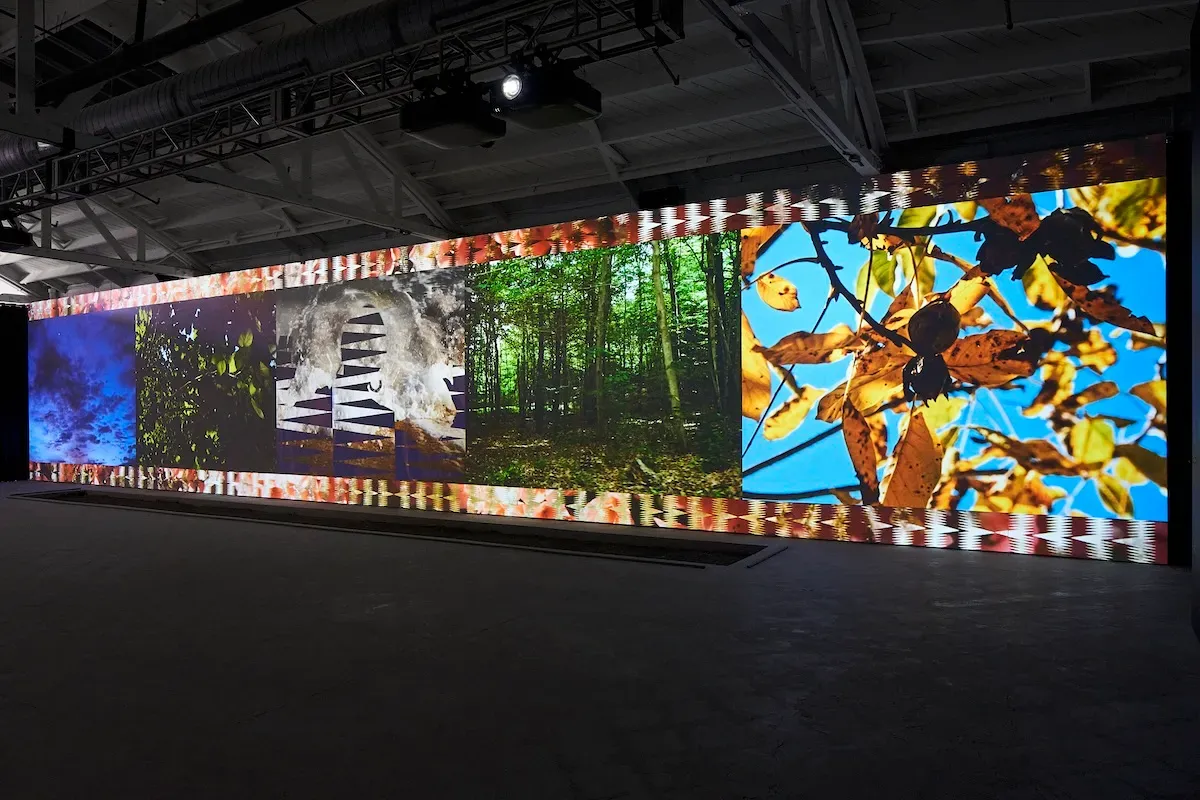
A massive vinyl mural by artist Jeffrey Gibson is wrapping an entire city block in downtown San Francisco, turning the former Bloomingdale's building at San Francisco Centre into a canvas that asks us to reconsider our relationship with the natural world.
The 433-foot installation goes live on February 2, timed with Super Bowl LX festivities. Gibson adapted the work from his 2022 video installation "THIS BURNING WORLD," which premiered at the Institute of Contemporary Art San Francisco. The new piece weaves together still images from that original work—footage captured in upstate New York and the Bay Area—into a visual meditation on what Gibson calls "the precarity of humanity's relationship to the natural world."
Gibson's conceptual framework draws from Indigenous kinship philosophies, which treat natural elements not as resources to exploit but as equal ancestors and living relatives. "When we damage or treat the land without regard for its own sustainable well being, we are in turn hurting and damaging ourselves," Gibson explained in a statement. It's a philosophical reframing that shifts from dominion to kinship—a reminder that environmental harm is self-harm.
We're a new kind of news feed.
Regular news is designed to drain you. We're a non-profit built to restore you. Every story we publish is scored for impact, progress, and hope.
Start Your News DetoxPublic art at this scale does something specific: it interrupts the everyday commute. "Public art changes how people experience a street," said Shola Olatoye, CEO of the San Francisco Downtown Development Corporation, which is funding the project alongside the Yerba Buena Partnership. The organizations have previously supported installations by artists like Sarah Sze and Hank Willis Thomas, treating vacant walls and public spaces as legitimate exhibition venues.
This commission marks the first major project for ICA SF since the institution shifted to a nomadic model in December, moving away from its home at The Cube in the Dogpatch neighborhood. The new approach treats the entire city as a potential gallery—vacant buildings, public spaces, significant architectural sites—all platforms for experimentation and civic dialogue. It's a bet that contemporary art doesn't need walls to reach people; sometimes it just needs a city block and a moment when millions are paying attention.