In 1930, Carl Breer, Chrysler's head of automotive research, looked at cars and thought, "This is all wrong." He was right. These early vehicles were essentially motorized horse carriages, designed to ram through the air with all the grace of a brick. After a quick chat with aviation legend Orville Wright (because, naturally, when you're questioning basic physics, you call a pioneer), Breer built a wind tunnel. His shocking discovery? Every car was more aerodynamic running backward than forward.
Around the same time, architect and futurist Buckminster Fuller reached a similar, eye-opening conclusion. He'd been looking at diagrams of wind resistance and realized the most efficient shape was an ovoid — blunt at the front, tapering at the back. He immediately sketched a car based on this idea. Both men had independently stumbled upon the teardrop shape.
The Teardrop's Turbulent History
The teardrop shape's moment in cars was, to put it mildly, short-lived. The physics were impeccable, but the public's taste was... not. For most of the 20th century, cheap gas meant nobody in Detroit really cared about whether their cars were cutting through the air or just muscling their way through it.
We're a new kind of news feed.
Regular news is designed to drain you. We're a non-profit built to restore you. Every story we publish is scored for impact, progress, and hope.
Start Your News Detox
But now, nearly a century later, the teardrop is having its glorious, long-overdue comeback. Especially with electric vehicles like the Lucid Air, Hyundai Ioniq 6, and Mercedes-Benz EQS. Because when every mile of battery range counts, those superior physics suddenly become essential.
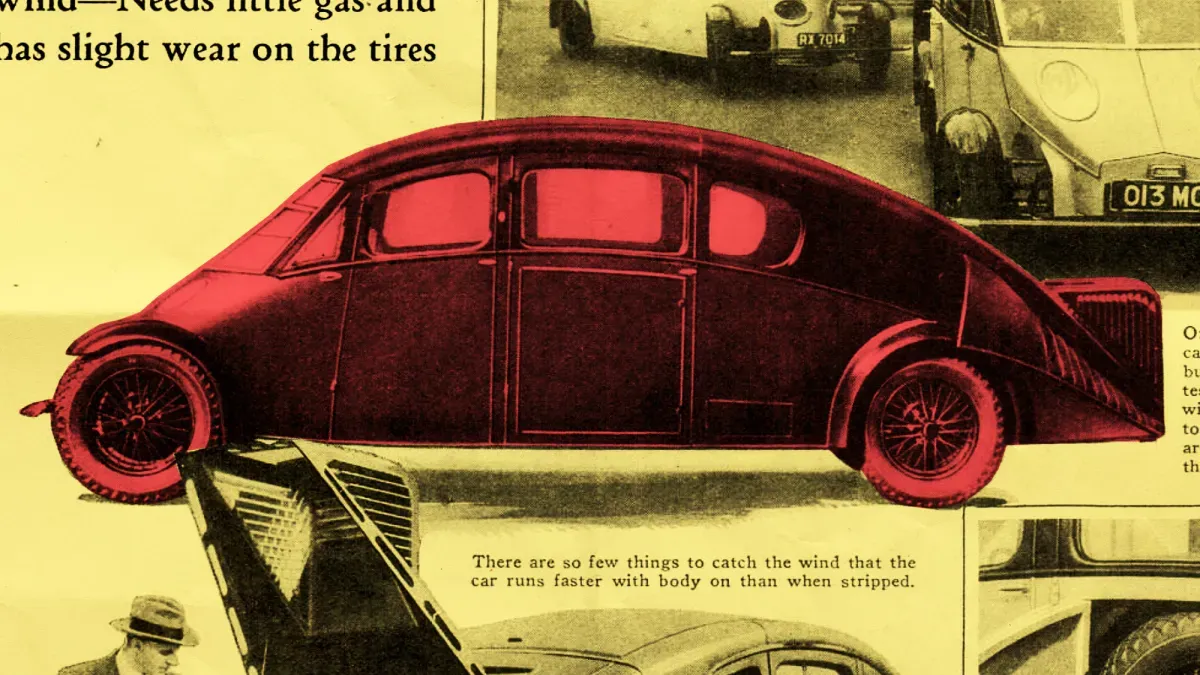
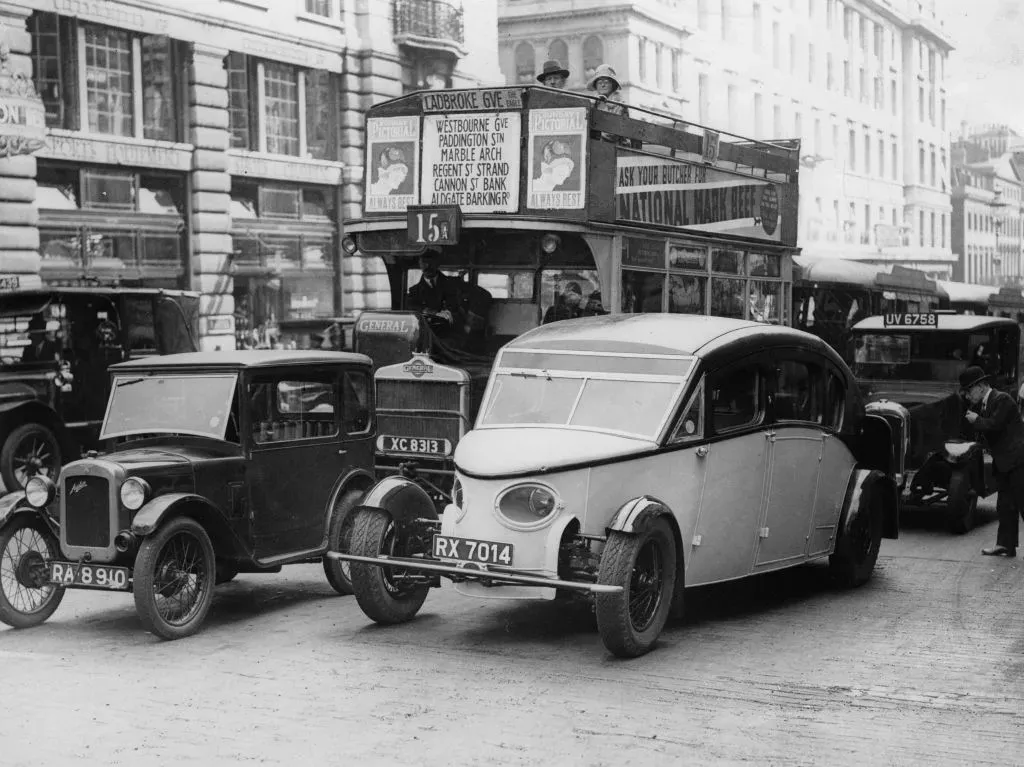
In December 1930, Popular Science introduced readers to Sir Dennis Burney, who designed the R-100 airship. Burney built a car so aerodynamic it used half the fuel, sporting a rear-mounted engine, sunken headlamps, and a "crescent-shaped back" that the magazine described as looking like a "monster beetle." Which, if you think about it, is both impressive and slightly terrifying.
Robert E. Martin, writing in Popular Science in 1934, explained that at highway speeds, a staggering 85% of an engine's power was used just to push the car through the air. Carl Breer and his team found that the ideal shape had a blunt, rounded nose and a long, tapering tail — just like a teardrop. This design allowed air to flow smoothly around the widest part and rejoin cleanly at the back, creating minimal turbulence.
For reference, a perfect teardrop has a drag coefficient (Cd) near 0.04. Most cars of that era? Closer to 0.70. They were, in essence, driving walls.
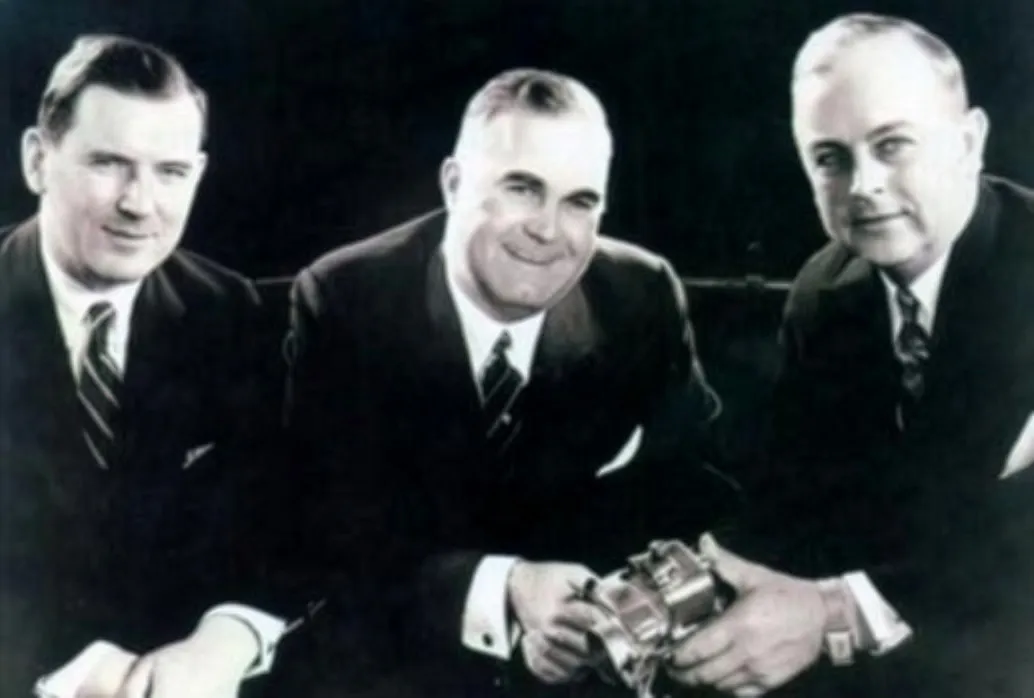
By late 1932, Breer and his Chrysler colleagues, Owen Skelton and Fred Zeder—known affectionately as the "Three Musketeers"—had a prototype. This hand-built marvel would become the Airflow, Chrysler's grand attempt to bring the teardrop ideal to the masses.
Meanwhile, Buckminster Fuller was busy with his Dymaxion car. Inspired by Le Corbusier's diagrams, Fuller envisioned a three-wheeled vehicle with inflatable wings that would revolutionize transportation. He even found an unexpected sponsor in Nannine Hope Dale Biddle, a wealthy Philadelphian known for her adventurous spirit. Because apparently, that's where you find funding for a car with inflatable wings.
The Dymaxion car, nearly 20 feet long and steering from the rear like a boat, debuted in July 1933. Its engineering problems quickly overshadowed the excitement. The rear wheel wobbled, tires wore out fast, and at high speeds, the car lifted, making it notoriously difficult to steer. This was, as you might imagine, never a good sign.
Then came October 27, 1933. A Dymaxion car skidded on Lake Shore Drive in Chicago, rolled, and killed its driver. Fuller claimed another car hit it, but privately admitted the Dymaxion lacked basic safety features. The car, the most famous example of the teardrop movement, never recovered. Biddle withdrew her support, and Detroit largely ignored Fuller's project.
Chrysler's Airflow: Too Soon, Too Smooth
While Fuller's dream was crashing, Breer's team at Chrysler was putting the finishing touches on the Airflow. Introduced in January 1934, it was the most aerodynamic mass-produced car of its time. The New Yorker called it "nothing quite so radical." Time magazine described it as "an approach to the sweeping curve of a tear drop." Walter Chrysler wanted to end the era of boxy cars.
The public, however, had other ideas. Critics called the Airflow "bug-eyed" and "rhinocerine." One reviewer compared its rounded front to a human face covered with a stocking. Chrysler advertised its "floating ride" and improved performance, but notably didn't highlight its impressive 18 to 22 miles per gallon. Because back then, nobody cared about fuel efficiency.
DeSoto sales plummeted 47% in the first summer. Chrysler, scrambling, started adding more conventional grilles, slowly abandoning the very aerodynamic principles that made the car efficient. By 1937, the Airflow was gone.
The problem wasn't the design or the science; it was the American consumer. Across the pond, the Tatra 77, also introduced in 1934, proved a teardrop could sell. Ferdinand Porsche's Volkswagen Beetle even drew from this European tradition. But in America, with cheap gas flowing, consumers wanted the box. And Detroit built it.
The Teardrop's Modern, Electric Renaissance
Boxy cars reigned for half a century. But with electric vehicles, everything changes. Every tiny improvement in drag coefficient directly increases battery range, and range sells electric cars. For the first time since Breer's wind tunnel, the physics argument is also a commercial one. The teardrop shape is no longer a novelty; it's essential.
The Lucid Air is currently the most aerodynamic passenger car in the world, with a drag coefficient of 0.197. A number that would have seemed utterly impossible to Breer. The Mercedes-Benz EQS follows at 0.20. And the Hyundai Ioniq 6, at 0.21, is bringing that sleek, efficient shape to mainstream buyers.
These modern cars share the rounded nose, seamless body, and roofline that tapers earlier than expected, just like those 1930s designers envisioned. They aren't perfect teardrops, because things like wheel wells and mirrors mess with the ideal. But they're closer than any mass-produced car since the Airflow got the axe in 1937.
Yet, history, ever the cheeky repeat offender, seems to be doing it again. Reviewers have called the Mercedes EQS "jellybean" or "egg-shaped," and it's not exactly flying off the lots. Kia's new EV3 went with a boxier shape, as did the Rivian R2. The teardrop, it seems, still needs to be subtle. Sales of the aerodynamically superior Hyundai Ioniq 6 still lag behind the boxier, cheaper Ioniq 5. Buyers still choose the box.
The teardrop shape was always correct. Breer knew it in 1930. Martin highlighted it in 1934. Even Fuller understood it, though he was arguably more focused on investors than engineering.
The challenge, as it turns out, has always been consumer preference. People say they want efficiency, then they buy SUVs, minivans, and pickups. The teardrop keeps winning the physics argument, but the consumers? They're still not prioritizing those physics. Some things, it seems, never change.