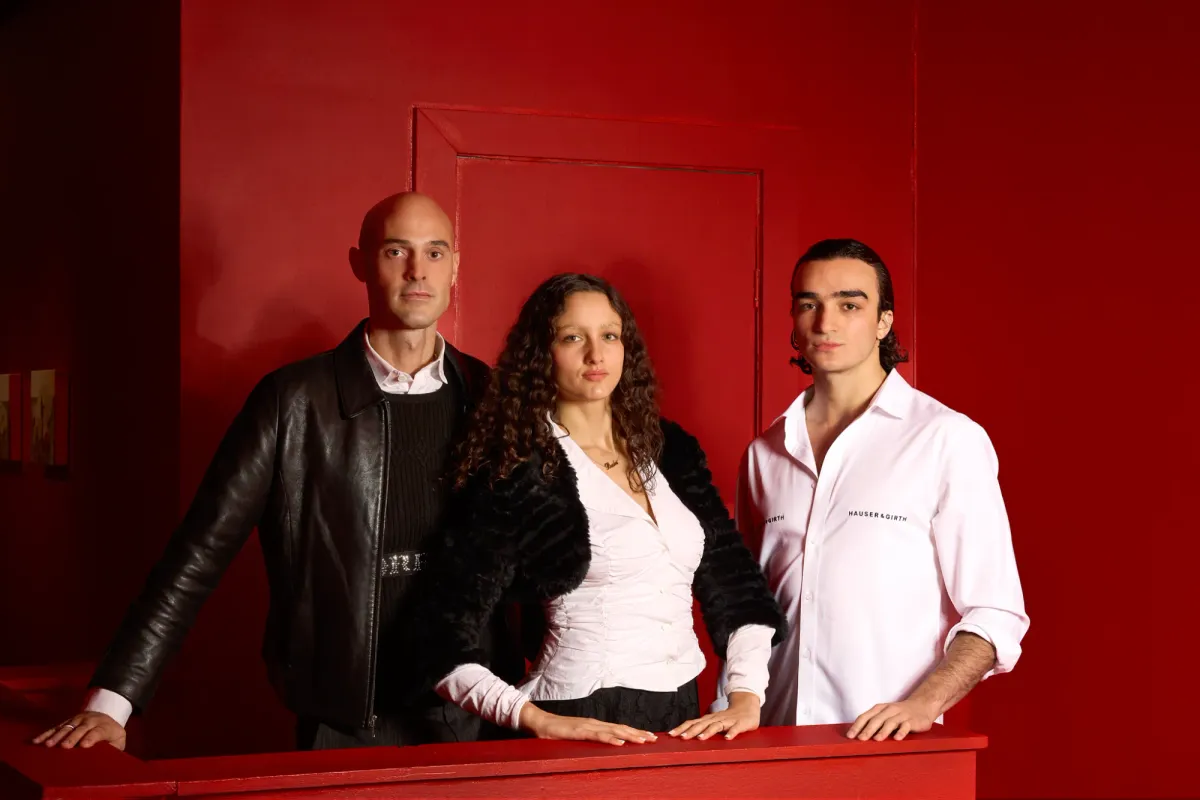
A cold wind cuts through lower Manhattan past shuttered storefronts—casualties of the rent crisis—before reaching the corner of Broome and Chrystie Streets, where something unexpected took root. Last year, Spielzeug Gallery, a nomadic curatorial project, claimed its first permanent address, testing a model that feels almost defiant in 2026: one where chaos isn't aesthetic posturing, but the messy reality of combining pleasure and survival under one roof. The gallery's name is the German word for "toy."
Evan Karas, 24, founded Spielzeug after landing in New York in 2021. A brief internship at Marc Straus Gallery and an encounter with Hungarian painter Diki Luckerson sparked the vision. But it was his earlier years—moving between hospitality and interior design gigs—that shaped his real education: how vibe, object, and space talk to each other.

"Toys always come with an idea of control," Karas said. "As children, we rely on objects to make sense of reality. That intensity never really goes away in adulthood; it just shifts into something psychosexual." His first exhibition at Chrystie Street, titled "TOYS! TOYS! TOYS!", felt less like a showroom than a dimensional rift. Chimeric objects and kinetic installations sprawled across crimson walls. One massive, mutated jester by Thomas Liu Le Lann sprawled on the floor, forcing the opening-night crowd to navigate around it. A silicon figure by Josh Rabineau—part man, part creature, crowned with a chrome deer head—invited visitors to peer through peepholes on its chest. Across the room, a ceramic traffic cop by Michelle Im faced these lewd portals, which Karas described as "a simulated soul trapped inside a hallmark of authoritarian subservience."
We're a new kind of news feed.
Regular news is designed to drain you. We're a non-profit built to restore you. Every story we publish is scored for impact, progress, and hope.
Start Your News DetoxSpielzeug secured the Chrystie Street space through 1 Day at a Time, an organization offering nomadic creatives the practical scaffolding to stay in New York City—less a guarantor of success than a response to what the rent crisis has made nearly impossible: room to grow. Jordan Harper White, one of the founders, calls this "manufacturing legitimacy," answering the brutally simple question investors ask: Is this gallery going to be here tomorrow?
Before launching 1 Day at a Time, Harper White and his collaborator Isabelle Rose—a graphic designer and performance artist respectively—built their reputation through virtual walkthroughs of gallery and museum exhibitions during the pandemic. What began as painstaking 3D renderings of art became an industry standard. Their early clients included the Brant Foundation, the Shed, and Art Basel Miami Beach. Later, they moved into artist management, advising roughly 40 artists simultaneously through residency and exhibition programs. One result: Sophie Jung's Wahrnzeichen (2023), presented by Spielzeug at Basel Social Club, was acquired by Kunstmuseum Basel.
"It's negotiating a paradox," Harper White said. "Teaching the frameworks of the business to out-of-the-box projects, so they can reach a certain level of market appreciation." Virtual walkthroughs also serve as tools of access—opening exhibitions to visitors who may never pass through the door—and as instruments of reflection for curators newly responsible for a physical room.
Spielzeug slots naturally into a lineage of New York alternative spaces: from the loose coalition of artists who converted 112 Greene Street in SoHo into ad hoc venues in the 1970s, to Colin de Land's American Fine Arts, Co., which operated as a hybrid of salon, gallery, archive, and intellectual provocation across marginal spaces. Experimentation has always flourished in deliberately unstable conditions.
But the terrain has shifted. New York has lost roughly 60 small venues over the last three years—including Clearing, JTT, Queer Thoughts, and Canal Projects. Karas has peers like Alyssa Davis Gallery, personality-driven and conceptually nimble spaces, but the room to linger or improvise is narrowing.
Within that churn sits a familiar New York contradiction: can a provisional practice be granted more time without losing the spontaneity that made it noteworthy. "It's objects that make me feel less alone in my body," Karas said. Pairing them with the right place, "there's a sense of cleaving open a complete imaginative realm—a beautiful escapism in which people feel re-embodied in the hyper-physicality of everything." It's a game Spielzeug will play, come what may.