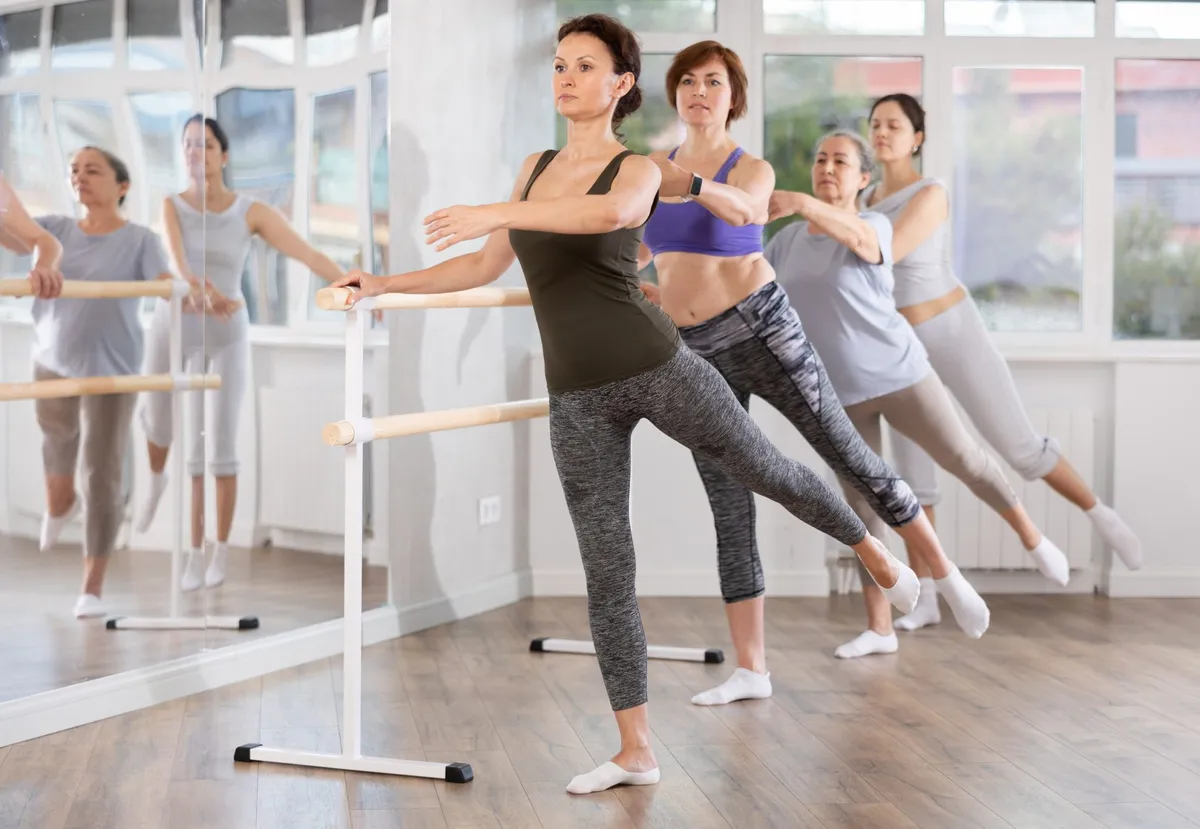
Your quivering muscles after a barre class aren't lying — they've just worked differently than you might expect. The question of whether barre counts as strength training or cardio has a straightforward answer: it does both, but neither in the way you might think.
Barre, inspired by ballet, Pilates, and yoga, delivers a total-body workout using mostly body weight and light props. The catch is that it builds muscular endurance rather than maximum strength. "Barre is an absolutely fantastic way to build muscular endurance," says Lisa Schale-Drake, instructor trainer at barre3. "It's heart-healthy and fantastic for core strength, balance, mobility, and stability."
True strength training typically involves lifting heavy weights at about 80% of your one-rep max for just a few reps. Barre does the opposite. Most classes use high-rep sequences — often 24 or more reps per muscle group — with light dumbbells, mini bands, or just your body weight. You'll work within small ranges of motion called pulses that keep your muscles under tension longer. Andrea Fornarola, certified personal trainer and founder of Elements Barre Fit, explains that you'll also hold isometric exercises like planks or wall sits, which challenge muscles without movement.
We're a new kind of news feed.
Regular news is designed to drain you. We're a non-profit built to restore you. Every story we publish is scored for impact, progress, and hope.
Start Your News DetoxThis approach excels at building what Schale-Drake calls the ability to "move with integrity longer" — the kind of endurance that supports posture, injury prevention, and functional fitness. If your goal is to deadlift heavy or build significant muscle mass, barre won't be your primary tool. But if you want to improve control, form, and muscular endurance, it's genuinely effective.
The Cardio Question
That pounding heart you feel during class is real. Barre can deliver meaningful cardiovascular benefits, especially when classes flow from one movement to the next without pause. The CDC recommends 150 minutes of moderate aerobic activity weekly, and barre-style classes can contribute to that goal.
"You're continuously moving, which keeps the heart rate elevated," Schale-Drake says. Quick transitions — squats at the barre to planks on the mat and back again — create a cardio-like effect without high-impact movements. "You're moving quickly through small ranges of motion, so your heart rate stays up," Fornarola adds.
Some barre formats lean harder into aerobic benefits. Cardio barre and dance-based classes, which Fornarola describes as "Jane Fonda meets Madonna," pack more serious aerobic punch while keeping things playful.
The practical upshot: barre isn't one-size-fits-all. If strength is your goal, look for class descriptions mentioning "weight-based," "resistance," or "strength focus." For cardio benefits, search for words like "sweat," "high-intensity," or "cardio barre." What you won't get from barre is the same kind of gains you'd achieve from heavy squats or sprints. What you can expect is a strong, balanced, mobile body with improved core strength, better balance, and joint-friendly movement.
Barre works well as a cross-training tool. Schale-Drake has clients using it to complement marathon training and powerlifters who've improved their form and lifting capacity through barre's focus on stability and endurance. "She's actually able to lift heavier because of it," Schale-Drake says of one powerlifter client.
If you're new to barre, start with one or two sessions weekly and notice how your body responds. "You don't need a big recovery window after barre," Schale-Drake notes. "It's something that can be done on a daily basis." Most classes offer modifications, so you can scale intensity based on your energy. After a few weeks, check in with yourself: Does barre make you feel stronger? More energized? Is it supporting your other fitness goals? If yes, you've found something worth keeping.