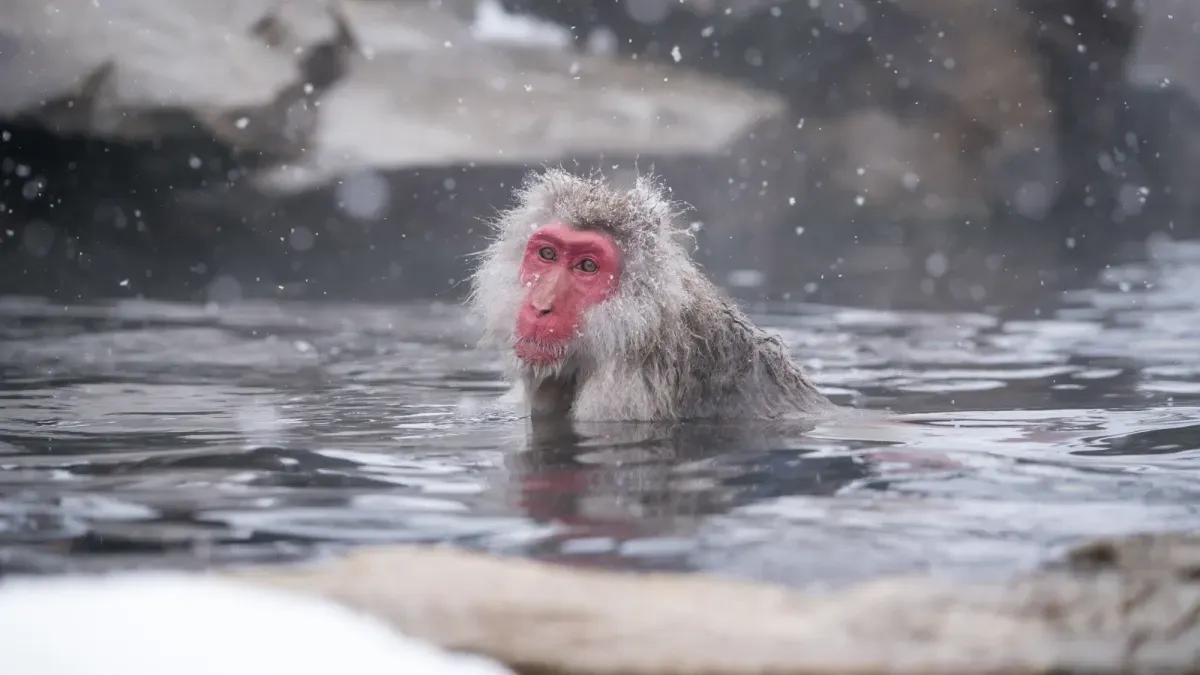
Japanese macaques have been soaking in hot springs for decades, and scientists just discovered the habit does far more than keep them warm through brutal winters. A new study found that bathing in these thermal waters subtly rewires the monkeys' relationship with parasites and gut bacteria — suggesting that what looks like simple comfort-seeking actually influences their biology at a microscopic level.
Snow monkeys live in Japan's harshest regions, with their northernmost populations on Honshu Island enduring temperatures below -4°F and snow depths exceeding three feet for months. They're the world's northernmost wild primates, and their hot spring bathing is one of the most unusual behaviors observed in any non-human primate. Until now, researchers mostly understood it as thermoregulation — a smart way to stay warm. But Abdullah Langgeng, a Ph.D. student at Kyoto University, wanted to know if something deeper was happening.
Over two winters, Langgeng's team observed female macaques at Jigokudani Snow Monkey Park in Nagano prefecture, comparing regular bathers with non-bathers. They collected fecal samples to analyze the monkeys' parasites and gut microbiome. What they found was subtle but significant: bathing macaques showed different lice distributions and distinct gut bacteria profiles compared to those that stayed out of the water. The warm water appears to disrupt lice activity or egg placement in fur, while also shifting which bacterial species thrive in their guts.
We're a new kind of news feed.
Regular news is designed to drain you. We're a non-profit built to restore you. Every story we publish is scored for impact, progress, and hope.
Start Your News Detox
The surprise came in what the researchers didn't find. Despite concerns that shared hot springs might increase disease exposure, bathing macaques showed no higher parasite infection rates than non-bathers. The overall gut microbiome diversity remained similar across both groups — just with different bacterial proportions. This challenges a common assumption: that communal water sources automatically become disease vectors in natural settings.
What matters most is how this reframes animal behavior itself. "Behavior is often treated as a response to the environment," Langgeng noted. "But our results show that this behavior doesn't just affect thermoregulation or stress: it also alters how macaques interact with parasites and microbes that live on and inside them." In other words, the monkeys aren't just adapting to their environment — they're actively shaping their own biology through learned habits.
This opens a broader question about how animal behaviors evolve to support health. The hot spring bathing likely developed as a thermoregulation strategy, but its effects ripple through the monkeys' microbiomes and parasite loads in ways that may have reinforced the behavior over generations. Understanding these connections could reshape how we think about the evolution of health-related actions across species — including our own.
More research is underway, but this study hints at something deeper: that the Japanese snow monkeys have stumbled onto a behavior that works on multiple levels at once, each one subtle enough that you'd miss it if you only looked at temperature.