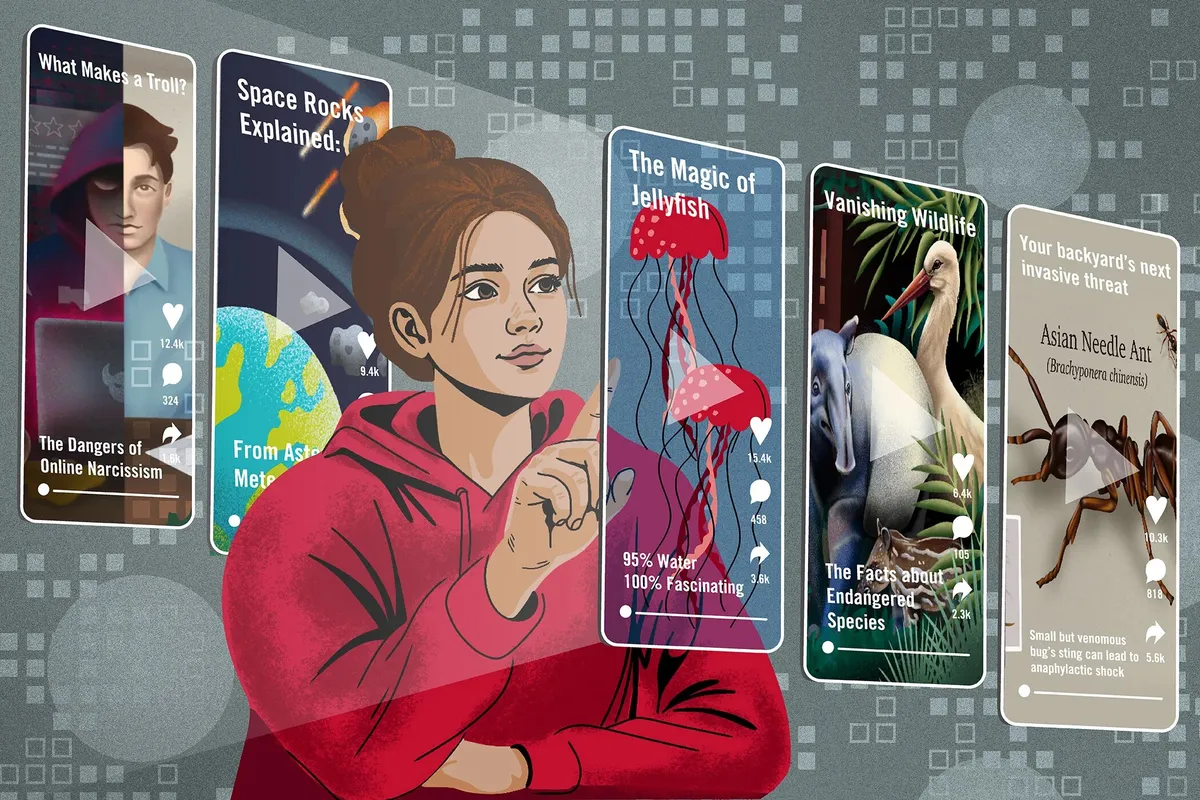
You know the drill: You open TikTok for "just a second," and suddenly you're 45 minutes deep into a mesmerizing video about, say, the surprisingly dramatic love lives of jellyfish. Science content, especially the funny, cartoon-style stuff, is having a moment on social media. But a new study from the University of Georgia has some news for content creators: Your viral explainer might not be landing with everyone.
Turns out, while many creators hope to do more than just make you snort-laugh at a tardigrade fact, inspiring a lifelong love for learning is a trickier business. Researchers wrangled over 1,000 people and made them watch a dozen different science videos about jellyfish, all designed to mimic the rapid-fire style of TikTok and Instagram. The takeaway? Generally, the more people enjoyed a video, the more their curiosity piqued. But that's where the consensus ended.
Michael Cacciatore, the lead author and a UGA professor, put it rather eloquently: curiosity is like "fertile soil" that sparks joy and wonder. You get a little bit of info, and suddenly you're off to Google, determined to unearth every last secret of the deep sea. Which, if you think about it, is the dream for any educator.
We're a new kind of news feed.
Regular news is designed to drain you. We're a non-profit built to restore you. Every story we publish is scored for impact, progress, and hope.
Start Your News DetoxThe SpongeBob Effect (and why it's complicated)
The research team, in cahoots with PBS Digital Studios, crafted 12 distinct videos. Some were formal, some casual. Some dropped a SpongeBob SquarePants reference; others did not. They even varied the ethnicity of the speaker (white, Black, or Latina). On average, the casual, SpongeBob-infused videos were more enjoyable and, crucially, made people more curious.
Cacciatore explained that enjoyment is a gateway drug to learning. If you like the content, you're more open to the science. Simple enough, right? Except cultural references are a minefield. What landed with white participants sometimes fell flat or even offended Black or Latino viewers. Black respondents, for instance, often felt that cartoony science content "dumbed down" the material, implying creators thought they couldn't grasp complex ideas otherwise.
And it's not just about jokes, Cacciatore noted. You can't just translate humor; it needs to resonate with cultural values. Plus, the messenger matters. Black audiences were more curious about science when the speaker shared their ethnicity. Because, apparently, representation isn't just a nice-to-have.
The Goldilocks Zone of Curiosity
So, how do you get people hooked on science without either overwhelming them or leaving them hanging? The researchers suggest a strong "hook," tailored messages, and keeping videos short. But the real art is in the balance.
Spark too much curiosity without enough answers, and people wander off. Give too many answers, and you stifle the very curiosity you're trying to ignite. The sweet spot, according to Cacciatore, is giving just enough information to make viewers want to search for more on their own. It’s like a good cliffhanger, but for science. Which, if you think about it, is a pretty brilliant way to get people to actually learn something on social media.